ReallyBadTalk

  • Subscribe to our RSS feed.
  • Twitter
  • StumbleUpon
  • Reddit
  • Facebook
  • Digg
Showing posts with label Flashing Blades. Show all posts

Saturday, 22 June 2013

The Art of Persuasion

Posted on 02:21 by Unknown
I've written about my approach to social skills and roleplaying, the significance of non-player character attributes, and a new npc attribute - Tractability - I introduced for my Flashing Blades campaign. In my last post, I discussed social skills in Flashing Blades, both how they are presented in the game and how they are used in my campaign. Now I want to turn to when I call for social skill rolls.

Deciding on when a die roll is called for or not is perhaps one of the most important decisions a referee is called upon to make in the course of actual play. Dexterity check to climb a rickety ladder? Endurance check to avoid the grippe after travelling through a cold, wet night? Roll for damage for a coup de grâce ? Many games attempt to answer questions like these through the rules, while others leave them to the discretion of the referee, but in my experience, even games which offer either a plethora of fiddly rules or simple, broad-stroke rules to cover as many circumstances as possible may still require adjudication by a human being in the many and varied circumstances which require their application in actual play. In games where the range of potential actions are as unconfined as human imagination, only human imagination can truly keep up, and in most traditional roleplaying games, it's the referee's role to take the players' input and make sense of it in the context of the game and the game-world.

In my experience, social skills may be particularly tricky in this regard. A player may have no idea how to parry-and-thrust with a rapier or jump from a window onto a horse's saddle, but virtually all of us believe we can put together a reasonable argument or tell a convincing lie, so turning to the dice can, for some gamers, feel very intrusive to what they consider to be 'common sense,' or 'immersion breaking.' I think this is where part of the disconnect with social skills occurs for quite a few gamers, both players and referees.

As referee, then, what I look for is what climbers call 'the crux move,' the most challenging part of the pitch. With respect to social skills, it's looking for the point at which a non-player character is asked to make an out-of-the-ordinary decision. Most roleplaying, including but not limited to in-character dialog, simply requires the referee to stand in the non-player character's shoes, to consider the situation from that character's perspective, perhaps influenced by a reaction roll. In the same way that walking up a flight of stairs doesn't require an Acrobatics check, most social interactions don't require more than a single die roll, for reaction, if any roll at all.

Social skills, then, come into play when a non-player character reaches a critical decision point, a gut check. For me, usually this means the character is asked to put something, personally or professionally, at risk: examples from my current campaign include dissuading a tavern keeper from calling the provost-martial's archers when a friend of the players' character smashed up the bar, learning details of the investigation of an attempted assassination from a prosecutor, or seducing a lady-in-waiting at the duke of Savoy's court. Roleplaying - how a player's character approaches the non-player character and frames the argument - determines which skill(s), if any, may be applied in resolving success or failure.

For the relatively simple examples above, applying the results of a skill check seems unlikely to be immersion-shattering even for gamers who don't care for social skill rolls, but what about more complex social interactions? Should it be possible, say, to convince King Louis XIV not to repeal the Edict of Nantes with a successful Charm check? At what point is too much hanging on a single die roll? Social skills should be robust enough to handle a courtship as well as a seduction, or to laying out a case for innocence versus a plea for mercy.

The "Duel of Wits" from The Burning Wheel is one example of a set of social skills designed to scale with this sort of scope and complexity, but for my Flashing Blades campaign, I drew inspiration from a different source, the rules for seduction in Victory Games' James Bond 007: Roleplaying In Her Majesty's Secret Service.

JB 007 breaks seduction down into a series of five evocatively named skill checks: 1. The Look, 2. Opening Line, 3. Witty Conversation, 4. Beginning Intimacies, 5. When and Where? Each skill check is increasingly difficult at determined by the Ease Factor, which is multiplied by the character's Primary Chance, which is equal to the character's skill plus the relevant attribute score; as a frame of reference, The Look is EF 10 whereas When and Where? is EF 4. What this rule does is divide a social interaction into discrete steps of increasing difficulty.

As a rule for handling one specific form of social interaction, the JB 007's five steps are fine as far as they go, but they don't do much to differentiate between the personality or individual inclinations of different non-player characters, one of the fundamental difficulties of using certain kinds of social skills, as noted previously. Fortunately, for my own campaign, I have a way around that: the Tractability score. Tractability represents how receptive to suggestion a non-player character may be, providing a modifier to social skill checks. It can also be used in more complex social interactions to determine the number of successful checks required to influence a non-player character as well.

Consider an example: a player character is caught issuing a challenge to a duel by the provost-martial and the player character attempts to convince the provost-martial to 'look the other way' over this violation of the royal edicts. Tractability is applied as a negative modifier to the attempt to persuade; if the two have crossed paths before, as referee I may apply a situational modifier as well, favorably or unfavorably, depending on a reaction roll or the outcome of previous attempts at using a social skills. Suppose that, rather than risk discovery by the provost-martial in the act, the player character wants to secure the provost-martial's agreement not to interfere with this 'affair between gentlemen' prior to the duel. If the provost-martial's Tractability is three, then the player character must succeed at three social skill checks; the Tractability modifier is reduced by one-half, rounded up. Should the player character be interrupted in the middle of the duel, blade drawn and bloodied, then the provost-martial's Tractability score may be doubled - it's more difficult to persuade the king's representative in the heat of the moment from discharging his official duties.

So when does a single skill check roll suffice, and when are a number of skill checks called for? My simple rubric is this: if a social skill is used in an attempt to influence a specific behavior immediately, then a single roll is required; if a social skill is used to influence a recurring behavior or to change a non-player character's attitude, then multiple skill checks will generally be required to succeed.

Failure of a single check is fairly straight-forward, of course; the referee need only assess the degree of failure to resolve the outcome. For a series of skill checks associated with a more complex social interaction, a single failure is only a delay, but consecutive failures means the character must start again with zero successes; three consecutive failures means the character has utterly botched the attempt, and in fact the non-player character's Tractability is now doubled with respect to all future attempts at social skill use by that character!

This system can also be used to handle a player character and a non-player character, or two player characters, attempting to influence a third party, frex, two royal ministers attempting to persuade the king to adopt their respective courses of action, or two lawyers arguing a case before a magistrate. Both the player and the non-player character may attempt to score a success in their attempt to persuade, or they can attempt to rebut a point made by their rival, reducing the other's successes by one instead.

In actual play, I've found this approach to be robust and versatile, frex, dealing with the rakish King's Musketeer's serial attempts at seduction and courtship. The Tractability score shapes how social interactions are likely to unfold and makes each non-player character distinctive, at least to a point - for additional nuance, however, I added one more set of stats to non-player characters, which is the subject of the next post in this series.
Read More
Posted in Flashing Blades, house rules, James Bone 007 Roleplaying Game, refereeing | No comments

Thursday, 13 June 2013

Social Skills in Flashing Blades

Posted on 23:14 by Unknown
So far, I've written about my approach to social skills and roleplaying, the significance of non-player character attributes, and a new npc attribute - Tractability - I introduced for my Flashing Blades campaign. In this post, I'll introduce the social skills in Flashing Blades in a bit more detail, including how they are presented in the game and how they are used in my campaign.

By my reckoning, there are six non-martial skills which qualify as social skills in Flashing Blades' core rules.
BARGAINING
This skill is the ability to haggle and deal to get what one wants. It has greatest effect when buying items in a common marketplace, where haggling is the way things are bought. It may be more difficult to use when buying items with a set price or making special deals. A character with Bargaining skill may get 10% off of the normal price when buying common goods (clothing, food, livestock, etc.).

BRIBERY
This skill represents the ability to determine if various officials may be easily bribed and to calculate the amount of money the bribe should be. Most minor officials (Provincial Sheriffs, Court Clerks, Village Mayors, etc.) may be bribed to overlook minor regulations, lack of proper documentation, etc., for 10 to 20 L (Livres). Officials of the Realm (Town Mayors, Court Secretaries, Provincial Tax Collectors, etc.) and Magistrates will be more difficult to bribe, and will not go for less than 50 L. Royal Officials and other high ranking bureaucrats are far more difficult to bribe, and will generally require some sort of special deal or settlement. Characters with Bribery skill have a better chance of bribing officials than those without, and less chance of being reported.

CAPTAINCY
This skill is the ability to lead men in battle and other emergency situations. It is necessary to have Captaincy skill when leading any organized group. Characters with Captaincy skill will be skilled at taking command in emergency situations, giving effective orders, and controlling large groups of men. Captaincy is required for all officer ranks in the military.

ETIQUETTE
This skill represents knowledge of the social graces. This includes bowing correctly, holding silverware properly, dancing, saying the right thing at the right times, etc. Characters with Etiquette skill may hide their rough edges when in distinguished company, and will be sure of behaving properly in the presence of high nobility and royalty. All characters without this skill must live in constant fear of making a social blunder (tripping their dancing partners, or eating dinner with their salad forks, for example).

ORATORY
This skill represents the ability to speak well publicly. Characters with Oratory skill may be able to persuade and convince others, talk their way out of tight situations, etc. Oratory skill may also be used to make Etiquette, Captaincy, and Magistracy more effective in certain situations.

SEDUCTION
This skill represents the ability to flatter, cozen, and tease the opposite sex into giving information, aid, or various other services. Characters with this skill are adept at courting and are rarely without affectionate companionship. . .
A couple of highlights: first, I like the synergy of Oratory with other social skills; it's the base skill of persuasion, but a character with both, say, Etiquette and Oratory may gain an advantage over another character with just one of the two skills. Second, I like that the Seduction skill is framed in terms of intelligence gathering, with the strong implication that seduction is simply 'intrigue by other means.' In my campaign, Captaincy tends to provide a benefit to attempts to intimidate or otherwise browbeat a non-player character.

Examples of FB's social skills are few in the published adventures for the game. Here are a couple of mentions of the skills as used 'by the book.'
When a Player-Character receives a decoration or field promotion, he may attempt to make a roll against his Luck[/2] or his Charm[/2] (player's choice, +4 to either roll for Etiquette skill). If this roll is successful, he is noticed by the King, and allowed to kiss the monarch's hand. - "The Great Marksmanship Tourney," Parisian Adventure

They could try to trick her out her bonbons somehow (by telling her they are not worthy of a Duchess, and offering to bring her a box of truly royal chocolates, perhaps). This would require a good idea from the players (as judged by the Gamemaster) and a successful roll on Charm (+2 for Oratory or Etiquette skill; +4 for both). - "Scavenger Hunt,"
Parisian Adventure
True to the general description of how the skill rules work in the game, social skills aren't opposed rolls, but rather rolls against the appropriate attribute as modified by possessing a skill. As described previously, my feeling is that this puts the character's attribute in the mode of defining non-player characters' personalities, eg, every character is as bribable as the player character's Wit score allows. To this end, adding the difference between the characters' Social Ranks, to reflect the important influence of class and rank on social interactions in the game-world, and the Tractability score, as a reflection of the npc's receptivity, ameliorate this without expanding opposed rolls beyond what are already suggested in the core rules.

In practice, this means using a social skill looks something like this.

Chance of success = ATTRIBUTE SCORE +/- SOCIAL RANK DIFFERENCE - TRACTABILITY + APPLICABLE SKILL(S) +/- GAMEMASTER-IMPOSED SITUATIONAL MODIFIERS

That's a target number plus two to four - in my experience, usually just two or three - modifiers, which I find readily manageable in the heat of the action.

One of the referee's most important jobs in any roleplaying game is determining when a skill check is required, and this is perhaps especially true with respect to social interactions in the game: when does roleplaying lead to rolling a die? I'll dive into that topic next.
Read More
Posted in Flashing Blades, house rules, refereeing | No comments

Saturday, 8 June 2013

Tractability

Posted on 00:49 by Unknown
On Wednesday I wrote about one of the pitfalls associated with using a player character's ability or skill score as the target number for social interactions, specifically that, if not treated with some forethought, the score comes to define the world. Seduce a marquise? Roll under Charm. Bluff a provost-martial? Roll under Charm. Persuade the king to go to war with Spain? Yeah, you get the idea.

In fact, this is one of the reasons some gamers say they don't like social skills - 'They don't make sense!' - and prefer to simply override them at will when the results don't 'fit.' They have a point with respect to the problem, but their solution - to set aside the rules when they feel like it - is, to me, throwing the baby out with the bathwater. A better fix, for me, is to use smarter rules.

In Flashing Blades, the base value of a skill is the associated attribute score, which is then modified by possessing the skill, usually increasing the target number by + 1 to + 3, usually assigned at the gamemaster's discretion; frex, a character with a 12 Charm and the Etiquette skill might get a + 2 bonus, giving the player a target number of 14 to roll under on a d20 to impress a countess. Assigning ad hoc modifiers helps to alleviate some of the problems inherent in simply rolling under the attribute number, but I wanted something more holistic.

The first modifier I decided to use was the difference in Social Ranks between characters. This was something I started with Traveller, with the difference in Social Standings as a modifier to the reaction table roll, to better reflect social stratification in the Imperium. For FB, this was even more appropriate; characters with higher Social Ranks already expect to receive deference from their social inferiors, and this would be reflected in the modifiers assigned to social skill use as well.

I also wanted something more personal as well, to reflect a non-player character's individual nature, and for this I adapted a feature from another FB gamemaster's house rules for handling mistresses and courtship. In these house rules, which I discovered somewhere on the intrewebs and can no longer locate, each potential mistress was assigned a value of one to six; this number would be used in determining how loyal the potential mistress was to her lover or husband, should a player character attempt to seduce her away. I decided to expand this into a non-player character stat which reflected how amenable to suggestion that character might be. I called the new stat Tractability.

As with the loyalty rating on which it was based, Tractability is usually expressed by a number between one and six, making it a simple roll of a die to determine for randomly developed non-player characters; I did, however, leave myself the option for numbers greater than seven, for special cases. As with the BITS task system for Traveller, I wanted each score to have a verbal shorthand attached as well.

Rating Description
1 Mercurial
2 Impulsive
3 Flexible
4 Reserved
5 Unwavering
6 Intractable
7 + Inhuman


I made three - Flexible - the default value for most non-player characters. The Tractability score is used a couple of ways; as noted, it can be a modifier to the attribute-plus-skill target number for social skill rolls; it can also be used as a divisor, in keeping with a number of skill checks used in FB's published adventures, for a greater degree of difficulty; frex, Tractability 4 can be used as a - 4 penalty to a roll, or to divide the target number by four. The specific circumstances of using Tractability is the subject of the next post on social skills in Flashing Blades.
Read More
Posted in Flashing Blades, house rules, Le Ballet de l'Acier | No comments

Monday, 3 June 2013

Social Skills and Roleplaying

Posted on 23:53 by Unknown
Okay, let's get this out of the way right from the giddyup: roleplaying is not 'talking in funny voices.' In-character dialog may be a component of roleplaying, but it is not roleplaying in-and-of-itself.

At its most basic, roleplaying answers the question, 'What will my character do now?' Referring to one's character in the third person all the time is no less roleplaying than speaking only in-character. The is no purity or superiority in the latter approach; I personally enjoy first-person, in-character dialog, both as a player and as a referee, but I don't think less of gamers who prefer the remove of, 'My guy says . . .'

With that in mind, we can dispense with the notion that social skills diminish roleplaying any more than any other skills do. The overwhelming majority of the roleplaying games out there include some sort of rules for social interaction, whether they are as basic as reaction and loyalty rolls in D&D or as involved as Burning Wheel's Duel of Wits. The notion of resolving social interaction through 'pure roleplay,' without some sort of recourse to the rules, is limited to a tiny handful of games, or to gamers who choose to ignore the rules in games which include them; in my experience, the latter are far more common than the former.

So why do some gamers have a nutty over social skills? In my experience, there are a couple of reasons for this. First, some gamers are of the opinion, 'I can't thrust a rapier or swing from a chandelier at the table, so I need rules and rolls for those, but I can just say what my character says, and I don't need rules for that!' That's certainly true: adjudication of non-player character reactions can be handled by the referee without recourse to a die roll or an attribute score, but once again, very few games actually leave social interaction solely to the referee's discretion. The norm is to include rules for resolution, whether those rules are rendered with a broad-brush or crafted in intricate detail.

Second, some games give social skills a bad name, though not always deservedly so. Tales of d20 'diplomancers' optimised to take advantage of the Diplomacy or Bluff or Intimidate skills, breaking entire campaigns by turning a social skill into a form of mind control, can be found in the many different corners where gamers gather, on- and off-line. Despite the fact that at least some of these stories come from misinterpreting the actual rules associated with the skills, they reinforce the predilections of those who prefer to remove or ignore most or all of the rules for social interactions, or more rarely to find those few games with no such rules at all.

Third, as noted right at the beginning, gamers conflating roleplaying with in-character dialog - the 'amateur thespians' - express the opinion that social skills 'inhibit roleplaying!' by 'reducing social interaction to the roll of a die.' I think that's bollocks. Consider the following.
Example 1: "Ahead of you, on a curve in the stream, is a stone bridge. A carriage is overturned at the far end of the bridge, creating a barricade blocking passage to the road beyond. Behind the carriage you see the tips of a dozen pikes above an equal number of gleaming morions. To the right, across the stream, just inside the tree line, is a hastily-built stone revetment, and behind it the light through the trees glints off the barrels of a half-dozen arquebuses. Because of the curve in the stream, the revetment is at right angles to the bridge, giving the arquebusiers a clear field of fire across the open ground approaching the span."

"Uh . . . I roll for Tactics."

Example 2: "The king's minister, Enfou, pulls you aside as dancers swirl to the musicians huddled in one corner of the ballroom. 'The king is desperate,' he says. 'The baron de Bauchery can raise enough mercenaries to defend the frontier, but he refuses to do so unless he the king promises him Princess Pinkflower's hand in marriage. Meanwhile the conte di Grognardo is the best commander we have, but he refuses to serve under de Bauchery, and he wants the princess' hand for his son.'"

"Uh . . . I roll for Diplomacy."
Here's the thing: social skills are used to resolve your attempts to accomplish a task. They don't do your roleplaying for you.

In the first example, you, the player, need to decide how the adventurers are going to get past the soldiers holding the bridge, and in the second you need to figure out how you're going to resolve the conflict between the courtiers in time to get the soldiers to the front. Your character's social skills resolve how well you accomplish what you set out to do.

Moreover, social skills are not charm spells. A non-player character made Helpful through the Diplomacy skill in d20 may be willing to take considerable risks on behalf of your highly persuasive character, but that doesn't make the npc a thrall. The npc will still look after his interests and pursue his agenda while offering assistance to the adventurers.

I've used rolls for social interactions in every game I've ever played, from the aforementioned Charisma-adjusted reaction rolls and loyalty scores for henchmen and hirelings in AD&D to the Contact rules in Top Secret to the social skills of d20 and now Flashing Blades, and in my experience they neither inhibit in-character dialog nor do they result in the players substituting skill rolls for actually having to figure out how to best use those skills to get what they want.

Now, if a game's social skills are being called into play, it follows that the stats of both player and non-player characters come into play. Next up, a quick look at stats for non-player characters.
Read More
Posted in Boot Hill, Dungeons and Dragons, Flashing Blades, roleplaying, roleplaying games, Top Secret | No comments

Thursday, 16 May 2013

Dash and Glory

Posted on 23:52 by Unknown
A recent thread on theRPGsite asks the question, "Karma, action points, extra dice/points are they a sign of a weak system[?].

I first ran into what John Kim calls "Hero Points" - "a type of mechanic where the player can spend from a limited supply of abstract points to gain successes on actions, cause background events, or perhaps manipulate the plot in other ways" - with Top Secret's Fame and Fortune points, which can be used to turn a fatal wound into a miss, a nice feature in a game with such a high potential for lethality as TS. Later I encountered them in d20 Modern, where Action Points are used to power certain class abilities or as a beneficial modifier to many combat and skill checks, and I really liked them in actual play - for me, they represented a character really 'bearing down' in an attempt to succeed, and like the best resource management rules, they presented the players with an interesting choice of when to spend them and when to hoard them against a future need.

When I picked up Flashing Blades again, I decided to add something similar via a house rule for my campaign. Adding a 'hero point' that worked like d20M Action Points seemed pretty straight-forward, with a point spent providing an extra die added to the target number the player wants to beat. These I called Panache points, and I awarded them as a perq for attempting something swashbucklery, as a roleplaying bennie of sorts.

Lately I found myself revisiting that approach, though; re-reading John Kim's essay, I was reminded of the eponymous Hero Points from James Bond 007, which are received for rolling a critical success. The same rule would work with Flashing Blades, with a roll of 1 on 1D20 providing the player's character with a Panache point instead. This approach short-circuits attempts at players pandering to what they think the referee wants them to do. However, tthat's definitely not a problem with my current players, and honestly I can't think of too many players I've known over the years who would try to take advantage of such a rule; it seems more like one of those 'encountered mostly on the intrewebs' things rather than a real-world problem, at least in my own experience. With that in mind, I can't see why I shouldn't do both: allow a Panache point on any roll of 1 during a martial or non-martial skill check, or as a roleplaying bennie when the mood takes me or the other players.

There is one area of the game where Flashing Blades characters could definitely use a helping hand, and that's in rolls for openings and promotions in careers. The simplest solution would be to allow characters to use Panache points here as well - one rule to bind them all - but I liked the idea of a separate pool of points awarded not for swashbuckling antics but rather for fulfilling the character's professional obligations as well. This pool of points was named Gloire points, and they could be acquired, again at the referee's discretion, for doings something noteworthy in pursuit of that character's career. One Gloire point could be spent for each opening and promotion roll - when Riordan O'Neill recently had the opportunity to roll for promotion to ensign of the King's Musketeers, he spent both of his Gloire points to bump the two rolls necessary for him to gain rank.

Where Panache points represent a character devoting extraordinary effort or concentration to a task, Gloire points represent a favorable reputation which opens doors to opportunities.

And that brings me back to the RPGsite thread linked above. While most of the posters see them favorably, and not as a patch for "weak" games, a couple of gamers with whom I normally share similar outlooks on gaming are strongly opposed to 'Hero Points,' as described here.
For me, the difference isn't so much about the 'do over' or not nature of the mechanic but rather the relationship of the mechanic and how it is understood to work from an in-character POV.

A bennie or action point or whatever, has no meaning whatsoever to the character being played. It is a 4th wall mechanism that pulls you right out of first person roleplay every time you deal with it.

While perhaps not a 'weakness' in a strictly mechanical sense, such tools are antithetical to actually roleplaying a character ( unless that character is in fact a storyteller and not supposedly living the events happening in game.)
Now, I absolutely understand where Exploderwizard is coming from; a number of games I've seen use Hero Points in ways that are antithetical to how I approach roleplaying games, such as spending a point to gain a useful contact or a needed piece of equipment on the spot. At the same time, my sense of immersion isn't impeded by the use of something like Action Points, even if the connection between rationale for the benefit to the in-character action and the player's decision to spend the point may seem fairly tenuous.

More importantly, my experience of using them in actual play is that they're fun. They're fun to hand out, and they're fun to spend, and that's why I chose to add them to my campaign, and so far they've worked out great.
Read More
Posted in Flashing Blades, hero points, house rules | No comments

Tuesday, 29 January 2013

Pass/Fail

Posted on 12:40 by Unknown
Jumping onto the bad guy's horse and knocking him off is awesome; missing, hitting the ground, and getting trampled isn't. On the other hand, halfassing it, catching one hand in the saddle, and being dragged while you scramble up the horse is best of all.
So writes Mike 'Old Geezer' Mornard over at Big Purple.

Part of the referee's role in most trad roleplaying games is to interpret the rolls of the dice in actual play. Often, particularly during combat, the interpretations are pretty simple, yes/no affairs: do I hit? do I parry? Other circumstances, such as some types of skill checks, may lend themselves to more nuanced interpretations, however: if I fail my attempt to seduce the princess, does she simply spurn my advances or does she have me thrown in the moat by the guards?

Referees are often advised, as in OG's example above, to make the results interesting and exciting, or at least not-boring. The approach of 'yes, but . . .' and 'yes, and . . . ' suggests adding complexity to the situation as an alternative to failure. Another approach is to use degrees of success or failure.

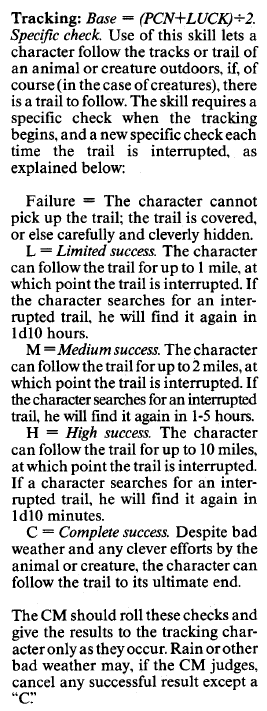
The horror roleplaying game Chill was perhaps the first game I played in which degrees of success were actually spelled out in the rules, rather than being left to the referee's judgement. How well the character rolls determines not only if the character succeeds or not, but how well, as seen in the example of the Tracking skill at right.

Flashing Blades combat rules include something like this. To hit, the player must roll 1D20 under a target number based on their character's attributes and expertise; if the player rolls less than half the target number, then the wound is serious and causes an additional 1D6 damage. A roll of 1 always hits, and bypasses any protection from armor the target of the attack may have. A roll of 20, on the other hand, is a fumble, and may result in anything from loss of actions to injury.

The rules for non-martial skills in FB state, "A roll equal to or less than the attribute indicates that the skill was used successfully," but I can't think of a single referee with whom I've played who didn't carry over the degrees of success from combat to skill rolls as well. In my own campaign, rolling between the target number and half the target number is simple success, rolling less than half the target number is a more significant success, and rolling a one means achieving Master-level success; conversely, rolling between the target number and half the range to twenty is a simple failure, rolling between half the range to twenty and twenty incurs some consequence for failing, and twenty is complete failure, likely with a dangerous consequence as well.

To use OG's example of attempting to jump onto a horse and knock off the rider, an Acrobatics roll is required to leap up behind the saddle. Let's say the character needs a fifteen or less to succeed: on a roll of 9-15, our swashbuckler manages to mount the horse behind the rider, and in the next round a successful grappling roll is required to knock the other rider off; on a roll of 2-8, I'd allow the grappling roll in the same round, and on a 1, the rider must make an immediate Dexterity check or tumble off on his own. On a roll of 16-18, however, our erstwhile swashbuckler is unable to gain a purchase on the rider or saddle and simply slides off the horse on the opposite side - make failure interesting, or at least a bit comical, remember? - on a roll of 19, he slides over the horse and catches his lace cuff on the saddle, trapping his arm until a succesful Dexterity roll works it loose, and on a twenty, the swashbuckler does indeed end up under the horse's hooves for an immediate trampling attack, if the rider should wish it - hey, it ain't all pratfalls. All of these results are likely to incur a Horsemanship check at some point as well.

There are circumstances in which outright failure is indeed an option, but playing about with the margins can be much more fun, both for the referee and the players. One of the most important aspects of refereeing, in my experience, is training my mind to improvise exactly these sorts of results quickly. I've found there's no substitute for being well-versed in genre tropes when it comes to making these calls in actual play, and that's the main reason I devote so many blog posts to books and movies and art; Cinematic and Wednesday Wyeth and The Pen and the Sword aren't filler - they're my conditioning program for the heavy-lifting of refereeing.
Read More
Posted in art, Chill, Cinematic, Flashing Blades, literature, Mike Mornard, playstyle, refereeing, The Pen and the Sword | No comments

Thursday, 24 January 2013

I Didn't Spend All Those Years Playing Boot Hill and Not Learn a Little Something About Bravery

Posted on 00:01 by Unknown
A 2e Boot Hill character's attributes are Speed, Gun Accuracy, Throwing Accuracy, Bravery, Strength, and Experience. Five of the six affect how well your character fights; the sixth, Strength, determines how much damage the character can take.

The five attributes, including Bravery, which affect combat include modifiers to a character's speed and/or accuracy with various weapons. The Bravery attribute score increases or decreases a character's Speed and Accuracy, for example, providing a discrete, quantifiable impact on the character's performance in the game: a character with a high Bravery score is cool under fire, faster and more accurate than his counterpart with a low Bravery attribute value.

Consider a character who is a town marshal with a Coward Bravery rating and no Experience; maybe he got the job through a political connection, or maybe the townsfolk stuck the badge on him because no one else wanted it and he didn't have the guts to say no. Now a gang of bank robbers come to town, and it's the marshal's job to confront them.

Now here's the thing: there's nothing about the attribute itself rules-wise which determines if or how the marshal will confront the robbers; the attribute modifiers only speak to what happens if he tries to fire his gun at them. The attribute and the modifiers influence how successful the character is in a particular task; they say nothing about when or how the character decides to attempt the task.

So the marshal checks his six-shooters, grabs a double-barrel from the rack, and walks into the dusty Main Street to face-down the robbers. His hands shake like he has the palsy, sweat drips off his brow making his eyes sting, and his mouth is as dry as an arroyo in August so that when he shouts, "Throw up yer hands!" it comes out as little more than a hoarse whisper, and that is what is represented by the Bravery attribute modifiers, not the decision to confront the gang - that decision is solely the province of the player.

In thinking this through, I realised that the character's stats are reflected not in what the character does, but in how well he does it. By treating character attributes as a nothing more than a rules interface and not a determinant of personality, roleplaying and character stats exist independently of one another. Put another way, roleplay your character as you like, and let the stats take care of themselves.

Consider another example, this time the loquacious player who uses a 'social stat' like Charisma or Charm as his character's dump stat; whether you're using something as simple as a reaction roll-plus-modifier or something as complex as Duel of Wits, let the player be as charming and as eloquent as he likes, and let the dice handle the actual result. The player of a would-be warlord may deliver a stirring in-character speech, but if his Charisma modifier is in the negatives, however inspiring the player may believe it to be, the warlord isn't persuasive, for this is the limitation imposed by the character's actual ability, in the same way that his Strength or Dexterity may affect his effectiveness at fighting.

If the player wants the character to be better at something, then it's on the player to choose that for the character, by whatever means the system supports, whether that's adding skill points, raising an attribute, or whatever - a would-be Cassanova with a 5 Charisma needs to invest skill points in Bluff or Diplomacy or whatever, or accept that he's only going to get play when he's really, really lucky.)

I've floated this argument on different roleplaying gaming forums over the years, and I found it's one which reliably brings out the self-anointed real roleplayers to tell me I'm doing it oh-so-profoundly wrong, to accuse me of advocating 'roll-play over roleplay,' and on, and on, and on. Perhaps their most compelling - though by no means persuasive - argument is, 'But that's what the books say!' And pretty often they're right. There's a sort of schizophrenia between what some rule books say about attribute scores, and what they mean in actual play. One of the rules-rebuttals offered is the 2e AD&D PHB, in a section subheaded, "What the Numbers Man," which offers examples of interpreting character personality from the attribute scores.


I have two specific issues with this. First, in the case of many roleplaying games but AD&D in particular, the implications of the attribute scores don't relate well to other parts of the game. Take this, frex, from the page above: "His Dexterity is 3? Why? Is he naturally clumsy or blind as a bat?" Well, if he's blind as a bat, is his chance of detecting secret doors lower? Is his outdoor encounter detection range reduced? Or if he's clumsy, is his movement reduced when he runs? Does it affect his melee attacks? Interpreting the stats this way has knock-on effects through other parts of the game with which Dex 3 simply doesn't interact. In 1e AD&D, Dex 3 means the character must be a cleric, that she cannot be a half-elf, elf or halfling, and that she suffers penalties to her reaction time, missle attacks, armor class, and certain saves. And that's it. Neither "blind as a bat" nor "naturally clumsy" fit because of the way attribute scores relate to the rest of the rules.

Second, insisting that attribute scores define personality may limit the range of potential characterisations to 'playing to type.' For example, maybe Rath, again from the 2e example, is a thief who really wants to be the leader of a gang, so he's forever trying to recruit cutpurses and bandits. But of course he's not a natural leader at all, no matter how hard he tries - I know this because his reaction rolls and loyalty scores suck when he tries to lead. The fun thing is, his rare successes simply reinforce his perception of himself, or offer him hope, so he keeps trying.

Playing against type can make for memorable characters. I have a great example of this from my Flashing Blades campaign, Riordan O'Neill, King's Musketeer, would-be Casanova with (originally) Charm 11. Most of his attempts at courtship and seduction are an uphill struggle, and luck is a huge factor in his successes. It's his repeated attempts at being the great lover in spite of lacking the natural acuity reflected by his Charm score that make him so much fun in actual play.

Or how 'bout the lily-livered Boot Hill town marshal I wrote about earlier? Maybe he took the job of marshal out of a sense of responsibility to his community, and he's determined to overcome his shakes when faced with the bank robbers. Or maybe he's a braggart and a bully who likes lording the position of marshal over the rest of the townsfolk, but like most bullies, deep-down he's gutless - he goes to face the bank robbers because he knows if he doesn't, he'll be exposed as yellow.

There's nothing wrong with playing to type, of course, but by unhooking personality from ability, a broader range of characterisations becomes available to the players.

'But what about immersion?' the real-roleplayers complain. 'An Int 6 barbarian shouldn't solve puzzles as well as an Int 18 magic-user!' There are a couple of weaknesses to this rebuttal as well. I don't mean to keep picking on D&D here, but since this argument comes up so often with respect to The World's Most Popular Roleplaying Game™, D&D examples provide a convenient gamer lingua franca. First, let's look again at what the rules say Intelligence actually provides to the character. In 1e AD&D, frex, Intelligence covers the number of possible languages spoken, the minimum and maximum number of spells a magic-user may know by level, the chance to learn a given spell, and the minimum score required to learn spells of a particular level; in 3e, Intelligence covers languages again, skill points, and the modifier for a number of skills. There is no mention of puzzle solving in there at all, and referees who 'slip clues' to players running characters with a high Intelligence score are adding something to the game that simply doesn't exist to compensate for this.

Looking more closely at the rules, what Intelligence, Wit, &c often provide in roleplaying games are resources, not abilities. Perhaps the player of the Int 6 barbarian solves sudokus in his sleep, but he's not solving a puzzle in a language his character doesn't understand until or unless someone translates it for him. Skills may also be gatekeepers, in that a character must learn a certain skill simply to be able to perform a given task. A player who's a master at pike-and-shot wargames is still limited to making brilliant maneuvers in Flashing Blades by first taking the Strategy skill and then rolling under one-third of his character's Wit. In each case, the player's ability is constrained by the character's resources.

In truth, I admit I couldn't care less if a player isn't roleplaying her character's Wit 6. Maybe it comes from starting with D&D way back when, but honestly, I expect players to metagame, to rely on their resourcefulness and experience, and I design my challenges accordingly. I never expected players to pretend their characters didn't know, say, that fire kills trolls; if I wanted them to face an unexpected challenge, then I would simply change things up on them, like trolls which are killed with salt instead of fire. One of the characters in my Flashing Blades campaign nearly died because his player ignored a clue - a case of Anjou wine - which came straight out of The Three Musketeers novel. Easter eggs from books or movies aren't there out of laziness or to try to be clever - they're there because they're fun for the players, and I fully expect them to take advantage of them, or I wouldn't include them in the first place. We're playing a game, and the experience should reward smart play.

Second, because attribute scores are often disconnected from other rules, what tends to snap my suspenders of disbelief isn't an Int 6 barbarian is solving puzzles, but rather roleplaying him as the same stupid lunk at 10th level as he is a 1st level. The barbarian's explored ancient ruins, fought men and monsters, survived poisoning, travelled across trackless wastes, seen priests drive off and destroy undead with a word, felt the power of magic, raised a horde and sacked an evil temple, maybe even been turned to stone and restored to flesh, and yet a few gamers would have that Int 6 trump all of the actual play experiences of the character - and no, that's not hyperbole.

There are roleplaying games out there which integrate both who a character is and how that does what she does - Pendragon is one of my favorite examples of 'personality mechanics' in a roleplaying game. Ability scores, however, are not personality rules, in my experience, and unfortunately even the rule books themselves sometimes confuse this.
Read More
Posted in Boot Hill, Dungeons and Dragons, Flashing Blades, immersion, roleplaying | No comments

Thursday, 17 January 2013

Experience Comes From Bad Judgement

Posted on 11:56 by Unknown
Good judgement comes from experience. Experience comes from bad judgement. - Nasruddin (attributed)
Most experience systems in roleplaying games reward characters for success - defeat the monster, pocket the gold, complete the mission, &c, &c. But as Nasruddin notes, success isn't always the best teacher. What about actively rewarding failure?

Flashing Blades uses a tick-mark experience system. Earning checks for attributes allows those attributes to increase, and earning check for skills allows the character to become a Master or Master Superior in the use of that skill. Here's what the rules have to say about awarding checks for skill use.
If, in the course of an adventure, a character uses a skill extensively in dangerous situations, the Master may award him a 'check' in that skill. Checks are noted in the boxes to the right of skills on the character sheet. Each skill may receive only one check per adventure, and normally no more than three or four skills will receive checks in a single adventure.
Attributes are increased similarly, with only one or two attributes recommended for checks in a 'single adventure.'

The number of checks need to improve an attribute increases as the score increases while the number of checks required to achieve skill mastery decreases the higher the related attribute score is. Frex, a character with Charm 11 needs two checks to increase the attribute to 12, whereas a character with Charm 17 needs four checks to increase the score to 18; conversely, if both characters have the Seduction skill, then the Charm 11 character needs thirteen checks to become a Master while the Charm 17 character needs only three.

If success at using an attribute or skill is the only measure by which a check can be earned, then increasing attributes and achieving mastery become much harder, but the rules are clear that using skills "extensively" is grounds for a check; success isn't assumed, only that the skill is put into practice. One of the advantages of FB's tick-mark rule is that the decision to award a check rests with the referee; as such, I can judge if a skill was used not only effectively but in situations where failure was still a meaningful learning opportunity for the character.

This came up in our campaign awhile back when a player decided his character would grapple another character and hold a dagger to his throat. The player made the roll to hit, but lost the opposed Strength check needed to maintain the grapple - after the fight, I awarded his character a check for using the dagger anyway, since it was only the defender's greater strength, and a good die roll, which allowed him to break the grapple and keep the blade from his neck.

Nasruddin was a wise teacher, and FB allows me to apply his lesson to my campaign.
Read More
Posted in Flashing Blades, house rules, Nasruddin, refereeing | No comments

Monday, 14 January 2013

Gaming is Good

Posted on 09:23 by Unknown
Pop quiz, hotshot. What do Santa Claus, Vito Corleone, and Emperor Palpatine have in common?

I channeled all of them while roleplaying Cardinal Richelieu on Saturday night.

This was the first chance I had to first-person roleplay His Eminence in our campaign, and wow, what a rush! First came Santa Claus. Riordan O'Neill, King's Musketeer, spotted a tail following him shortly after his return to Paris, and the next day he and his travelling companion, formerly Huguenot but recently converted doctor Guillaume Sébastien were rounded up by a contingent of the Cardinal's Guards and escorted to the Louvre for an interview with the Cardinal. The prelate sat, stroking a cat in his lap - which got a laugh for its Blofed-ness - as he first offered the doctor a commission as a médecin ordinaire du roi, one of the king's physicians, which the doctor accepted quickly. Next it was the soldier's turn, as His Eminence dangled an ensign's commission in his Guards. Riordan was sorely tempted but in the end he turned it down, even in the face of blackmail over a duel he fought a year ago in a Parisian alley.

After the Musketeer was dismissed, I got to pull out Vito Corleone - 'I may call upon you for a service' - and Emperor Palpatine as I broke down the doctor's resistance to spying at court for the Cardinal. Guillaume is genuinely conflicted over his character's religion and sincere in bridging the divide between his former and present co-religionists - and this produced some truly inspired roleplaying - and the Cardinal used this to insure the doctor's submission.

I also got to see how well one of my house rules worked in actual play as well as put 'rulings, not rules' into action. Player characters in my campaign may earn gloire (glory) dice, which are applied to openings and promotions in the various career paths open to the characters. Riordan earned two gloire dice, one for being decorated on campaign, the other for participating in the cavalry duel with Imperial soldiers at Casale. A roll of 10+ on 2D6 is normally required both an opening and a promotion from sergeant to ensign in the Musketeers in my campaign, so Riordan's player got to roll three dice instead. He cruised on the first roll with a fifteen, but only managed a nine on the second; after thinking about it for a moment, he asked if serving as cornet in Challons' company was worth a bonus, and I agreed that his brevet rank was worth a +1 to the roll, so he got his commission. This was something I'd contemplated as a house rule previously, and now I'm going to make it so, but with a slight twist - more about that another time.

I left my iPad at home, so I ran the game wiki-free for a change. I'm a little startled sometimes at how good my memory for the campaign background is - the only npc name I couldn't remember was Riordan's old landlady, and I improvised a pair of random encounters on the road home.

Finally, this was the first time in over a year the three of us were in the same room together to play. Playing over Skype is good enough, but face-to-face is better.

Now the two are off to Fontainebleau, to join the Musketeers' company and the king's court, respectively.

Gaming is good.
Read More
Posted in actual play, Flashing Blades, house rules, Le Ballet de l'Acier, refereeing | No comments

Tuesday, 8 January 2013

Rulings, and Rules

Posted on 16:31 by Unknown
There's a sprawling discussion on Big Purple's d20 ghetto right now dismissing the putative old-school notion of 'rulings, not rules' as A Bad Thing. This is one of those arguments discussions which gets repeated again and again and again and again by gamers.

The truth of it, which may be obscured by shrill rants about 'arbitrary GMs!' and 'thousand-page rule books!' is that roleplaying games typically involve both rules and rulings, and the more interesting questions are, who gets to make rulings? and, what should the rules cover and what should be left to rulings? With respect to the first, most traditional roleplaying games answer the question of WHO DECIDES? by assigning that role to a referee, though other games may spread that role among the players to one degree or another. For now I'm going to assume the former, but when I write 'referee,' understand that I know there are other ways of doing this.

How often, and in what circumstances, the referee is called upon to make a ruling may be largely determined by the answer to the second question: what do the rules attempt to address specifically, and what is left to the discretion of the referee to adjudicate as the need arises?

One of the arguments which resonates with me for hard-coding many of these potential cruxes into the rules is that players can make informed decisions around what their characters are likely, or unlikely, to be able to do. Traditional task-resolution rules may offer a replicable, dependable game-world simulation - if I roll x, I get result y, meaning I can jump so far or hide in shadows this easily or whatever.

But the range of potential character choices is as broad as the imaginations of the players at the table. In the linked big Purple thread, one of the posters talked about knowing the DC of jumping a horse onto a boat without capsizing the craft. Is it reasonable to expect the designers of a roleplaying game to anticipate that choice with a written rule, or for a referee to remember it on the fly during actual play? In my experience, corner cases like this are exactly why rulings are necessary and desirable, because actual play often becomes one corner case after another.

The best rules, then, may be those which provide guidelines for everyone around the table, rather than, say, a rule like, "Jumping a horse onto a boat without capsizing is DC 30 for a raft, DC 40 for a dinghy, DC 25 for a barge,' &c. Of course, the nature of the guidelines becomes the next point of fracture between gamers.

I don't say much about 4e D&D because I've never played it or read it; in fact the only pieces of it I've seen first hand are the table on page 42 titled, "Difficulty Class and Damage by Level," and the section on skill challenges. As luck would have it, those are two of the sections cited in another Big Purple thread which spun off the first, as examples of how 4e makes adjudication easy, particularly for inexperienced gamers. My own feeling is that page 42 may constrain as much as it inspires and the repetitive margins for success can lead to 'flat' encounters, and that skill challenges are just a hot mess, but I can definitely understand the appeal they hold for others - replicable, reliable math is nothing to sneeze at, particularly in games with lots of fiddly bits.

Flashing Blades takes a different approach. Here's the section on how skills are handled.
During the course of an adventure, characters will wish to make constant use of their skills. This is achieved normally by rolling a D20 against one of the character's attributes. A roll equal to or less than the attribute indicates that the skill was used successfully.

The attribute rolled against is usually the base attribute for the skill, but this may vary depending upon the circumstances. For instance, a character with Acrobatics skill might roll against his Dexterity to put on a 'sham' brawl, but would be required to make a roll against his Wit to recognize one if he saw it. The difficulty of most rolls will vary widely, so the Gamemaster should add bonuses or subtract penalties from the needed roll as indicated by the situation. For example, a character with Stealth skill, and a Dexterity of 13 would normally need to roll 13 or less to hide effectively. If there were no shadows and little cover, he might receive a -2 penalty, making his needed roll 11 or less. Likewise, if it were late at night in a thick forest, he might get a +4 bonus, making his required roll a 17 or less. In cases of extreme difficulty, the Gamemaster might require a roll under a given attribute divided by two or three (always round up).

When two characters use their skills in opposition to each other, it becomes a resistance roll. The first character's roll modifies the second's by the difference between his roll and what he needed. Thus, if a character with Stealth and a Dexterity of 12 were running through a forest, he might be required to make a roll against Dexterity to leave a sparse trail for his pursuer. If he rolled an 8, any character tracking him would receive a -4 penalty (8 - 12 = -4). If he missed and rolled a 15, any character tracking him would get a +3 bonus (15 - 12 = 3).

Resistance rolls are used commonly with Cut Purse, Disguise, Forgery, Stealth, Tracking, and Espionage.

In some cases, skills will only modify normal rolls. For instance, if a character were standing on top of a table about to be flipped by an enemy, he might be required to make a roll against Dexterity to jump down in time. Acrobatics skill might give him a +3 bonus.
It's clean and simple - no Disneyland, no live nude girls. Roll against the applicable attribute, or against that attribute divided by two or three, maybe get a modifier, maybe make an opposed roll. Broad guidelines, broadly applicable. The math is reasonably consistent, too, in that a player knows what his attributes are, and the referee simply needs to let the player know what the relative difficulty is - roll under the attribute? roll under half the attribute? - and any applicable modifiers, and perhaps make an opposition roll. The rules also imply, through the combat section, that skill checks may be interpreted as degrees of success.

I don't know if this would satisfy 'jumping a horse onto a boat without capsizing it is DC 30' guy or 'page 42 makes anyone a competent referee' guy, but as a player it lets me have some idea of what it takes to accomplish something and as a referee it provides me with a framework on which to adjudicate the action as the players make their choices. I don't want a folio of rules which try to cover every corner case, like 'horse jump' guy, and I don't need one rule that applies to every possible corner case, like 'page 42' guy.
Read More
Posted in Flashing Blades, playstyle, refereeing | No comments

Tuesday, 18 December 2012

Lumpers and Splitters

Posted on 12:21 by Unknown
There are two kinds of people in the world . . . [insert joke here].

Simulating real-world activities in a game often requires some measure of abstraction - a die roll to see if you can stab your foe with a sword, or to climb a trellis to a balcony. Just how abstract is necessary and desirable is a source of near constant debate among gamers. One element of creating an abstraction of a real-world process or action is deciding how complex the abstraction needs to be, balancing the want of detail for the need of playability. Each abstraction, then, involves trade-offs, and many of these trade-offs come from lumping or splitting like things into a single unifying rule or many separate rules.

On the one hand, you have a game designer like Gary Gygax, who in OD&D wrote that all weapons did 1d6 damage, lumping together everything from a crossbow to a dagger to a sword to a polearm. On the other hand, you have a game designer like . . . Gary Gygax, who in 1e AD&D famously included twenty different polearms in the core rules of the game, each with its own rules for determining how effective it is against different types of armor, how fast it is to use in combat, and the different ranges of damage done.

Another old school example of splitting and lumping is the difference between firearms in Top Secret and Boot Hill. The core rules for Top Secret include thirty-one distinct firearms, from the Colt M1911 and Browning Hi-Power to the AKM and M-16; the Top Secret Companion added another thirty, while articles in Dragon lavished attention on Uzi variants and the weapons of Heckler & Koch. Each gun has its own projectile weapon value based on a variety of characteristics. Contrast TS's approach with that of Boot Hill, which has thirteen basic firearm types - single-action revolver, double-action revolver, fast-draw revolver, rifle, carbine, &c. In BH, a SAR6 - a six-shot single-action revolver - can represent everything from a Colt Peacemaker to a Smith & Wesson Schofield to a Remington Model 1875.

There's utility in both approaches, of course, but as much as I enjoy comparing the effectiveness of various polearms versus plate armor on the weapon versus armor type table or deciding which is more my agent's style, the Walther PPK or the Beretta Bantam, I find myself leaning more toward lumping when it comes to weaponry in roleplaying games. Once I was comfortable with describing a CBR - cap-and-ball revolver - as 'a greasy Colt Single Action Army' or a R15 as 'a gleaming brass-plated Henry rifle' when I was running Boot Hill, I grew to appreciate the versatility and relative simplicity of the approach. For me, when it comes to the rules of the game, ease of play trumps evocative flavor - the latter I will add to the mix myself.

Like Boot Hill and firearms, Flashing Blades takes a spare approach to swords. There are six basic types of swords in FB: longswords, rapiers, foils, sabers, cutlasses, and two-handed swords. "Longsword" and "foil" can be a bit confusing, as both are anachronisms as used in the rules - longswords, which are closer to two-handed swords in FB, for the most part fell out of use in the 16th century, while foils are the 18th century descendants of the smallsword.

Adding flavor to the swords of Flashing Blades begins with identifying some of the different swords that each of the five represent.

FB WeaponReal-world Examples
LongswordBasket-hilted broadsword, side-sword, pallasch, schiavona, Walloon sword, mortuary sword
RapierRapier, Pappelheimer rapier, cup-hilt rapier
FoilSmallsword
SaberSabre, szlaba, kilij, Schnäpf
CutlassCutlass, hanger
Two-handed SwordDoppelhänder, estoc, claymore


'Basket-hilted broadsword' is the correct name for what FB labels a "longsword." The side-sword is an Italian blade, later called spada da lato, developed from the Spanish espada ropera in the late 16th century but still popular among soldiers. The pallasch is the Hungarian broadsword, popular in the Empire, while the schiavona is its Italian counterpart, taking its name from the Dalmatian guards - Schiavoni - who served the doges of Venice. The Walloon sword is a Dutch weapon while the mortuary sword is the English Civil War-ear name for the broadsword - the style of sword used to execute Charles I, many royalists would have an image of the late king on the pommel or hilt.

The Pappelheimer rapier has a distinctive guard from the more-or-less standard swept-hilt rapier, developed in Germany; the cup-hilt rapier is popular among the Spanish.

The smallsword is a mid- to late-seventeenth century development - in my own campaign, set in the 1620s, this would be more properly considered simply a small rapier - but for simplicity's sake, I go ahead and call it a smallsword anyway, replacing Mark Pettigrew's anachronism with my own.

The szlaba, kilij, and Schnäpf are Polish, Turkish, and Swiss sabers, respectively.

The hanger is a hunting sword, with a heavy, slightly curved blade, used for performing the coup de grâce on a wounded animal.

The Swiss and German Doppelhänder, later known as the Zweihänder, descended from the medieval longsword. The French estoc, is a proper longsword, and may be used one- or two-handed. The claymore is the Scottish two-handed sword, which is not to be confused with the basket-hilted broadsword also called a claymore.

I actually had a gamer tell me once that his group was too busy playing for fluff. Fortunately, I've never experienced anyone like that across the table from me - most players seem to prefer, 'the Spaniard with the cup-hilt rapier of shining Toledo steel' to 'the guy with the sword,' so I make the effort to build out from the rules to a more evocative description. That said, I don't really need the rulebook to do it for me - 'no flowers, by request.'
Read More
Posted in Boot Hill, Dungeons and Dragons, Flashing Blades, Gary Gygax, rules, Top Secret | No comments

Monday, 17 December 2012

Boarding Action

Posted on 12:11 by Unknown
Flashing Blades' maritime supplement, High Seas, introduces rules for creating characters such as pirates and sailors and their careers, building and crewing ships, and shipboard combat, including boarding actions. The rule for boarding are bloody, in my experience, as the fight begins with each side raked by musket and pont gunfire, followed by a general melee.

Player characters are treated a bit differently, as described on page 21 of High Seas.
In boarding melee, player-characters should not be subjected to the normal brawl and chaos, and should not be counted among those killed by gunfire and melee combat. Player-characters in boarding melee should be forced to fight, using the personal combat rules. Assume that one enemy will engage a player-character in combat every [shipboard combat] turn (once every five normal personal combat turns) if he is not already engaged. In addition, player-characters may attempt to perform Heroic Actions . . .
The rules as written are fine, but in combats involving, say, a pair of galleons with hundreds of crew members, they are slow. In contrast, the rules for military campaign engagements are faster, so I've adapted the engagement rules for shipboard action.

As per the original campaign rules, all characters participating in a boarding party must roll for injury and special events.
. . . All characters must choose their attitude during combat, before the results of each encounter are determined: cowardly, average, or heroic. Chance of injury is rolled on 2D6.
The following modifiers are applied to the 2D6 roll and the results determined from the table below.

Rank:
Master at Arms + 1
Chief Gunner - 1
First Officer - 1
Sailmaster - 2
Ship's Pilot - 3
First Mate - 3
Captain - 3
Fleet Commander - 4
Admiral - 5
Duties:
Sail Crew - 1
Gunnery Crew + 1
Helm Crew - 1
Marines + 2
Officers + 1
Attitude and Results of Engagement modifiers are as per the original rules.

Modified RollResult
7 or lessno injury
8powder burns (1 pt. general damage)
9-10minor pistol wound (2 pts. damage to a random location)
11minor hand axe wound (3 pts. damage to a random location)
12-13minor cutlass wound (4 pts. damage to a random location)
14minor swivel gun wound (5 pts. damage to a random location)
15-16serious pistol wound (2 + 1D6 pts. damage to a random location)
17serious hand axe wound (3 + 1D6 pts. damage to a random location)
18-19serious cutlass wound (4 + 1D6 pts. damage to a random location)
20-21serious swivel gun wound (5 + 1D6 pts. damage to a random location)


Each character also rolls for a special event.
Directly after rolling for injury, roll for special events (there is no time to rest or regain Hit Points). The chance for special events is also rolled on 2D6, . . . . There are three special events tables, one for each of the three possible outcomes of the encounter: French Victory, French Defeat, and Draw.
The modifiers for the special events roll are below.

Rank:
Captain - 1
Squadron commander or above - 2
Duties:
Sail Crew - 1
Gunnery Crew + 1
Helm Crew - 3
Marines + 2 Officers - 1
The modifiers for Attitude - Heroic, Average, or Cowardly - taken during the battle are as per the military campaign rules.

Modified RollSpecial Events for Victory
8 or lessNo special event
9Personal Encounter with enemy sailor (character must fight one-on-one at close range with an enemy sailor, rolled up by the Gamemaster)
10Personal Encounter with enemy marine or trained fighter (character must fight one-on-one at close range with an enemy marine or other trained fighter, rolled up by the Gamemaster)
11-12Fight to gain control of strategic position (character takes part in a heroic action - cutting sails and rigging, lighting the ship's magazine, or ungrappling, per the rules on pages 21 and 22 of High Seas, plus another roll on the injury table)
13Personal Encounter with an enemy Officer (character must fight one-on-one, at close range with an enemy Officer, rolled up by the Gamemaster; if reduced to 1/2 of his Hit Points, he may be subdued, taken prisoner, and ransomed back to his side)
14-17Chance to take enemy flag (this includes a Personal Encounter with a marine, and two more rolls on the injury table)


Modified RollSpecial Events for Draw
9 or lessNo special event
10-11Personal Encounter with enemy sailor (as listed above)
12-13Personal Encounter with enemy marine or trained fighter (as listed above)
14-17Personal Encounter with an enemy Officer (as listed above)


Modified RollSpecial Events for Defeat
7 or lessNo special event
8-10Personal Encounter with enemy sailor (as listed above)
11-12Personal Encounter with enemy marine or trained fighter (as listed above)
13Surrounded (character must fight his way through an enemy sailor, or be captured)
14Fight to defend strategic position (character takes part in a desperate defense of the ship's magazine, &c.; this includes a Personal Encounter with an enemy marine or trained fighter, plus another roll on the injury table)
15-17Chance to regain ship's flag (character attempts to regain the ship's flag; this includes a Personal Encounter with a marine, and two more rolls on the injury table)


Taking a heroic action successfully, capturing the enemy's flag, defending a strategic position, or regaining the ship's flag all qualify for either an extra share or a bonus, as per High Seas, page 22.

(A special thanks to Beedo at Dreams in the Lich House for reminding me to get this done.)
Read More
Posted in Beedo, Dreams of the Lich House, Flashing Blades, High Seas, house rules, pirate | No comments

Thursday, 13 December 2012

Random Encounters in Real-time: the Verbal Kint Method

Posted on 12:08 by Unknown
Over the last couple of weeks, I've written at some length over the many ways in which I put together random encounters for my campaign. Most of my random encounters are prepped away from the table: my goal when I prep a location, from sites as small as a tavern to as large as a province, is to include at least a handful of chance encounters so that it's ready to run at any time. But best-laid schemes gang aft agley: actual play means facing a knee-buckling curve thrown by my the players, and that means improvising in real-time.

In a post at EN World, Ethan Skemp coined the phrase "Verbal Kint method of GMing" to describe a method of preparing random encounters.
I'm intrigued by randomness because I'm always keeping an eye out for potential structure that can help me move things along when I don't have an immediately fantastic idea, or an immediately obvious way in which a situation will play out. Sometimes that structure is rolling a die and then making myself hold to some interpretation of what the die roll means. Sometimes it's drawing in structure from an external source: running a St. Patrick's Day-themed game, for instance, wherein I may have to figure out a way to make something leprechaunish relevant while concealing the source from the players. Or basing villains off tracks on a semi-randomly chosen album and never letting the players know.

Call it the Verbal Kint method of GMing, I guess: find some structure in the world around you to act as a skeleton, let the logic of the game world add flesh and blood and skin, and there you go. The extra structure means you're often trying out new things, and adhering to it is good discipline.
(Fair warning: if you haven't seen The Usual Suspects and you want to be surprised by the ending, you're forewarned that the video and the rest of the post contain spoilers.)


Through this series of posts I've been using the structure provided by the rules for encounters and events from a variety of different games - Flashing Blades, Rory's Story Cubes, Backswords & Bucklers, Robots & Rapiers, Mythic Role Playing - as a tool for preparing the chance encounters which populate my game-world. The encounters I generated are not only random in their appearance in actual play, but by the process of their creation as well. The 'external structure' provided by a die roll, or a shuffled track on my iPod, or an adventure scenario generator, helps me to break out of the creative ruts into which my mind might otherwise settle. But, while well suited to advance preparation away from the table, some of these methods are admittedly a bit impractical to use in real-time, with the players waiting expectantly.

So, how would I go about Verbal Kint-ing an encounter at the table?

When called on to improvise in actual play, most of us pull from our knowledge of the game-world and the context of the adventurers' present circumstances. There are any number of external structures from which we could also draw inspiration, from music playing in the background to miniatures on the table to a passing comment from one of the players to the weather outside. But absent a bulletin board covered with wanted posters and dispatches and a porcelain coffee mug, I've found one source to be particularly useful and relevant to the task: the rule book.

If I'm working from my actual printed copy of Flashing Blades, this is particularly easy - the random encounters are located at the back of the book, so I simply flip through the pages, and the first three pages at which I stop are my inspiration. If I'm working from my pdf of the rules, on the other hand, I program three '1d24' into my random roller, take the first result as the first page, add the first two results for the second page, and add all three results for the third page.

Going back once more to the random encounter tables, my roll of 1d20=12 on the Encounter at Palace table is, "A Bishop, with 1d6=2 Curia Members (a possible Patron)" - his Patronage roll is 1d20=8, "The Patron wishes to have a message taken to someone in a dangerous position (a prisoner in the Bastille, perhaps, or a soldier on the front)."

Now I scroll through the rulebook. The page numbers are 1d24=20, 1d24=13, 1d24=4. Page twenty is from the combat rules section and along with several special attacks, it introduces the dueling code and features a striking woodcut of a duelist standing over a vanquished foe on a beach. Page 33 describes upper positions in the royal bureaucracy - magistrates, provincial governors, ambassadors, court ministers, and royal ministers. Page 37 describes the careers of bankers and investors.

Putting it together, the bishop of ____________ knows of the adventurers on the basis of their dueling exploits. He invites them to dinner. Through the meal, the prelate makes inquiries about the adventurers' exploits, as well as bits of court gossip, to test their honor and reserve, and if he's satisfied they are men of discretion, the bishop will explain that he seeks trustworthy messengers to carry a letter to a Flemish banker in Antwerp - Dutch ships and soldiers have recently attacked outworks around the city, and the journey is expected to be perilous. The bishop offers the adventurers a generous reward for their service.

The letter? A bank draft for the purchase of tulip bulbs, drawn on the diocese's accounts - the bishop is speculating in foreign commerce using Church funds.

And with that my series on random encounters, randomly created, concludes. It's not necessary, or even desirable, to do this for every chance encounter the adventurers face - there's nothing wrong with "Orcs (1-4)" or "1D6 Highwaymen" playing out exactly as advertised. But chance encounters need not be 'ran-DUMB,' either. In my campaigns, chance encounters represent the living game-world around the adventurers, and by generating the content randomly, in or out of actual play, I force my imagination to turn the corners on familiar paths in search of undiscovered country.
Read More
Posted in baseball, EN World, Ethan Skemp, Flashing Blades, Le Ballet de l'Acier, random, refereeing, The Usual Suspects, video | No comments

Thursday, 6 December 2012

Random Encounters: Rory's Story Cubes

Posted on 12:53 by Unknown
Rory’s Story Cubes are a remarkably simple and effective means for inspiring creative thinking and problem solving in all of us. Simply toss all the dice, examine each of the nine face-up images and let them guide your imagination through a story that begins with “Once upon a time…”.

The nine dice, each with an image on six sides, hold a total of 54 images. This means that with every roll, there are over 10 million combinations for you to use as the inspiration for your story. The uses for Rory’s Story Cubes are boundless. Whether it’s in a classroom or business, the process of creating and telling your own story can provide untold understanding of our language, of the world we live in and of ourselves.

The secret is not to think too deeply. Simply ‘gulp’ in the images and start talking. The story will reveal itself through the cubes and in so doing, will unleash creativity, freedom of expression and frequently, an insight to how to solve a seemingly intractable personal or business problem.
I don't recall where I first stumbled across Rory's Story Cubes, but after reading a bit about them, I was eager to check them out, for a couple of reasons. First, my daughter loves to write and tell stories, and I knew this was right in her wheelhouse, and second, the applications to my style of campaign preparation were obvious.

There are actually three different sets of Story Cubes: the original set, the Actions set, and the Voyages set. The nine blue-inked Actions dice icons feature little stick figures or drawings - "picto-verbs™" - of actions, while the nine green-inked Voyages dice icons represent places or travel. That's twenty-seven dice offering an astounding 1,023,490,369,077,469,249,536 possible combinations; the only real limitation is my own imagination in interpreting the various icons.

I'm been using the Story Cubes in a couple of ways: first, generating random encounters, either in conjunction with the tables contained in Flashing Blades or on their own, and second, to create events in the lives of various non-player characters whom the player characters know. They provide a means of creating a more complex backstory to an encounter than the random motivations table, and because they are geared to creating short stories, they give me a means of introducing some sort of random conflicts into the lives of their friends and allies, conflicts in which the player characters may choose to involve themselves out of loyalty, or be drawn into by virtue of a patron-client relationship. They are also very good for creating rumors.

My usual method for using the Story Cubes is to toss all twenty-seven dice into a container of some sort - in this instance, it's my son's travel-team baseball cap, left lying on the ottoman - and grab out a handful of dice. Here's my throw, and my initial free associations for each.
Helmet - armor, defense
Ball bouncing - playing tennis
Domed towers - Central Asia or Arabia
Drawing a picture - creating art
Parachutist - controlled descent, da Vinci invention?
Torii - Japan, Far East
Rocket crashing - fireworks?
Since I'm thinking about life at 17th century Fontainebleau at the moment, the parachutist and the rocket crashing appear to be anachronisms - typically in these instances I treat them as metaphors, as in the parachutist representing a 'controlled descent,' perhaps a courtier falling from the king's good graces and struggling to keep his offices, pensions, and so forth in the process. But I also recall that Leonardo da Vinci designed a parachute, and a Google search reveals that not only was he not the first person to illustrate the concept, there are claims that a working parachute was tested by Croatian inventor, Faust Vrančić or Fausto Veranzio, sometime between 1590 and 1617.

So perhaps the parachute isn't metaphorical after all. Now to turn this into an encounter.

At the tennis courts (bouncing ball) at Fontainebleau, there's a spirited discussion among several players of a rake leaping from his mistress' bedroom window into a moat in order to escape her husband's guards (helmet). Someone opines that such an exit is a dicier proposition without water to break the fall (rocket crashing). Another player of the group says that a missionary with the Spanish ambassador's entourage, recently returned from Tartary (domed towers), described how dancers in the Far East (torii) leaped from high platforms with large silk parasols to break their fall. Not to be outdone, the first player relates that a secretary of the Venetian ambassador's party spoke of a marvelous invention, a canopy from which a man was suspended and could float to the ground in perfect safety (parachutist) - it's said he even has an illustration of the machine (drawing a picture). The veracity of the claims is debated, and a wager to test the theory is offered.

Perhaps the adventurers decide to follow up with the Portuguese missionary or the Dalmatian secretary, to learn more about these marvels, with an eye to some future application or even to win the wager. Maybe they ignore it all together. This encounter or rumor is what I think of as grist for the mill - it establishes facts of the game-world for the player characters, to use or not at their discretion, which in my experience is an important part of running a sandbox-style campaign. And as a bit of historical background, it's kinda fun in its own right, a small way of bringing the historical period to life for the players.

Now, this probably sounds like a butt-load of work for very little return - in fact, the whole process took me less than ten minutes, including the Google searches - but here's the thing: I would never, ever have come up with anything even remotely like this on my own. The Story Cubes lead my imagination to wholly unexpected places, which is what makes them so much fun. I'll have more on this in a later post.

Tomorrow, creating a random encounter using the Backswords & Bucklers job tables.
Read More
Posted in Flashing Blades, Le Ballet de l'Acier, random, refereeing, Rory's Story Cubes | No comments

Tuesday, 4 December 2012

Random Encounters: Flashing Blades Core Rules

Posted on 13:26 by Unknown
As described yesterday, random encounters "represent the 'living world' which the adventurers inhabit, serving up a variety of unfolding events and chance meetings." Today i'd like to go through how I put a random encounter together, using the encounter tables provided in the core rules for Flashing Blades, plus a couple of house rules borrowed from Traveller and a random motivations table created for 4e D&D I stumbled across which seems to have since disappeared from the intrewebs.
Whenever player characters spend time traveling or in a specific locality, they will meet individuals and groups of people there. These normal everyday encounters may be used to add color and suspense to the game, or they may be expanded into adventures of their own. Powerful non-player encounters may become Patrons for characters. If characters are looking for an adventure and/or patronage, the Gamemaster may roll to see what a possible Patron wants on the Patronage table at the end of this section.

Frequency and types of encounters vary by situation and location, as detailed in the subsections below.
The description of random encounters in Flashing Blades fits very well with the principles I developed from Mad Mesa, of encounters which are complete in-and-of-themselves as well as encounters which may carry future consequences for the player characters, including the possibility of patronage arising from the encounter.

FB's encounter tables are divided between "city" and "countryside"; there are five city tables - tavern, marketplace, palace, ministry or townhall, and church - and three countryside tables - open countryside, forest, and King's Roads. I'm presently working on encounters for the royal palace of Fontainebleau for my campaign - Fontainebleau is a sprawling complex in 1626, which includes the palace proper, two chapels, and wings devoted to the royal ministers who accompany the king, plus gardens, nearby hôtels belonging to various noble families, and the forest which is the king's hunting preserve. This means developing encounters from the palace, church, ministry, forest, and King's Roads tables for Fontainebleau and its environs.

The number of random encounters I prepare in advance for a location is based on how much use I expect it to receive in actual play. Sites likely to receive regular visits from the adventurers may have a dozen encounters preparede, while less frequented locations may have just three readied. I also keep a list of drop-in encounters for locations which I improvise in actual play.

I'm going to put together an encounter for the palace of Fontainebleau proper, so my initial roll is on the Encounter at Palace table: 1d20=3, a Baroness and a possible Patron - 1d20=20, "The Patron offers the character a permanent position in his service, with some sort of special deal or pay for services rendered lin this care, it is similar to the Secret: 'Secret Loyalty.'" So, if the player characters sufficiently impress the baroness, they may be offered some sort of clientage relationship to her. An interesting start.

I incorporated the reaction, surprise, and encounter range tables from original, 'classic' Traveller into my campaign house rules for the simple reason that I know them by heart from long usage. The baroness' reaction roll is a natural 2d6=12, which corresponds t, "Generally friendly." This tells me a little something about her: she's gracious and at ease in her surroundings - a courtier, perhaps? Surprise determines whether or not a character can evade an encountert; the baroness' roll is 1d6=4, which is on the high end - she is neither blissfully unaware nor particularly vigilant. Range measures the distance between the adventurers and the baroness; with a roll of 2d6-5=2, she is at Close range, 0-4 meters away.

Finally, I roll for a motivation: 1d100=76, cooking and eating. Since she is not likely to be cooking for herself at Fontainebleau, I take this to mean she's enjoying something - a cup of chocolate, or coffee, both recently introduced novelties at the French court?

Next, per my house rule, I roll again for another encounter; if a second encounter occurs, on a roll of 5-6 on 1D6, then two encounters are merged into a single event. The second roll, 1d6=5, indicated that a second encounter is included, and it will be rolled on the Encounter at Palace table again. The second encounter is 1d20=9, a Duke, Archduke, or Grand Duke, with 2D6 (2d6=7) Attendants and 1D6 (1d6=4) sycophants, also a possible Patron - the roll for patronage is 1d20=8, "The Patron wishes to have a message taken to someone in a dangerous position (a prisoner in the Bastille, perhaps, or a soldier on the front)."

An encounter with a duke, peer, or foreign prince - the titles of archduke and grand duke are house-ruled out of my campaign - means I will incorporate an actual historical figure if I can; while I've invented a great many fictional nobles for the campaign, for the upper nobility I prefer to use the historical personages of Louis XIII's court - interacting with powerful historical figures is one of the conceits of the cape-and-sword genre. Fortunately, a possibility immediately springs to mind: the duc de Bellegarde.

Bellegarde was a mignon, one of the close circle of favorites around King Henri III; after that king's untimely end, the duke caroused regularly with his successor, the libidinous Henri IV. He is the governor of the province of Burgundy and, as grand squire of France, one of Great Officers of France. Bellegarde is a notorious gallant - a playa, in the parlance of the time - who even has the temerity to flirt with Louis' prim, uptight Spanish queen, Anne. Though he's in his sixties now, he's still vigorous and, as I roleplay him, incorrigible.

Okay, let's see how the rest of this unfolds. The duke's reaction is 2d6=8, Interested; his surprise roll, 1d6=1, is modified to 3 based on skills and military experience - his mind is elsewhere, but long habit makes him hard to catch unawares. Range, based on a roll of 2d6-5=7, is Medium, 8-24 meters away - this means that the baroness and the adventurers are effectively out of earshot of the duke, at least for a moment.

Because the duke is a known, established character, I don't feel the need to roll for a random motivation for him, and the way the encounter is shaping up, I have a pretty good idea of why he's there anyway.

I roll once more to see if a third encounter gets folded into this emerging scene: 1d6=4 - no, just the baroness and the duke and his cronies.

The next question is, who is the baroness? Do I have a non-player character already created who fits well in this spot, or do I need to create a new character instead? Searching through my list of npcs, I don't have a baroness character waiting in the wings, though I do have a few barons - could she be someone's wife? There's the baron de Gras, a member of the queen-mother's household; the baron de Saint-Jurs, a Provençal soldier, and the baron d'Île-de-Batz. I know Saint-Jurs is married, but there's no reason for his wife to be at court at the moment. Gras is a courtier to the Queen-Mother, Marie de' Medici, so he's a possibility for a baroness. D'Île-de-Batz is an agent of Cardinal Richelieu - he has mistress, a rather notorious courtesan, but there's no reason why he can't have a wife at court as well - in fact, making her a lady-in-waiting to the Queen-Mother would fit.

So, the adventurers encounter the baronne d'Île-de-Batz, courtier to Marie de' Medici, strolling in the Galere des Cerfs, perhaps, or along the Grand Parterre overlooking the gardens, sipping a cup of chocolate from a Chinese porcelain cup, occasionally stirring it with a small silver spoon. She offers a gracious nod to the characters - or a deep curtsy, if their social rank warrants it - as they pass, when the booming voice of the Grand Squire, Bellegarde, is heard, approaching. He and his coterie of aides and hangers-on are fresh from the royal stables, trailing clouds of dust and shedding clods of mud - and worse - from their boots. The duke sees the baronne and makes straight for her.

She leans slightly toward the player characters and, as the duke whips off his hat and brushes even more of the dust from his clothing as he strides toward the baronne, whispers quickly, "Sang dieu! Please, save me from this old goat! Follow my lead!" Depending on how the characters respond, she will introduce one of them as a cousin, visiting court, with whom she's eager to catch up. As introductions are made, one of Bellegarde's aides, knowing his master's predilections, whispers something in his ear, to which the duke smiles. Bellegarde is gracious to the "cousin," asking a couple of polite questions, when the aide interjects that perhaps the "cousin" and his companions could be of some small service to the Grand Squire of France.

Now the players have choices: help the baronne escape the amorous attentions of the duke, provide a service to the duke and perhaps gain the favor of a member of the king's household, or perhaps weasel their way out of the whole situation, to avoid getting dragged into the affairs of their betters. Decisions, decisions . . .

And there you have it. I need to develop the character of the baronne d'Île-de-Batz, Bellgarde's trusted aide, and one of the duke's sycophants, a boor who will mock the adventurers' discourtesy should they turn the duke's offer of service down - perhaps a duel is in order? Wife of a faithless husband, lady to the Queen-Mother, the baronne offers all sort of interesting possibilities right out of the gate, and by fleshing out her background, such as her relations, opens up other doors as well.

So that's how I do that.

On Thursday, incorporating Rory's Story Cubes into random encounters.
Read More
Posted in Flashing Blades, house rules, random, refereeing | No comments
Older Posts Home
Subscribe to: Posts (Atom)

Popular Posts

  • The Pen and the Sword: Captain Alatriste
    It was clear that the Italian was doing very well. He could have killed the wounded man any number of times, but he was satisfied to harass ...
  • Letters to Isabel, Redux
    Marcello recounts a game played by the adventurers in his latest missive to his dear Isabel . I love this, integrating another game played ...
  • Madame la Présidente
    In Ancien Régime France, the title of présidente belonged to the presiding magistrates of the Parlements , the high court of Paris as well...
  • Off the Shelf: Chapbooks
    Chapbooks are popular books printed on cheap paper, often a single sheet folded into a booklet of eight to twenty-four pages, and illustrate...
  • Letters to Isabel, Redux
    The title of the post says it all: courtly intrigue . I'm often left at more than a little bit of a loss when referees complain that al...
  • Graphic Novels Challenge: Belladone
    An assassin takes a shot at Louis XIV, but the ball is deflected by the iron fan of a nearby nun, who with a winsome smile leaps over the s...
  • Special Maneuvers, Redux: A Reply to Jeff Rients
    "You are using Bonetti's defense against me, eh?" "I thought it fitting considering the rocky terrain." "Natura...
  • The Pernicious Influence of The Princess Bride
    Mandy Patinkin called it " The Wizard of Oz of our generation." Conceived as a fairy tale by William Goldman, TPB is a love stor...
  • The Pen and the Sword: The Cavalier in the Yellow Doublet
    He decided to finish the business, although not so hastily that it might work against him. Besides, there was no point in complicating his l...
  • The Cat Out of the Bag
    Jedediah at Book Scorpion's Lair has another actual play log from his 7th Sea campaign, in which the intrepid adventurers learn someth...

Categories

  • -C
  • 1602
  • 1612 (movie)
  • 1650 (game)
  • 7RPGS
  • 7th Sea
  • A Field in England
  • A to Z 2012
  • actual play
  • adventure path
  • Adventure Time
  • Against All Flags
  • Age of Ravens
  • Alain Delon
  • Alatriste
  • Alexander Macris
  • Alexandre Dumas
  • Alice B Woodward
  • All for One Régime Diabolique
  • alt history
  • Amanda Heitler
  • ancien régime
  • Andy Murray. meta
  • animal
  • animation
  • Anthony Hope
  • Arabian Nights
  • art
  • Arturo Pérez-Reverte
  • At Sword's Point (movie)
  • award
  • background
  • Backswords and Bucklers
  • bandwagon jumping
  • baragei
  • Barbaric Frontier
  • Barbie
  • Bardelys the Magnificent
  • Barry Lyndon
  • baseball
  • Batman
  • Bayuca
  • BBC America
  • Beedo
  • Belladone
  • BH 1 Mad Mesa
  • Big Purple
  • Black Vulmea
  • Black Vulmea's Vengeance
  • Blog of Holding
  • blogfest
  • Blogger
  • Blunders on the Danube
  • board game
  • Bob Anderson
  • Bold Pueblo Games
  • Bombshell Miniatures
  • Book Scorpion's Lair
  • books
  • Boot Hill
  • Bren at RPG Net
  • British Isles Traveller Support
  • BryanMD
  • Bushido
  • Caoimhe Ora Snow
  • cape-and-sword
  • Capitan
  • Capitán Alatriste (game)
  • Captain Alatriste
  • Captain Blood (movie)
  • Captain Blood (novel)
  • Captain from Castile
  • Captain Hook
  • Captain Horatio Hornblower
  • Captain Morgan
  • Cara King
  • card game
  • cartography
  • cartoon
  • Cassini map
  • catacombs
  • Catan Junior
  • Cesare Borgia
  • character
  • charity
  • Charles Perrault
  • chase
  • chateau
  • Chill
  • Christopher Columbus
  • Chronicles of Shadow Valley
  • Cinematic
  • comics
  • commercial
  • Condottieri Conflicts
  • conquistadors
  • ConTtessa
  • corsairs
  • cosplay
  • Crimson Cutlass
  • Crossbones
  • CS Forester
  • Cutthroat Island
  • cycling
  • Cyrano de Bergerac
  • d'Artagnan
  • d20
  • d20 Modern
  • d20 Past
  • d20 Pirates
  • Daffy Duck
  • Dangerous Beauty
  • Dangerous Liasons
  • Danny Kaye
  • Dark Dimension
  • David Balfour
  • DC Comics
  • De cape et d'épée
  • DeviantArt
  • Die Another Day
  • disability
  • Disneyland
  • diversity
  • Douglas Fairbanks Sr
  • Dr Rotwang
  • Drama Dice and Damsons
  • Dreams of the Lich House
  • DriveThruRPG
  • duel
  • Duelist (prestige class)
  • Dungeons and Dragons
  • Dynamite Entertainment
  • Dynasties and Demagogues
  • ECW
  • El Cazador
  • Ellen Kushner
  • Emmy Rossum
  • en français
  • En Garde (game)
  • EN World
  • endgame
  • Eric Treasure
  • errata
  • Errol Flynn
  • Ethan Skemp
  • Exchange of Realities
  • Fabled Lands
  • fantasy
  • festival
  • Fist Full of Seamen
  • Flashing Blades
  • Flashman
  • FLGS
  • Flying Swordsmen
  • Frank C Papé
  • Frank Frazetta
  • Frank Schoonover
  • Frankenstein
  • Fred Funcken
  • FXR
  • Game Empire
  • game fiction
  • game style quiz
  • games
  • Gary Gygax
  • George Waymouth
  • Gloire
  • Gonsalvo
  • gospel
  • Graham Bottley
  • Graphic Novels Challenge
  • grognard
  • gun control
  • GURPS
  • Hack and Slash
  • Hamlet (1996 movie)
  • Han shot first
  • Harold Lamb
  • heads up
  • Hearts
  • Heidi Brühl
  • Helen Hunt Jackson
  • Hendybadger
  • hero points
  • HeroPress
  • Hidden in Shadows
  • High Seas
  • historical roleplaying
  • history
  • hobby
  • holiday
  • Honor + Intrigue
  • Horatio Hornblower
  • Horrible Histories
  • horror
  • house rules
  • Howard Pyle
  • Howling Tower
  • humor
  • I Waste the Buddha With My Crossbow
  • ice hockey
  • Iceland
  • immersion
  • improv
  • Inca
  • Infernal Sorceress
  • International Catacomb Society
  • interview
  • IntWisCha
  • Ivanhoe
  • Jack Sparrow
  • James Bone 007 Roleplaying Game
  • James Fenimore Cooper
  • James Mason
  • Jean Laffite
  • Jedediah
  • Jeff Black
  • Jeff Rients
  • Jeffrey Catherine Jones
  • jeu de palme
  • JF
  • John Gilbert
  • John Paul Jones
  • John Sayles
  • Jules Verne
  • Khlit the Cossack
  • Kickstarter
  • Kingdom of Saguenay
  • komradebob
  • La Fille de d'Artagnan
  • lazy git
  • Le Ballet de l'Acier
  • Le Bossu
  • Legends of the High Seas
  • LEGO
  • linear adventure
  • literature
  • location
  • Lone Star
  • Long John Silver (novel)
  • Lord Dunsany
  • Lord Gwydion
  • Lord Nelson
  • Los Nikis
  • Lowell Francis
  • M.P.
  • magic
  • magic items
  • map
  • maritime
  • Mark Twain
  • martial arts
  • Marvel Comics
  • Masks
  • Maureen O'Hara
  • Mayan non-Apocalypse
  • Mead Schaeffer
  • Mediterranean
  • Melan
  • meta
  • Michael Crichton
  • Mike Mornard
  • milestone
  • miniatures
  • Mitch Williamson
  • Mithril Wisdom
  • Molière
  • Moonfleet
  • movie
  • music
  • musketeer
  • Mysterious Island
  • Mythic Game Master Emulator
  • Mythic Role Playing
  • names
  • Nasruddin
  • Natalie Dormer
  • Nate Christen
  • navel gazing
  • nc wyeth
  • NC Wyeth's Pilgrims
  • New France
  • Nick
  • npcs
  • NPS
  • Obsidian Portal
  • Odie
  • OEF
  • off the shelf
  • off-hand weapon
  • old man is old
  • Old Stuff Day
  • Order of the d30
  • Oriental
  • Osprey Publishing
  • OSR
  • Ottavia Piccolo
  • Paris
  • Pathfinder
  • Paul
  • PDQ#
  • perdustin
  • personal
  • Peter and Wendy
  • phoning it in
  • Pierre Alary
  • pike-and-shot
  • pilgrims
  • pirate
  • Pirate Latitudes
  • Pirates of the Caribbean Curse of the Black Peal
  • Pirates of the Caribbean On Stranger Tides
  • Pirates of Tripoli
  • playstyle
  • poetry
  • points of light
  • politics
  • pulps
  • Puss in Boots
  • QUAGS
  • Quickly Quietly Carefully
  • Rafael Sabatini
  • Raiders of the Seven Seas
  • Ramona
  • random
  • random. Mediterranean
  • rant
  • Raphael Sabatini
  • Ravyn
  • Ray Harryhausen
  • real life can be a pain in the ass
  • reenactors
  • refereeing
  • Regency
  • REH
  • reply
  • resolutions
  • Restoration
  • review
  • rewards
  • Richard the Lionheart
  • Rip Van Winkle
  • Rob Roy
  • Robert E Howard
  • Robert Louis Stevenson
  • Robert Newton
  • Robert Taylor
  • Robin Hood
  • Robin Laws
  • Robinson Crusoe
  • Robots and Rapiers
  • Rochefort
  • roleplaying
  • roleplaying games
  • Rome
  • Romeo and Juliet
  • Rory's Story Cubes
  • Royal Flash
  • RPG Blog Carnival
  • rpg history
  • RPG Stuff (blog)
  • RPGBA
  • rules
  • Ruritania
  • Saint Patrick's Day
  • sale
  • samurai
  • Samurai Heaven and Earth
  • sandbox
  • Sandy Hook shooting
  • Santa Claus
  • Sanxesta
  • SAR
  • Savage Worlds
  • save or die
  • Save Vs. Dragon
  • Scallywags
  • Scaramouche
  • Sean B
  • Semper Initiativus Unum
  • setting
  • sexism
  • shields
  • ship
  • siegecraft
  • Sinbad
  • SirJarva
  • social contract
  • social sandbox
  • social standing
  • solo
  • Solo Nexus
  • Solomon Kane
  • Sophie Marceau
  • Source of the Nile
  • Spacejacking
  • Spanish Fury
  • stage fighting
  • Stanley J Weyman
  • Star Wars
  • Steve Winter
  • Stewart Granger
  • story games
  • Super-Team Family
  • Swashbuckler (Jolly Roger game)
  • Swashbuckler (Yaquinto game)
  • swashbuckling
  • swashbuckling and sorcery
  • sword
  • Swords of the Red Brotherhood
  • Swordspoint
  • Swordswomen of the Silver Screen
  • Talk Like a Pirate Day
  • Taras Bulba
  • Tartuffe
  • Tavern Cards
  • TCM
  • Te Deum pour un massacre
  • Telecanter
  • Telecanter's Receding Rules
  • television
  • Tenkar's Tavern
  • tennis
  • Tercio Creativo
  • The 13th Warrior
  • The 9Qs
  • The Admiral's Ghost
  • The Adventures of Don Juan
  • The Adventures of Robin Hood
  • The Adventures of Sindbad
  • the Batman
  • The Black Arrow
  • The Black Buccaneer
  • The Black Swan
  • The Borgias
  • The Boy's King Arthur
  • The Buccaneer
  • The Business of War
  • The Cavalier in the Yellow Doublet
  • The Court Jester
  • The Courtship of Miles Standish
  • The Crimson Pirate
  • The Crown and the Ring
  • The Deerslayer
  • The Deluge
  • The Dragon's Flagon
  • The Duelists
  • The Dungeon Dozen
  • The Escapist
  • The Golden Voyage of Sinbad
  • The Isle of Pirate's Doom
  • The Justice of the Duke
  • The Lady and the Bandit
  • The Lion in Winter
  • The Mark of Zorro (1920)
  • The Mark of Zorro (1940)
  • The Mask of Zorro
  • The Master of Ballantrae (movie)
  • The Master of Ballantrae (novel)
  • The Mysterious Stranger
  • The Other Side
  • The Pen and the Sword
  • The Perfect Captain
  • The Phantom of the Opera
  • The Princess Bride
  • The Prisoner of Zenda
  • The Queen's Cavaliers
  • The Russian Storybook
  • The Savage AfterWorld
  • The Scarlet Cockerel
  • The Scarlet Pimpernel (1982 movie)
  • The Scarlet Pumpernickel
  • The Scottish Chiefs
  • The Sea Hawk
  • The Sea-Hawk
  • The Shadow of the Vulture
  • The Spanish Main
  • The Swordsman of Siena
  • The Thief of Bagdad
  • The Three Musketeers
  • The Three Musketeers (novel)
  • The Three Musketeers (Paul WS Andersen)
  • The Three Musketeers (RIchard Lester)
  • The Three Musketeers (Rowland Lee)
  • The Tudors
  • The Usual Suspects
  • The White Company
  • The World of Music
  • theatre
  • theRPGsite
  • Thoul's Paradise
  • Tim Brannan
  • Tim Snider
  • Tiny Solitary Soldiers
  • Top Secret
  • Toshiro Mifune
  • Tour de France
  • Traveller
  • Treasure Island
  • Treasure Island (1934)
  • Troll in the Corner
  • Trollsmyth
  • ttfn
  • TV Tropes
  • Twenty Years After
  • Twitter
  • Tyrone Power
  • Under the Red Robe
  • Universal Studios
  • Vaesen
  • Valley of the Giants
  • vanity
  • Vatel
  • veil of ignorance
  • Very Civile Actions
  • video
  • video game
  • Vikings
  • W Heath Robinson
  • Walter Paget
  • War and Game (blog)
  • wargames
  • Warren W Baumgartner
  • Warrior Pursuits
  • Wars of Louis Quatorze (blog)
  • Wayne R
  • Westward Ho
  • what shite
  • wiki
  • William Hobbs
  • Wimbledon
  • Wine and Savages
  • World of Music
  • world-building
  • Zak S
  • Zorro
  • Zorro (1974)

Blog Archive

  • ▼  2013 (157)
    • ▼  September (15)
      • Talk Like a Pirate Day!
      • Wednesday Wyeth
      • "The pass to Bourbon . . . Slapshot! . . . GOAL!"
      • Lazy Monday Link Dump
      • The Pen and the Sword: The Cavalier in the Yellow ...
      • Here Be Monsters
      • Dividends
      • Wednesday Wyeth
      • Meditation on a Visit to a Game Store
      • Random Encounters Coda: Order from Chaos
      • The Pen and the Sword: The Cavalier in the Yellow ...
      • Seriously
      • Retcon
      • Wednesday Wyeth
      • Another Solo Gaming Resource
    • ►  August (13)
    • ►  July (11)
    • ►  June (24)
    • ►  May (21)
    • ►  April (4)
    • ►  March (18)
    • ►  February (22)
    • ►  January (29)
  • ►  2012 (343)
    • ►  December (32)
    • ►  November (34)
    • ►  October (27)
    • ►  September (21)
    • ►  August (33)
    • ►  July (29)
    • ►  June (28)
    • ►  May (31)
    • ►  April (34)
    • ►  March (39)
    • ►  February (29)
    • ►  January (6)
Powered by Blogger.

About Me

Unknown
View my complete profile