ReallyBadTalk

  • Subscribe to our RSS feed.
  • Twitter
  • StumbleUpon
  • Reddit
  • Facebook
  • Digg
Showing posts with label roleplaying games. Show all posts

Tuesday, 10 September 2013

Meditation on a Visit to a Game Store

Posted on 23:46 by Unknown
Last Sunday I stopped at Game Empire in Pasadena.

First, let me say that Game Empire is what other gaming stores should aspire to be. The retail space is well-stocked but not unnecessarily cluttered. They have current games and an out-of-print section. There are board games - including a wall of games recommended on Board Game Geek - and roleplaying games and puzzles and dice. There are miniatures and paints. The vast play area has miniatures terrain for use by visiting gamers. The staff member was helpful and knowledgeable. It's a beautiful store.

But as I thumbed through books and studied boxes, I was struck by something I hadn't really noticed so obviously before: trade dress is more important than content.

I looked at Bruges, and was struck by how much it reminded me of a dozen other resource management and strategy games, such as Doge, which I already own. Change the tokens, the cards, and the nominal setting and Bruges could be set in Antwerp or a dozen other cities as easily as Doge could be set in Livorno or Amsterdam or anyplace else with canals. Most of the games weren't about anything but rules of incredible sameness, and the trade dress of pirates and merchanters or Renaissance traders or whatever existed solely as window dressing.

On top of a book case full of Warhammer 40K books sat a copy of Avalon Hill's Starship Troopers, still in the shrink wrap - and only twenty-five bucks?! that's crazy cheap! All of the minis and army books and terrain and the meticulous and relentless art direction, just to offer the same bughunts as the board-game-in-a-box on top of the bookcase. In the future, there is only trade dress once again.

I flipped through FATE Core System. Talk about a game I really wanted to like but could never quite embrace. The core book reminded me why. Why are 'basic' roleplaying games so bloody involved? I've been playing for the better part of more than thirty-five years now, and if I'd had to read a rule book that big to start, I'd never've given up wargames. That point was reinforced when I got to our game later that day, and I pulled out my printed-out .pdfs for Flashing Blades - the core rules, the piracy supplement, and three adventures, all of which fit together in a term paper report cover. Our hobby is dominated by designers writing for existing gamers, and if this is supposed to attract new gamers, there's some serious delusion going on.

In the end, I bought some beautiful dice - two twenty-siders, two six-siders - the only products in that terrific store for which I had an actual use.
Read More
Posted in board game, FLGS, Game Empire, old man is old, roleplaying games | No comments

Friday, 6 September 2013

Seriously

Posted on 00:46 by Unknown
Yesterday, like so many days, the Cabin Boy and I were at the baseball field.

He's a big kid, like his captain dad, and, should he decide to stay with the game, as such he's likely to find himself playing the corners - first base or third base - as he gets older. With that in mind, we're working hard on fielding grounders. Unlike shortstops and second basemen, who must cover more ground but play much further back from the hitter, a hard-hit ball is on the corner infielders in no time, so handling fast-moving ground balls is not just a requirement of the position, it's a matter of personal safety.

Footwork moving to the ball, receiving the ball, making the transfer, throwing footwork, fingers on top of the ball - over and over he fields as I hit balls at him and exhort him to take a different angle to the ball, or make sure the fingers of his glove are all the way down to the dirt as he receives the ball. He did a fantastic job, so much so that I cut practice short - better a dozen good reps than a bunch of sloppy ones.

At the end of the day, of course, for all the Cabin Boy's dedication and toughness and burgeoning skill as a ballplayer, for all the awards and recognition he's received, he's a seven year old kid, playing youth baseball with a bunch of other seven and eight year olds, and he's only a couple of years removed from this.


Given that I'm writing a blog and keeping a wiki devoted to my favorite roleplaying games, I've pretty much surrendered any claim on the title of 'casual gamer.' I've churned out hundreds of posts and thousands of words on what can generously be described as trivia. As much as I'd like to enjoy the laid-back cachet of 'beer 'n' pretzels gamer' or 'cheetoist,' realistically 'lifestyle gamer' - or perhaps just 'lifer' - seems much more appropriate.

But at the heart of roleplaying games is the childlike joy of playing pretend; flipping through rule books, rolling dice, scribbling on character sheets, moving minis around a tabletop, and, yes, acting all thespy an' stuff, are the 'mature' trappings of our kids' games, but at the end of the day, no matter how many blog posts or wiki pages or house rules I create, no matter how many setting locations and non-player characters I research and write up, no matter how many manor or fortress or courtyard plans I draw, it's nothing more than a slightly more elaborate version of the imaginative play I engaged in as a kid.

I thought of this yesterday as I was reading a blog - doesn't matter which one, so don't ask - and saw the long list of products the blogger assembled for sale or download. I've been approached a few times about writing gaming products, and actually made a half-hearted - half-assed, really - effort at it once, and that was enough to disabuse me of the notion that I should be attempting to publish anything. Writing and creating for my campaign is fun, but even taking that same information and putting it into a publication-friendly format is too much like Serious Business for me. I have nothing but respect for those who make that leap, but I have no interest in joining them.

Today the Cabin Boy told me he wants to play in the major leagues. For right now, and for many years to come, I want him to play because he loves it.
Read More
Posted in baseball, roleplaying games | No comments

Monday, 3 June 2013

Social Skills and Roleplaying

Posted on 23:53 by Unknown
Okay, let's get this out of the way right from the giddyup: roleplaying is not 'talking in funny voices.' In-character dialog may be a component of roleplaying, but it is not roleplaying in-and-of-itself.

At its most basic, roleplaying answers the question, 'What will my character do now?' Referring to one's character in the third person all the time is no less roleplaying than speaking only in-character. The is no purity or superiority in the latter approach; I personally enjoy first-person, in-character dialog, both as a player and as a referee, but I don't think less of gamers who prefer the remove of, 'My guy says . . .'

With that in mind, we can dispense with the notion that social skills diminish roleplaying any more than any other skills do. The overwhelming majority of the roleplaying games out there include some sort of rules for social interaction, whether they are as basic as reaction and loyalty rolls in D&D or as involved as Burning Wheel's Duel of Wits. The notion of resolving social interaction through 'pure roleplay,' without some sort of recourse to the rules, is limited to a tiny handful of games, or to gamers who choose to ignore the rules in games which include them; in my experience, the latter are far more common than the former.

So why do some gamers have a nutty over social skills? In my experience, there are a couple of reasons for this. First, some gamers are of the opinion, 'I can't thrust a rapier or swing from a chandelier at the table, so I need rules and rolls for those, but I can just say what my character says, and I don't need rules for that!' That's certainly true: adjudication of non-player character reactions can be handled by the referee without recourse to a die roll or an attribute score, but once again, very few games actually leave social interaction solely to the referee's discretion. The norm is to include rules for resolution, whether those rules are rendered with a broad-brush or crafted in intricate detail.

Second, some games give social skills a bad name, though not always deservedly so. Tales of d20 'diplomancers' optimised to take advantage of the Diplomacy or Bluff or Intimidate skills, breaking entire campaigns by turning a social skill into a form of mind control, can be found in the many different corners where gamers gather, on- and off-line. Despite the fact that at least some of these stories come from misinterpreting the actual rules associated with the skills, they reinforce the predilections of those who prefer to remove or ignore most or all of the rules for social interactions, or more rarely to find those few games with no such rules at all.

Third, as noted right at the beginning, gamers conflating roleplaying with in-character dialog - the 'amateur thespians' - express the opinion that social skills 'inhibit roleplaying!' by 'reducing social interaction to the roll of a die.' I think that's bollocks. Consider the following.
Example 1: "Ahead of you, on a curve in the stream, is a stone bridge. A carriage is overturned at the far end of the bridge, creating a barricade blocking passage to the road beyond. Behind the carriage you see the tips of a dozen pikes above an equal number of gleaming morions. To the right, across the stream, just inside the tree line, is a hastily-built stone revetment, and behind it the light through the trees glints off the barrels of a half-dozen arquebuses. Because of the curve in the stream, the revetment is at right angles to the bridge, giving the arquebusiers a clear field of fire across the open ground approaching the span."

"Uh . . . I roll for Tactics."

Example 2: "The king's minister, Enfou, pulls you aside as dancers swirl to the musicians huddled in one corner of the ballroom. 'The king is desperate,' he says. 'The baron de Bauchery can raise enough mercenaries to defend the frontier, but he refuses to do so unless he the king promises him Princess Pinkflower's hand in marriage. Meanwhile the conte di Grognardo is the best commander we have, but he refuses to serve under de Bauchery, and he wants the princess' hand for his son.'"

"Uh . . . I roll for Diplomacy."
Here's the thing: social skills are used to resolve your attempts to accomplish a task. They don't do your roleplaying for you.

In the first example, you, the player, need to decide how the adventurers are going to get past the soldiers holding the bridge, and in the second you need to figure out how you're going to resolve the conflict between the courtiers in time to get the soldiers to the front. Your character's social skills resolve how well you accomplish what you set out to do.

Moreover, social skills are not charm spells. A non-player character made Helpful through the Diplomacy skill in d20 may be willing to take considerable risks on behalf of your highly persuasive character, but that doesn't make the npc a thrall. The npc will still look after his interests and pursue his agenda while offering assistance to the adventurers.

I've used rolls for social interactions in every game I've ever played, from the aforementioned Charisma-adjusted reaction rolls and loyalty scores for henchmen and hirelings in AD&D to the Contact rules in Top Secret to the social skills of d20 and now Flashing Blades, and in my experience they neither inhibit in-character dialog nor do they result in the players substituting skill rolls for actually having to figure out how to best use those skills to get what they want.

Now, if a game's social skills are being called into play, it follows that the stats of both player and non-player characters come into play. Next up, a quick look at stats for non-player characters.
Read More
Posted in Boot Hill, Dungeons and Dragons, Flashing Blades, roleplaying, roleplaying games, Top Secret | No comments

Monday, 4 February 2013

The Queen's Cavaliers: An Interview with Caoimhe Ora Snow

Posted on 11:28 by Unknown
A Really Bad Eggs Exclusive!

In a recent post on Big Purple, designer of Wandering Monsters High School, proprietor of Bold Pueblo Games, and gaming blogger Caoimhe Ora Snow mentioned that she is writing and playtesting a new swashbuckling roleplaying game, The Queen's Cavaliers. Caoimhe generously agreed to answer a few questions about herself and TQC.

Really Bad Mike: Thanks so much for taking the time to answer a few questions, Caoimhe. How did you become a tabletop gamer? What games - roleplaying, board, card - did you play, and what were your favorites?

Caoimhe Ora Snow: I've been gaming since I was in junior high school, over 30 years ago. I started on Advanced Dungeons & Dragons, and I still play 4th Edition D&D today. I've played a number of other fantasy, superhero, and science fiction RPGs over the years, from early games such as Marvel Super-Heroes, DC Heroes, Gamma World, and Alternity, to current games like Marvel Heroic Roleplaying and Apocalypse World/Dungeon World.

Second edition AD&D had the best worlds and concepts, although the rules always needed tweaks and rebalancing. My favorite D&D setting has always been the Al-Qadim Arabian Adventures line.

RBM: As a big fan of The Arabian Nights and the awesome Ray Harryhausen movies, Al-Quadim is right in my wheelhouse, too - my favorite 2e D&D product by far. What lead you into game design? What do you consider to be your most significant design influences?

COS: I've always been the primary gamemaster in most of my groups, so tinkering with the systems came naturally to me. I made conversions of Al-Qadim to 3rd edition and 4th edition D&D, and posted those on the Web. I've also written a number of fan supplements and adventures for D&D Gamma World.

In 2005, I spent a day working on a 24-hour RPG, and Wandering Monsters High School was born. I ran a kickstarter for that in 2011 and published WMHS commercially in 2012. I've written a few other games for Game Chef, such as Bone White, Blood Red, Awesome Women Kicking Ass, and I'm a Pretty Princess! – all of which have a tendency look beyond the routine and come up with unusual ways of creating and tracking characters. For example, BWBR used a cord with threaded beads for a character sheet, while IaPP! was based around coloring books.

RBM: You described The Queen's Cavaliers as "a clockwork Baroque swashbuckling fantasy." What is the setting like? What do the player characters do?

COS: TQC is set in a fictional analogue of 17th century France called Gallinea. Gallinea is a matriarchal monarchy ruled over by a young queen who strives to maintain her late mother's progressive policies in the face of growing discontent. Internal and external enemies abound – from the Speakers of the Desert Mother and their underground cult, to the scheming Guardian of the Faith serving the Empress-Goddess and his own desires. More conservative counts and dukes consolidate their power in the distant provinces, while the foreign-born Prince-Consort finds himself opposed by the Prince-Father.

The setting is deliberately low-magic; you won't find wizards tossing fireballs here, nor dragons. The practice of alchemy and the study of portents are both common in Gallinea, as well as the practice of charmweaving – embedding magical protections and enchantments into apparel.

Our approach to technology is decidedly clockpunk rather than steampunk; think more of Leonardo Da Vinci's designs than of steam engines. Gallinea has gunpowder, experimental airships, clockwork prostheses, and gearswords.

The default scenario for a game or campaign of TQC casts the player characters as the elite members of the royal military – the Queen's Cavaliers. Characters are either directly affiliated with the Cavaliers or work closely with them to further the queen's interests; in one of our playtests, for example, the queen's physician accompanied the Cavaliers.

RBM: How does TQC work? What are your influences rules-wise? What's novel about the game? What are you most excited to share with other gamers?

COS: A TQC character is built from the combination of two character classes – so you could be a Cavalier/Chaplain, a Dragoon/Provincial, a Charmweaver/Mechanician, or a Courtier/Pirate. Your classes determine your starting skill, weapon, and armor prowesses, as well as special maneuvers.

TQC uses a dice pool system – one that evolved out of Wandering Monsters High School's mechanics with influences from Marvel Heroic Roleplaying and Dungeon World. Each character has a dice rating for Verve, Affinity, and Guile, and adds extra dice based on skill ranks. Equipment, special maneuvers, and charmwoven apparel can add additional dice to the pool.

Once the dice are rolled, the top two dice are added together for the total, while the number of success points is the smallest of those top two dice. For example, if the pool consists of 3d8+1d6 and you roll 5, 7, 2, 4, the total is 5 + 7 = 12 and the success points are 5. If you beat your opponent – or a standard difficulty roll for unopposed rolls – then you can spend your success points on various effects.

For example, if you successfully Parry your opponent's Lunge, you can spend 1 success point to negate the attack, then 2 points to execute a Riposte. If your Riposte hits (by beating his Dodge), you could move him closer to giving up by inflicting Yield on him (1 success point per Yield point), you could increase your own Advantage die (2 success points per die step), or gain another style point to power your style maneuvers (3 success points for a style point).

One key feature of the combat system is the Advantage die. Instead of the typical model of wearing down your opponent's hit points, swordfights in TQC are about jockeying for a position by building up your Advantage die from nothing, to a d4, a d6, up to a d12. Fights get more deadly the longer they go on, and are much more likely to end in a crescendo than a whimper – simulating the type of fencing battles you see in the best swashbuckling movies.

RBM: Wow, that sounds cool! If you could pick an author to write a novel, or a director to film a movie, based on TQC, who would it be and why?

COS: Oh, no debate, it would have to be Paul W.S. Anderson.

...just kidding! While we do take a little of our inspiration from the clockpunk technology in the 2011 The Three Musketeers movie, of course the ideal would be Richard Lester, plucked from the 1970s by some kind of clockwork time machine.

Since we started on this project, I've seen a bunch of Musketeer-themed movies – some awful, many of them with little tidbits of inspiration for TQC despite the quality of those movies. Lester's 1973 The Three Musketeers is the best of the lot, but I also enjoyed seeing a female Musketeer in La fille de D'artagnon (1994) and At Sword's Point (1952).

RBM: I love Maureen O'Hara in At Sword's Point - one of the best stage fencers in Hollywood in her day.

Thanks again, Caoimhe, for taking the time out to do this; I sincerely appreciate it, and I'm really looking forward to the release of The Queen's Cavaliers.
Read More
Posted in Bold Pueblo Games, Caoimhe Ora Snow, interview, roleplaying games, story games, swashbuckling and sorcery, The Queen's Cavaliers | No comments

Wednesday, 5 September 2012

Hot Babes

Posted on 02:27 by Unknown
I love Frank Frazetta's women.

I love their generous, often muscular curves, their powerful sexuality, their gratuitous lack of clothing.

I also understand why some people find them to be objectional, objectified charicatures.

And I'm okay with that.

Four months ago, a Whizbros art director published a short essay on sexism in fantasy art and soliciting opinions on the future art direction of the brand. A couple of weeks ago, a poster at RPG.net called for signatures on a petition to be sent to Whizbros, asking that D&D artwork be more inclusive with respect to women and people of color.

This week, a blogger, forum administrator - of a forum on which I post regularly, I should mention - game designer, and paid consultant for the development of 'D&D Next' decided to stir the pot, calling for a petition to Whizbros to include "hot babes" in their future artwork. Tweaking the progressive gaming community's noses, like his rants about "feminazis" and "political correctness," is this guy's signature style, and honestly, it should be taken with a grain fifty-pound bag of salt and seen for exactly the sort of childish taunting it is, because while this guy thrives on creating a dickish persona, he's really not an idiot.

That said, this blogger's screed speaks to those roleplaying gamers who feel put-upon when the things they like - such as stripper ninja artwork - are pointed out as problematic by others. I don't feel the need to recount their defensiveness here - they're easy enough to find for those who are interested - because their denials and false equivalences completely and utterly miss the point.

No one's telling them they can't like what they like.

All that's being asked is, could a wider range of images be offered so that other people can see what they like, also?

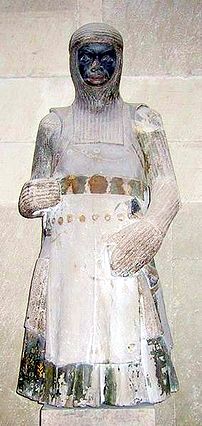
You want a picture of a naked witch summoning a demon? Sounds cool, but could we also have some pictures of women warriors dressed less like bikini models and more like Jeanne d'Arc, too? Does every paladin have to look like Saint George, or could we have more who look like Saint Maurice as well?

Is it really such a bad thing for gamers to want to see themselves in the artwork for roleplaying games?

And nothing about increasing the depth and breadth of represenation in game-art requires sacrificing the quality or originalty or excitement, of course.

I've thought about this subject quite a bit, actually, as there are problematic elements in cape-and-sword roleplaying games.

Running a campaign set in the early 17th century, I'm acutely conscious of the impact of discrimination associated with the period and neither do I soft-peddle it nor use it to severely - and ahistorically - limit player choices. I've read forum posts by gamers who believe that this does a disservice to women, LGBT, and gamers of color by putting them in a situation where the discrimination they feel in real life becomes part of the campaign. While I'm sympathetic to the argument, I accept that it's problematic for some gamers but integral to playing a historical roleplaying campaign for others. My response is to make clear from the outset what the campaign is like, so that anyone interested in playing can make an informed choice about whether or nor to participate.

The source literature which I try to emulate isn't always sensitive to the roles of women and others, either. Consider that d'Artagnan is a rapist and that the most important recurring female character in the Alatriste saga is a murderous racist.

And I do struggle to represent the diverse non-player characters in the game-world, as both period and contemporary artwork is short of swashbucklers of color and I'm not flush enough to commission the art myself for the campaign. But I do the best I can with what I can find.

So I accept that there are elements of my campaign which are problematic, and I acknowledge them as such, without feeling the need to dramatically change them to suit moral and ethical convictions, my own or anyone else's. There is sexism in the setting, but there are also powerful women who overcome, or at least work around, it. There is racism and intolerance, but 'Portuguese merchants' - Jews - and Moors and Turks are among those whom the adventurers may count as allies and rivals. I'm comfortable with the notion that adults can separate what happens in the game-world from the real one, that playing at intolerance doesn't reinforce it in our behavior and attitudes toward real-life human beings - and that to believe otherwise is to crawl down the Jack Chick rathole.

So bring on the naked, curvy Frazetta women, and the women in sensible armor, too - they're all hot babes to me.
Read More
Posted in art, historical roleplaying, roleplaying games, sexism | No comments

Thursday, 16 August 2012

As Promised On This Very Blog

Posted on 23:24 by Unknown
Sean B at Wine and Savages reviews the All for One: Régime Diabolique setting book for Savage Worlds.

And on the strength of his review, I think I'm going to buy it.

Good word of mouth is hard to beat, game publishers. Just sayin'.
Read More
Posted in All for One Régime Diabolique, roleplaying games, Savage Worlds, Sean B, swashbuckling and sorcery, Wine and Savages | No comments

Monday, 13 August 2012

Lightly Armored Fighter

Posted on 00:17 by Unknown
In the swashbuckling era, no swordsman worthy of the name would think of sullying the fine, graceful line of his body in motion with the use of anything so gauche as armor. Helmets and breatplates are for lowly guards and comically cowardly pirates, not gallant heroes or suave villains. Your DM should give you some free armor protection to compensate for the unforgiving treatment that D&D rules mete out to unarmored combatants.
So says Robin Laws, writing about "swashbuckling essentials" in Dragon magazine.

It is an article of faith - a received truth - among many gamers that the lightly armored Renaissance swordsman is the equal of the medieval knight by virtue of being quick on his feet and wielding a lighter blade. The lightly armored fighter archetype appears in fantasy literature as such, and to fail to represent this puts anyone who wants to play a swashbuckler in a world of plate mail and tower shields at an unfair disadvantage.

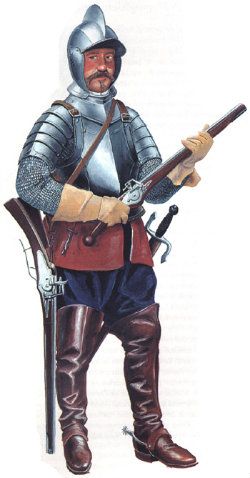
I'm guessing that an actual Renaissance or Early Modern warrior, in his leather buff coat and steel cuirass, his maille sleeves and epaulettes, his thigh-high cavalry boots and his steel helmet, would find the notion that he was a medieval knight's equal preposterous, for by virtue of the carbine slung around his neck and the pair of pistols carried in holsters draped from his saddle horn, he was the knight's master on the battlefield.

Armor didn't disappear from battlefields because swords got thinner or swordsmen more agile - armor disappeared because firearms rendered it ineffective.

But what about fencing techniques? Surely the great masters of the fifteenth, sixteenth, and seventeenth centries changed the nature of swords and swordplay? In fact, fashion, not fighting, dictated a change in blades, with swords growing thinner and shorter in response to the needs of courtiers, not soldiers, and the techniques of the swordmasters changed in response.

Well, so what, right? D&D's FANTASY, ain't it? Who cares what soldiers wore in the seventeenth century? After all, most fantasy worlds don't even have guns, so why can't a swashbuckler be just as good as a mail-clad warrior?

Fair enough. So how does D&D represent fighting skill? The ability to hit an opponent is tied to class and level, expressed, for example, on an attack matrix in 1e AD&D or basic attack bonus in 3.x D&D. As your character increases in level, so does her ability to hit things. So far, so good.

Defense is handed a bit differently. In 1e and 3e - and I'll keep referencing those two editions from here on out, as they are the ones with which I'm most familiar - a character's primary protection comes from armor, and thus we get to the "unforgiving treatment that D&D rules mete out to unarmored combatants," for which Robin Laws suggests the solution is "some free armor protection to compensate."

But armor isn't the only form of defense available to characters. First, characters can parry - in 1e, a parry subtracts the defender's Strength bonus to hit from the attacker's die roll, and in 3e, "fighting defensively" nets you a -4 on attacks but a +2 dodge bonus to armor class - or dodge - 3e feats and class ability which improve armor class. Second, characters get a bonus to their armor class - called defensive adjustement in 1e, Dexterity bonus in 3e - through having a high Dexterity ability score.

Defensive skill, however, is represented in D&D another way: hit points.

If I could go back in time and send a message to Gary Gygax as he was preparing the little brown books, it would be, 'Come up with a different names for hit points.' Intuitively most gamers associate hit points with the ability to withstand physical damage, and this association sowed untold confusion ever since. 1e defines hit points thus:

Because these reflect both the actual physical ability of the character to withstand damage - as indicated by constitution bonuses- and a commensurate increase in such areas as skill in combat and similar life-or-death situations, the "sixth sense" whith warns the individual of some otherwise unforeseen events, sheer luck, and the fantastic provisions of magical protections and/or divine protection (emphasis added).
3e, in the SRD, is much more succinct: "Hit points mean two things in the game world: the ability to take physical punishment and keep going, and the ability to turn a serious blow into a less serious one" (emphasis added again).

But Robin Laws isn't satisfied to allow hit points to be what hit points are: martial skill, the ability to turn aside a deadly blow. And unfortunately he's not the only one.

The original Duelist for 1e was written by Arthur Collins and published in May 1983 as a 'non-player character class' in Dragon 73. The class description includes some forgettable fluff, but the mechanics are what interest me. First, as one expects of the lightly armored fighter, the duelist is restricted to leather armor; somewhat surprisingly - and certainly comically for a character based on the swashbuckler - the duelist cannot use a shield. However, the role of hit points as combat skill - the presumed forte of the lightly armored fighter - is underscored by giving the character a d12 hit die. The author, Mr Collins, goes to some length to explain this design choice, writing, "Giving the duelist 12-sided hit dice is not intended to convey the impression that duelists are monstrous hulks . . ." and calling out the same passge in the 1e DMG quoted previously. Mr Collins concludes, "A 10th-level duelist will average more hit points than a 10th-level fighter, thus giving the former an appropriate edge in one-on-one combat; the duelist can outlast and wear out an opponent who is less skilful than he" (emphasis added once more).

To me, this is an adroit application of an elegant rule. Hit points were designed to emulate the give-and-take of swashbuckling swordplay from the very beginning, and the duelist takes that conceit and runs with it.

However, Mr Collins isn't content to stop there. Not only is the duelist given a higher hit die, representing his martial ability, he's also harder to hit, receiving "free armor protection" in the form of an armor class bonus every three levels; moreover, the duelist receives additional to-hit and damage bonuses as well, so that 10th-level fighter is at a further disadvantage against the 10th-level duelist.

It's a shame that some game designers just don't know when to let off the gas. The duelist and his d12 hit die does exactly what one expects of the swashbuckling fighter, to skillfully land the killing blow when his opponent runs out of tricks of his own; adding an armor class bonus gilds the lily.

The 3e Duelist prestige class is another take on the lightly armored fighter. Feats and skills ramp up the notion of the 'wily' fighter - as opposed to what other kind of fighter, one wonders? are other types of fighters less skilled somehow? - with feats like Dodge, Mobility, and Weapon Finesse which are the prerequisites for the prestige class. The Duelist's class abilities pile on, adding an armor class bonus for Intelligence bonuses, a precisely located strike for extra damage, even the ability to deflect arrows; as with so much about 3e, it takes the archetype and turns it up to eleven. Note that I don't think this is objectively bad for any reason; I do think it reinforces a parody trope of swashbuckling, but at the end of the day, it's simply not my cuppa.

So where am I going with all this?

Last week, Beedo at Dreams in the Lich House posed the question, "For purposes of D&D, what's the difference between a Norman knight, a viking, a samurai, a Roman centurion? What if we throw a muskeeter in the mix, a Mongolian horse archer, and a Hospitaler?"

It's a great question. Beedo continues:
I love this question with regards to the fighter, because the convergence of technology and tactics has created great variations in the fighting men of world history, and the differences are so easy for us to visualize. The evolution of D&D from its original vision has involved a long line of add-ons and extensions to create mechanical differentiation among character classes - new classes and sub-classes, secondary skills, kits, feats, prestige classes, and so on.

It's a topical question for me - I'm thinking over what a game in an Oriental Adventures setting would look like using a BX style of rules, and I have a pretty good idea how I'd handle archetypes like the samurai, the bushi, the kensai, the warrior monk: you're all fighters. You wear different armor, use different weapons, but at the end of the day, you all get paid to slug it out with the other guy. My work here is done.
I couldn't agree more. one of the strengths of the fighter class is that it embraces so many archetypes.

I also have some pratical experience with this approach. As I noted in the comments to Beedo's post, many years ago I ran a 1e fighter with a high Dexterity. An ex-pit fighter who escaped the arena, he was all about quickness, from his 12" movement rate in leather armor to his weapons speed factor 3 short sword to win initiative ties - this is why you use speed factors, boys and girls - to his spiked buckler which could be used for both offense and defense to his d10 hit dice which made him a more skilled combatant.

But where does that leave the poor swashbuckler, the duelist with his sword and dagger and no armor in a game filled with deadly warriors in iron suits? Well, I imagine it leaves them lighter on their feet and more likely to take a hit, like their counterparts in Melee, as Fenway5 at Sword and Shield reminds us.

Look, I completely understand the impulse to impose some sort of rules-parity between the lightly armored swashbuckling fighter and the plate mail-clad knight in a fantasy campaign, but I don't share that impulse.

Unlike some fantasy fans, I think history is instructive on this point. Real-life duelists fought without armor at a time when armor was the norm on the battlefield. Why would a duelist forego armor in a fantasy setting? Because of social taboos associated with honor, or because wearing armor around town is an incitement to violence that the authorities won't countenance, or because climbing a trellis into your lover's window is too noisy in chain maille and a great helm. Let the adventurers climb out of their tin cans once in awhile - give all the fighters a reason to be lightly armored.

Just not when a dragon's bearing down on them.
Read More
Posted in Dungeons and Dragons, Robin Laws, roleplaying games, swashbuckling | No comments

Friday, 10 August 2012

Savage Musketeers

Posted on 13:00 by Unknown
Courtesy of Tim Knight at HeroPress, All for One: Régime Diabolique is coming to Savage Worlds.

Intriguing.
Read More
Posted in All for One Régime Diabolique, HeroPress, roleplaying games, Savage Worlds | No comments

Thursday, 28 June 2012

Honor + Intrigue Coming to Your FLGS?

Posted on 00:51 by Unknown
Chris 'BASHMAN' Rutkowski confirmed at rpg.net that Honor + Intrigue will be appearing on the shelves of friendly local gaming stores in the future.
"The books are first going out to pre-orders while the bulk print run continues. When all the books are done, they're shipping them to the IPR Warehouse. IPR does distribute books to FLGS in the US, Canada, UK, and a number of other countries, so it ought to be available in stores at that point. However, that shipment has not gone out yet."
With dedicated cape-and-sword roleplaying games like H+I and All for One: Régime Diabolique and tabletop minis games like Gloire actively supported by their publishers, classics like Flashing Blades and En Garde! still in print, and other games like Savage Worlds' Solomon Kane and Pirates of the Spanish Main and 7th Sea plus freebies like PDQ Sharp available in .pdf, it's a great time to pretend to be a swashbuckler.
Read More
Posted in cape-and-sword, En Garde (game), Flashing Blades, Gloire, Honor + Intrigue, PDQ#, roleplaying games, Savage Worlds | No comments

Saturday, 17 March 2012

Crouching Fighter, Hidden Wizard

Posted on 18:22 by Unknown
This looks very cool.
Read More
Posted in Flying Swordsmen, martial arts, OSR, roleplaying games | No comments

Friday, 9 March 2012

GMs Day Sale Haul

Posted on 13:16 by Unknown
I am, by my own admission, a cheap spiv when it comes to roleplaying games, so I like that the GM's Day Sale at DriveThruRPG allows me to pick up a few titles each year at below-market rates.

This year's haul?

Bushido - Fantasy Games Unlimited's mytho-historic roleplaying game of fedual Japan. I'm working on a set of courtier rules for Flashing Blades and I want to see if Bushido has some ideas to steal emulate.

The Adventures of Sindbad - A QUAGS (Quick Ass Game System) hack of the Sinbad tales. I'm a sucker for anything Arabian Nights-ish.

Sanxesta - A setting book for the Suzerain game-setting compatible with The Free Musketeers. The cover blurb makes it sound something like The City from Swordspoint, so I decided to give it a look, for encounter and event ideas for my own campaign.

Honor + Intrigue - I immediately did a search for the word 'chandelier,' as one of the first things I want to know about a cape-and-sword game is how it handles a chandelier swing. Sure enough, it gets covered in the section on stunts, along with rules for how many "Pawns" and "Elites" can be taken out by a falling chandelier. Hrrm. Not the kind of stuff I typically look for from a roleplaying game, but then, I am a grognard with the innate mistrust of anything that sounds like it was published after about 1980 or so.* I must remember to keep an open mind as I read.

So, some new toys to break play with.


* Flashing Blades, which draws much of its inspiration from En Garde!, Crimson Cutlass, and Traveller, gets a pass on this.
Read More
Posted in Bushido, DriveThruRPG, Honor + Intrigue, QUAGS, roleplaying games, Sanxesta, The Adventures of Sindbad | No comments
Older Posts Home
Subscribe to: Posts (Atom)

Popular Posts

  • The Pen and the Sword: Captain Alatriste
    It was clear that the Italian was doing very well. He could have killed the wounded man any number of times, but he was satisfied to harass ...
  • Letters to Isabel, Redux
    Marcello recounts a game played by the adventurers in his latest missive to his dear Isabel . I love this, integrating another game played ...
  • Madame la Présidente
    In Ancien Régime France, the title of présidente belonged to the presiding magistrates of the Parlements , the high court of Paris as well...
  • Off the Shelf: Chapbooks
    Chapbooks are popular books printed on cheap paper, often a single sheet folded into a booklet of eight to twenty-four pages, and illustrate...
  • Letters to Isabel, Redux
    The title of the post says it all: courtly intrigue . I'm often left at more than a little bit of a loss when referees complain that al...
  • Graphic Novels Challenge: Belladone
    An assassin takes a shot at Louis XIV, but the ball is deflected by the iron fan of a nearby nun, who with a winsome smile leaps over the s...
  • Special Maneuvers, Redux: A Reply to Jeff Rients
    "You are using Bonetti's defense against me, eh?" "I thought it fitting considering the rocky terrain." "Natura...
  • The Pernicious Influence of The Princess Bride
    Mandy Patinkin called it " The Wizard of Oz of our generation." Conceived as a fairy tale by William Goldman, TPB is a love stor...
  • The Pen and the Sword: The Cavalier in the Yellow Doublet
    He decided to finish the business, although not so hastily that it might work against him. Besides, there was no point in complicating his l...
  • The Cat Out of the Bag
    Jedediah at Book Scorpion's Lair has another actual play log from his 7th Sea campaign, in which the intrepid adventurers learn someth...

Categories

  • -C
  • 1602
  • 1612 (movie)
  • 1650 (game)
  • 7RPGS
  • 7th Sea
  • A Field in England
  • A to Z 2012
  • actual play
  • adventure path
  • Adventure Time
  • Against All Flags
  • Age of Ravens
  • Alain Delon
  • Alatriste
  • Alexander Macris
  • Alexandre Dumas
  • Alice B Woodward
  • All for One Régime Diabolique
  • alt history
  • Amanda Heitler
  • ancien régime
  • Andy Murray. meta
  • animal
  • animation
  • Anthony Hope
  • Arabian Nights
  • art
  • Arturo Pérez-Reverte
  • At Sword's Point (movie)
  • award
  • background
  • Backswords and Bucklers
  • bandwagon jumping
  • baragei
  • Barbaric Frontier
  • Barbie
  • Bardelys the Magnificent
  • Barry Lyndon
  • baseball
  • Batman
  • Bayuca
  • BBC America
  • Beedo
  • Belladone
  • BH 1 Mad Mesa
  • Big Purple
  • Black Vulmea
  • Black Vulmea's Vengeance
  • Blog of Holding
  • blogfest
  • Blogger
  • Blunders on the Danube
  • board game
  • Bob Anderson
  • Bold Pueblo Games
  • Bombshell Miniatures
  • Book Scorpion's Lair
  • books
  • Boot Hill
  • Bren at RPG Net
  • British Isles Traveller Support
  • BryanMD
  • Bushido
  • Caoimhe Ora Snow
  • cape-and-sword
  • Capitan
  • Capitán Alatriste (game)
  • Captain Alatriste
  • Captain Blood (movie)
  • Captain Blood (novel)
  • Captain from Castile
  • Captain Hook
  • Captain Horatio Hornblower
  • Captain Morgan
  • Cara King
  • card game
  • cartography
  • cartoon
  • Cassini map
  • catacombs
  • Catan Junior
  • Cesare Borgia
  • character
  • charity
  • Charles Perrault
  • chase
  • chateau
  • Chill
  • Christopher Columbus
  • Chronicles of Shadow Valley
  • Cinematic
  • comics
  • commercial
  • Condottieri Conflicts
  • conquistadors
  • ConTtessa
  • corsairs
  • cosplay
  • Crimson Cutlass
  • Crossbones
  • CS Forester
  • Cutthroat Island
  • cycling
  • Cyrano de Bergerac
  • d'Artagnan
  • d20
  • d20 Modern
  • d20 Past
  • d20 Pirates
  • Daffy Duck
  • Dangerous Beauty
  • Dangerous Liasons
  • Danny Kaye
  • Dark Dimension
  • David Balfour
  • DC Comics
  • De cape et d'épée
  • DeviantArt
  • Die Another Day
  • disability
  • Disneyland
  • diversity
  • Douglas Fairbanks Sr
  • Dr Rotwang
  • Drama Dice and Damsons
  • Dreams of the Lich House
  • DriveThruRPG
  • duel
  • Duelist (prestige class)
  • Dungeons and Dragons
  • Dynamite Entertainment
  • Dynasties and Demagogues
  • ECW
  • El Cazador
  • Ellen Kushner
  • Emmy Rossum
  • en français
  • En Garde (game)
  • EN World
  • endgame
  • Eric Treasure
  • errata
  • Errol Flynn
  • Ethan Skemp
  • Exchange of Realities
  • Fabled Lands
  • fantasy
  • festival
  • Fist Full of Seamen
  • Flashing Blades
  • Flashman
  • FLGS
  • Flying Swordsmen
  • Frank C Papé
  • Frank Frazetta
  • Frank Schoonover
  • Frankenstein
  • Fred Funcken
  • FXR
  • Game Empire
  • game fiction
  • game style quiz
  • games
  • Gary Gygax
  • George Waymouth
  • Gloire
  • Gonsalvo
  • gospel
  • Graham Bottley
  • Graphic Novels Challenge
  • grognard
  • gun control
  • GURPS
  • Hack and Slash
  • Hamlet (1996 movie)
  • Han shot first
  • Harold Lamb
  • heads up
  • Hearts
  • Heidi Brühl
  • Helen Hunt Jackson
  • Hendybadger
  • hero points
  • HeroPress
  • Hidden in Shadows
  • High Seas
  • historical roleplaying
  • history
  • hobby
  • holiday
  • Honor + Intrigue
  • Horatio Hornblower
  • Horrible Histories
  • horror
  • house rules
  • Howard Pyle
  • Howling Tower
  • humor
  • I Waste the Buddha With My Crossbow
  • ice hockey
  • Iceland
  • immersion
  • improv
  • Inca
  • Infernal Sorceress
  • International Catacomb Society
  • interview
  • IntWisCha
  • Ivanhoe
  • Jack Sparrow
  • James Bone 007 Roleplaying Game
  • James Fenimore Cooper
  • James Mason
  • Jean Laffite
  • Jedediah
  • Jeff Black
  • Jeff Rients
  • Jeffrey Catherine Jones
  • jeu de palme
  • JF
  • John Gilbert
  • John Paul Jones
  • John Sayles
  • Jules Verne
  • Khlit the Cossack
  • Kickstarter
  • Kingdom of Saguenay
  • komradebob
  • La Fille de d'Artagnan
  • lazy git
  • Le Ballet de l'Acier
  • Le Bossu
  • Legends of the High Seas
  • LEGO
  • linear adventure
  • literature
  • location
  • Lone Star
  • Long John Silver (novel)
  • Lord Dunsany
  • Lord Gwydion
  • Lord Nelson
  • Los Nikis
  • Lowell Francis
  • M.P.
  • magic
  • magic items
  • map
  • maritime
  • Mark Twain
  • martial arts
  • Marvel Comics
  • Masks
  • Maureen O'Hara
  • Mayan non-Apocalypse
  • Mead Schaeffer
  • Mediterranean
  • Melan
  • meta
  • Michael Crichton
  • Mike Mornard
  • milestone
  • miniatures
  • Mitch Williamson
  • Mithril Wisdom
  • Molière
  • Moonfleet
  • movie
  • music
  • musketeer
  • Mysterious Island
  • Mythic Game Master Emulator
  • Mythic Role Playing
  • names
  • Nasruddin
  • Natalie Dormer
  • Nate Christen
  • navel gazing
  • nc wyeth
  • NC Wyeth's Pilgrims
  • New France
  • Nick
  • npcs
  • NPS
  • Obsidian Portal
  • Odie
  • OEF
  • off the shelf
  • off-hand weapon
  • old man is old
  • Old Stuff Day
  • Order of the d30
  • Oriental
  • Osprey Publishing
  • OSR
  • Ottavia Piccolo
  • Paris
  • Pathfinder
  • Paul
  • PDQ#
  • perdustin
  • personal
  • Peter and Wendy
  • phoning it in
  • Pierre Alary
  • pike-and-shot
  • pilgrims
  • pirate
  • Pirate Latitudes
  • Pirates of the Caribbean Curse of the Black Peal
  • Pirates of the Caribbean On Stranger Tides
  • Pirates of Tripoli
  • playstyle
  • poetry
  • points of light
  • politics
  • pulps
  • Puss in Boots
  • QUAGS
  • Quickly Quietly Carefully
  • Rafael Sabatini
  • Raiders of the Seven Seas
  • Ramona
  • random
  • random. Mediterranean
  • rant
  • Raphael Sabatini
  • Ravyn
  • Ray Harryhausen
  • real life can be a pain in the ass
  • reenactors
  • refereeing
  • Regency
  • REH
  • reply
  • resolutions
  • Restoration
  • review
  • rewards
  • Richard the Lionheart
  • Rip Van Winkle
  • Rob Roy
  • Robert E Howard
  • Robert Louis Stevenson
  • Robert Newton
  • Robert Taylor
  • Robin Hood
  • Robin Laws
  • Robinson Crusoe
  • Robots and Rapiers
  • Rochefort
  • roleplaying
  • roleplaying games
  • Rome
  • Romeo and Juliet
  • Rory's Story Cubes
  • Royal Flash
  • RPG Blog Carnival
  • rpg history
  • RPG Stuff (blog)
  • RPGBA
  • rules
  • Ruritania
  • Saint Patrick's Day
  • sale
  • samurai
  • Samurai Heaven and Earth
  • sandbox
  • Sandy Hook shooting
  • Santa Claus
  • Sanxesta
  • SAR
  • Savage Worlds
  • save or die
  • Save Vs. Dragon
  • Scallywags
  • Scaramouche
  • Sean B
  • Semper Initiativus Unum
  • setting
  • sexism
  • shields
  • ship
  • siegecraft
  • Sinbad
  • SirJarva
  • social contract
  • social sandbox
  • social standing
  • solo
  • Solo Nexus
  • Solomon Kane
  • Sophie Marceau
  • Source of the Nile
  • Spacejacking
  • Spanish Fury
  • stage fighting
  • Stanley J Weyman
  • Star Wars
  • Steve Winter
  • Stewart Granger
  • story games
  • Super-Team Family
  • Swashbuckler (Jolly Roger game)
  • Swashbuckler (Yaquinto game)
  • swashbuckling
  • swashbuckling and sorcery
  • sword
  • Swords of the Red Brotherhood
  • Swordspoint
  • Swordswomen of the Silver Screen
  • Talk Like a Pirate Day
  • Taras Bulba
  • Tartuffe
  • Tavern Cards
  • TCM
  • Te Deum pour un massacre
  • Telecanter
  • Telecanter's Receding Rules
  • television
  • Tenkar's Tavern
  • tennis
  • Tercio Creativo
  • The 13th Warrior
  • The 9Qs
  • The Admiral's Ghost
  • The Adventures of Don Juan
  • The Adventures of Robin Hood
  • The Adventures of Sindbad
  • the Batman
  • The Black Arrow
  • The Black Buccaneer
  • The Black Swan
  • The Borgias
  • The Boy's King Arthur
  • The Buccaneer
  • The Business of War
  • The Cavalier in the Yellow Doublet
  • The Court Jester
  • The Courtship of Miles Standish
  • The Crimson Pirate
  • The Crown and the Ring
  • The Deerslayer
  • The Deluge
  • The Dragon's Flagon
  • The Duelists
  • The Dungeon Dozen
  • The Escapist
  • The Golden Voyage of Sinbad
  • The Isle of Pirate's Doom
  • The Justice of the Duke
  • The Lady and the Bandit
  • The Lion in Winter
  • The Mark of Zorro (1920)
  • The Mark of Zorro (1940)
  • The Mask of Zorro
  • The Master of Ballantrae (movie)
  • The Master of Ballantrae (novel)
  • The Mysterious Stranger
  • The Other Side
  • The Pen and the Sword
  • The Perfect Captain
  • The Phantom of the Opera
  • The Princess Bride
  • The Prisoner of Zenda
  • The Queen's Cavaliers
  • The Russian Storybook
  • The Savage AfterWorld
  • The Scarlet Cockerel
  • The Scarlet Pimpernel (1982 movie)
  • The Scarlet Pumpernickel
  • The Scottish Chiefs
  • The Sea Hawk
  • The Sea-Hawk
  • The Shadow of the Vulture
  • The Spanish Main
  • The Swordsman of Siena
  • The Thief of Bagdad
  • The Three Musketeers
  • The Three Musketeers (novel)
  • The Three Musketeers (Paul WS Andersen)
  • The Three Musketeers (RIchard Lester)
  • The Three Musketeers (Rowland Lee)
  • The Tudors
  • The Usual Suspects
  • The White Company
  • The World of Music
  • theatre
  • theRPGsite
  • Thoul's Paradise
  • Tim Brannan
  • Tim Snider
  • Tiny Solitary Soldiers
  • Top Secret
  • Toshiro Mifune
  • Tour de France
  • Traveller
  • Treasure Island
  • Treasure Island (1934)
  • Troll in the Corner
  • Trollsmyth
  • ttfn
  • TV Tropes
  • Twenty Years After
  • Twitter
  • Tyrone Power
  • Under the Red Robe
  • Universal Studios
  • Vaesen
  • Valley of the Giants
  • vanity
  • Vatel
  • veil of ignorance
  • Very Civile Actions
  • video
  • video game
  • Vikings
  • W Heath Robinson
  • Walter Paget
  • War and Game (blog)
  • wargames
  • Warren W Baumgartner
  • Warrior Pursuits
  • Wars of Louis Quatorze (blog)
  • Wayne R
  • Westward Ho
  • what shite
  • wiki
  • William Hobbs
  • Wimbledon
  • Wine and Savages
  • World of Music
  • world-building
  • Zak S
  • Zorro
  • Zorro (1974)

Blog Archive

  • ▼  2013 (157)
    • ▼  September (15)
      • Talk Like a Pirate Day!
      • Wednesday Wyeth
      • "The pass to Bourbon . . . Slapshot! . . . GOAL!"
      • Lazy Monday Link Dump
      • The Pen and the Sword: The Cavalier in the Yellow ...
      • Here Be Monsters
      • Dividends
      • Wednesday Wyeth
      • Meditation on a Visit to a Game Store
      • Random Encounters Coda: Order from Chaos
      • The Pen and the Sword: The Cavalier in the Yellow ...
      • Seriously
      • Retcon
      • Wednesday Wyeth
      • Another Solo Gaming Resource
    • ►  August (13)
    • ►  July (11)
    • ►  June (24)
    • ►  May (21)
    • ►  April (4)
    • ►  March (18)
    • ►  February (22)
    • ►  January (29)
  • ►  2012 (343)
    • ►  December (32)
    • ►  November (34)
    • ►  October (27)
    • ►  September (21)
    • ►  August (33)
    • ►  July (29)
    • ►  June (28)
    • ►  May (31)
    • ►  April (34)
    • ►  March (39)
    • ►  February (29)
    • ►  January (6)
Powered by Blogger.

About Me

Unknown
View my complete profile