ReallyBadTalk

  • Subscribe to our RSS feed.
  • Twitter
  • StumbleUpon
  • Reddit
  • Facebook
  • Digg
Showing posts with label Robin Laws. Show all posts

Thursday, 3 January 2013

Playstyles & Pigeonholes

Posted on 00:02 by Unknown
I wonder if Robin Laws' most pervasive impact on roleplaying games is the quiz based on his book.

I see the results posted in gamers' signatures on various forums pretty often, as a sort of identity badge, perhaps - 'I'm a Storyteller 100%, and I want everyone to know it!' I'd taken it before, but I couldn't remember when, so I took it again the other day. Here's what it spit out at me.

You Scored as Tactician

You're probably a military buff who wants to have the chance to think through complex problems. You want the rules, and your GM's interpretation of them, to match up what happens in the real world or at least be consistant. You want challenging yet logical obstacles to overcome.

Tactician
67%
Method Actor
50%
Butt-Kicker
50%
Storyteller
42%
Power Gamer
42%
Specialist
33%
Casual Gamer
17%

A couple of things jumped out at me. First, it's interesting to me that only one of the scores was above 50%, but not terribly surprising, considering the number of 'neither this nor that' answers I chose. In fact, very few of my answers reached either extreme at all; for me, most of the questions were simply too polarised to elicit strong agreement or disagreement.

Second, looking over my results, I'm pretty consistent. With a little searching, I found my answers to this quiz from not quite a year ago - in both cases, Tactician was my highest score and the only answer to break fifty percent, and while there was a bit of jockeying in the rest of the pack, the answers are more or less consistent between the two. The rough consistency between the results - one score breaking away from the field, the rest varying by fairly small margins - suggests the quiz does a reasonable job of sussing out the likes and dislikes of gamers.

Here's the thing, though: as a diagnostic of my own gaming style, the most important result is not the top score, but rather the clump of answers which follow. The quiz proclaims that I'm a Tactician, ". . . a military buff who wants to have the chance to think through complex problems," who wants " . . . the rules, and your GM's interpretation of them, to match up what happens in the real world or at least be consistant," and wants, ". . . challenging yet logical obstacles to overcome." There's a nugget of truth in this: I like thinking through complex problems, and I like overcoming challenging obstacles, especially ones which must be reasoned through. And yes, I do enjoy wargames as well, though calling me a "military buff" is a bit too specific.

The description of the Tactician provided in the quiz results is a paraphrase of the description provided by Mr Laws, however. Here's the full description, as quoted in the linked passages, with bold text highlighting some of the key differences between the quiz and the book.
The Tactician is probably a military buff, who wants chances to think his way through complex, realistic problems, usually those of the battlefield. He wants the rules, and your interpretation of them, to jibe with reality as he knows it, or at least to portray an internally consistent, logical world in which the quality of his choices is the biggest determining factor in his success or failure. He may view issues of characterization as a distraction. He becomes annoyed when other players do things which fit their PCs' personalities, but are tactically unsound. To satisfy him, you must provide challenging yet logical obstacles for his character to overcome.
There's a quite a bit more here than the quiz results suggests, a much narrower interpretation of what a "Tactician" expects from the game, and, for me, the added specificity goes wildly wrong.

As far as "complex, realistic problems" go, I tend to think of 'battlefield complexity' as fun but perhaps the least interesting sort of complexity a roleplaying game may offer. Everything from traps and environmental hazards to mysteries and political intrigues interest me as problems to solve in roleplaying games, and those often far more than combat. I like the "quality" of my choices to skew the probabilities - for good or bad - of the dice, not be the "biggest determining factor" of success or failure.

And the idea that characterisation is a "distraction," or that "tactically unsound" in-character choices are annoying, isn't even in the ballpark.

So does "Tactician 67%" really come close to describing how I like to play a roleplaying game? Is Mr Laws' typology 'two-thirds' correct as it applies to me?

One of the very real problems of trying to divine players' interests, whether it's Mr Laws' game styles, or the Forge's 'Big Model(s),' or Fred Hicks' "secret language of character sheets", is that playstyle pigeonholes rarely provide even a useful fraction of the whole story. Looking at my quiz results, it's not the Tactician result which tells you most about my gaming style, but rather the bunch sprint between Method Actor, Butt-Kicker, Storyteller, and Power Gamer, all in roughly equal measure. I want action and system mastery and deepening characterisation and the opportunity to weave my character into the history of the game-world.

When I think about campaigns in which I've played, it's these qualities against which I judge how much I enjoyed the experience, not whether my character fought a duel on the deck of a burning galleon or if I adequately demonstrated my pike-and-shot tactical acumen. A referee who looks at my quiz score and tries to engage me with the equivalent of a minis skirmish game won't even be close.
Read More
Posted in game style quiz, playstyle, refereeing, Robin Laws | No comments

Monday, 13 August 2012

Lightly Armored Fighter

Posted on 00:17 by Unknown
In the swashbuckling era, no swordsman worthy of the name would think of sullying the fine, graceful line of his body in motion with the use of anything so gauche as armor. Helmets and breatplates are for lowly guards and comically cowardly pirates, not gallant heroes or suave villains. Your DM should give you some free armor protection to compensate for the unforgiving treatment that D&D rules mete out to unarmored combatants.
So says Robin Laws, writing about "swashbuckling essentials" in Dragon magazine.

It is an article of faith - a received truth - among many gamers that the lightly armored Renaissance swordsman is the equal of the medieval knight by virtue of being quick on his feet and wielding a lighter blade. The lightly armored fighter archetype appears in fantasy literature as such, and to fail to represent this puts anyone who wants to play a swashbuckler in a world of plate mail and tower shields at an unfair disadvantage.

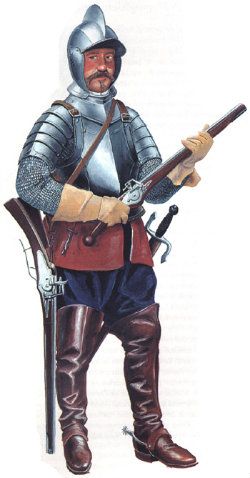
I'm guessing that an actual Renaissance or Early Modern warrior, in his leather buff coat and steel cuirass, his maille sleeves and epaulettes, his thigh-high cavalry boots and his steel helmet, would find the notion that he was a medieval knight's equal preposterous, for by virtue of the carbine slung around his neck and the pair of pistols carried in holsters draped from his saddle horn, he was the knight's master on the battlefield.

Armor didn't disappear from battlefields because swords got thinner or swordsmen more agile - armor disappeared because firearms rendered it ineffective.

But what about fencing techniques? Surely the great masters of the fifteenth, sixteenth, and seventeenth centries changed the nature of swords and swordplay? In fact, fashion, not fighting, dictated a change in blades, with swords growing thinner and shorter in response to the needs of courtiers, not soldiers, and the techniques of the swordmasters changed in response.

Well, so what, right? D&D's FANTASY, ain't it? Who cares what soldiers wore in the seventeenth century? After all, most fantasy worlds don't even have guns, so why can't a swashbuckler be just as good as a mail-clad warrior?

Fair enough. So how does D&D represent fighting skill? The ability to hit an opponent is tied to class and level, expressed, for example, on an attack matrix in 1e AD&D or basic attack bonus in 3.x D&D. As your character increases in level, so does her ability to hit things. So far, so good.

Defense is handed a bit differently. In 1e and 3e - and I'll keep referencing those two editions from here on out, as they are the ones with which I'm most familiar - a character's primary protection comes from armor, and thus we get to the "unforgiving treatment that D&D rules mete out to unarmored combatants," for which Robin Laws suggests the solution is "some free armor protection to compensate."

But armor isn't the only form of defense available to characters. First, characters can parry - in 1e, a parry subtracts the defender's Strength bonus to hit from the attacker's die roll, and in 3e, "fighting defensively" nets you a -4 on attacks but a +2 dodge bonus to armor class - or dodge - 3e feats and class ability which improve armor class. Second, characters get a bonus to their armor class - called defensive adjustement in 1e, Dexterity bonus in 3e - through having a high Dexterity ability score.

Defensive skill, however, is represented in D&D another way: hit points.

If I could go back in time and send a message to Gary Gygax as he was preparing the little brown books, it would be, 'Come up with a different names for hit points.' Intuitively most gamers associate hit points with the ability to withstand physical damage, and this association sowed untold confusion ever since. 1e defines hit points thus:

Because these reflect both the actual physical ability of the character to withstand damage - as indicated by constitution bonuses- and a commensurate increase in such areas as skill in combat and similar life-or-death situations, the "sixth sense" whith warns the individual of some otherwise unforeseen events, sheer luck, and the fantastic provisions of magical protections and/or divine protection (emphasis added).
3e, in the SRD, is much more succinct: "Hit points mean two things in the game world: the ability to take physical punishment and keep going, and the ability to turn a serious blow into a less serious one" (emphasis added again).

But Robin Laws isn't satisfied to allow hit points to be what hit points are: martial skill, the ability to turn aside a deadly blow. And unfortunately he's not the only one.

The original Duelist for 1e was written by Arthur Collins and published in May 1983 as a 'non-player character class' in Dragon 73. The class description includes some forgettable fluff, but the mechanics are what interest me. First, as one expects of the lightly armored fighter, the duelist is restricted to leather armor; somewhat surprisingly - and certainly comically for a character based on the swashbuckler - the duelist cannot use a shield. However, the role of hit points as combat skill - the presumed forte of the lightly armored fighter - is underscored by giving the character a d12 hit die. The author, Mr Collins, goes to some length to explain this design choice, writing, "Giving the duelist 12-sided hit dice is not intended to convey the impression that duelists are monstrous hulks . . ." and calling out the same passge in the 1e DMG quoted previously. Mr Collins concludes, "A 10th-level duelist will average more hit points than a 10th-level fighter, thus giving the former an appropriate edge in one-on-one combat; the duelist can outlast and wear out an opponent who is less skilful than he" (emphasis added once more).

To me, this is an adroit application of an elegant rule. Hit points were designed to emulate the give-and-take of swashbuckling swordplay from the very beginning, and the duelist takes that conceit and runs with it.

However, Mr Collins isn't content to stop there. Not only is the duelist given a higher hit die, representing his martial ability, he's also harder to hit, receiving "free armor protection" in the form of an armor class bonus every three levels; moreover, the duelist receives additional to-hit and damage bonuses as well, so that 10th-level fighter is at a further disadvantage against the 10th-level duelist.

It's a shame that some game designers just don't know when to let off the gas. The duelist and his d12 hit die does exactly what one expects of the swashbuckling fighter, to skillfully land the killing blow when his opponent runs out of tricks of his own; adding an armor class bonus gilds the lily.

The 3e Duelist prestige class is another take on the lightly armored fighter. Feats and skills ramp up the notion of the 'wily' fighter - as opposed to what other kind of fighter, one wonders? are other types of fighters less skilled somehow? - with feats like Dodge, Mobility, and Weapon Finesse which are the prerequisites for the prestige class. The Duelist's class abilities pile on, adding an armor class bonus for Intelligence bonuses, a precisely located strike for extra damage, even the ability to deflect arrows; as with so much about 3e, it takes the archetype and turns it up to eleven. Note that I don't think this is objectively bad for any reason; I do think it reinforces a parody trope of swashbuckling, but at the end of the day, it's simply not my cuppa.

So where am I going with all this?

Last week, Beedo at Dreams in the Lich House posed the question, "For purposes of D&D, what's the difference between a Norman knight, a viking, a samurai, a Roman centurion? What if we throw a muskeeter in the mix, a Mongolian horse archer, and a Hospitaler?"

It's a great question. Beedo continues:
I love this question with regards to the fighter, because the convergence of technology and tactics has created great variations in the fighting men of world history, and the differences are so easy for us to visualize. The evolution of D&D from its original vision has involved a long line of add-ons and extensions to create mechanical differentiation among character classes - new classes and sub-classes, secondary skills, kits, feats, prestige classes, and so on.

It's a topical question for me - I'm thinking over what a game in an Oriental Adventures setting would look like using a BX style of rules, and I have a pretty good idea how I'd handle archetypes like the samurai, the bushi, the kensai, the warrior monk: you're all fighters. You wear different armor, use different weapons, but at the end of the day, you all get paid to slug it out with the other guy. My work here is done.
I couldn't agree more. one of the strengths of the fighter class is that it embraces so many archetypes.

I also have some pratical experience with this approach. As I noted in the comments to Beedo's post, many years ago I ran a 1e fighter with a high Dexterity. An ex-pit fighter who escaped the arena, he was all about quickness, from his 12" movement rate in leather armor to his weapons speed factor 3 short sword to win initiative ties - this is why you use speed factors, boys and girls - to his spiked buckler which could be used for both offense and defense to his d10 hit dice which made him a more skilled combatant.

But where does that leave the poor swashbuckler, the duelist with his sword and dagger and no armor in a game filled with deadly warriors in iron suits? Well, I imagine it leaves them lighter on their feet and more likely to take a hit, like their counterparts in Melee, as Fenway5 at Sword and Shield reminds us.

Look, I completely understand the impulse to impose some sort of rules-parity between the lightly armored swashbuckling fighter and the plate mail-clad knight in a fantasy campaign, but I don't share that impulse.

Unlike some fantasy fans, I think history is instructive on this point. Real-life duelists fought without armor at a time when armor was the norm on the battlefield. Why would a duelist forego armor in a fantasy setting? Because of social taboos associated with honor, or because wearing armor around town is an incitement to violence that the authorities won't countenance, or because climbing a trellis into your lover's window is too noisy in chain maille and a great helm. Let the adventurers climb out of their tin cans once in awhile - give all the fighters a reason to be lightly armored.

Just not when a dragon's bearing down on them.
Read More
Posted in Dungeons and Dragons, Robin Laws, roleplaying games, swashbuckling | No comments

Tuesday, 24 April 2012

U is for Unbuilt

Posted on 13:10 by Unknown
For the July 2000 issue of Dragon magazine, Robin Laws wrote an article entitled "Swashbuckling Essentials," containing, ". . . twelve tips for the prospective swashbuckler," aimed at referees and players of Dungeons and Dragons specifically, and other games generally. Mr Laws' tips include such nuggets as "Panache Your Middle Name," "Chivalry to the Point of Idiocy," "Gentlemen Prefer Rapiers," and, "Armor is for the Weak."

Mr Laws then advises how to integrate these tips into the rules of the game. Here's a sample.
So when you're in a tight spot, when the bloodthirsty pirates have you cornered in the colonial governor's kitchen, look around for items that are waiting to help you. In swashbuckler mode, a found item almost always makes as effective a weapon as the cutlass in your scabbard or the dagger in your boot. Expect your [dungeon master] to assign you a big bonus for flinging a handy meat cleaver at the lead pirate. Expect an even bigger one for lifting a roasting boar from its spit and hurling it at him.
And another.
Wit is crucial component of your Charisma-based arsenal. It is not enough to defeat an opponent - you must prove yourself his master in the fine art of the cutting remark. Swashbuckling villains stand united in their reslolute lack of a sense of humor, especially regarding their own faults. Your DM should reward you for wittiness above and beyond the call of duty. For example, each time you successfully infuriate a foe with a cutting remark, your DM might reward you [experience points] equal to 10% of amount you'd get for defeating him outright.
Advice like Mr Laws' is pretty common for cape-and-sword roleplaying games, reflecting perhaps the most widely held perceptions of what swashbuckling adventure is all about. There's a lot to like here, particularly about the importance of romance and honor.

But "Swashbuckling Essentials" also falls into the familiar trap of failing to understand its sources, and as a result it ends up defining the genre as parody. He also gets some things flat wrong; for example, Mr Laws writes, "If your campaign draws inspiration from The Three Musketeers, don't expect to find treasure all over the place. . . . They get their equipment from the king's armory, their horses from his livery, and so on," whereas M. Dumas devotes whole chapters in his tale to the Musketeers figuring out how to pay for their equipment before going on campaign.

TV Tropes, that inestimable trove of "devices and conventions that a writer can reasonably rely on as being present in the audience members' minds and expectations," includes a page on swashbuckling. Among the "devices and conventions" associated with the cape-and-sword genre is the Unbuilt Trope.

The Unbuilt Trope "is a work that seems like a Deconstruction but is actually the Trope Maker itself. This is often because later appearances of the trope have decayed compared to the original, defining appearance." As TV Tropes explains, this can happen for a number of reasons, from conscious choice to lack of understanding to just plain hackery by later writers. In fact, TV Tropes specifically calls out Alexandre Dumas' The Three Musketeers and Anthony Hope's The Prisoner of Zenda as examples of the Unbuilt Trope in swashbuckling.

In the case of the cape-and-sword genre, I expect that the tropes decayed with the transition of swashbuckling stories to the medium of film. Many fans of the various movie versions of The Three Musketeers might be quite surprised by M Dumas' concise treatment of d'Artagnan's duels in his books. The Alatriste novels by Arturo Pérez-Reverte, written at the tail-end of the twentieth century, are in fact much closer in feel to the works by M Dumas and Mr Hope than they are Rafael Sabatini or Johnston McCulley.

Overemphasizing comically light-hearted action, as I feel Mr Laws does in "Swashbuckling Essentials," limits the range of experiences available through cape-and-sword roleplaying. Showering a player with bonuses that make using improvised weapons better than the sword is one way to encourage swashbuckling action; another is to make fights desperate enough that there is a pressing need for creative solutions, such that using an cleaver unbalanced for throwing to slow down a rush of attackers is preferable to relying on the sword alone, even if it entails a penalty to perform successfully.

When I set out to develop my own cape-and-sword campaign, Le Ballet de l'Acier, I knew I wanted the action in actual play to feel more like the Musketeers and Alatriste novels. I hadn't heard of the Unbuilt Trope at the time; I just knew that I wanted a game that felt more like the Richard Lester Musketeers movies and less like The Crimson Pirate. Swashbuckling can be a dirty business as well as a funny one, and focusing on the latter at the expense of the former, as "Swashbuckling Essentials" does, would result in a much shallower roleplaying experience.
Read More
Posted in cape-and-sword, Robin Laws, swashbuckling, TV Tropes | No comments
Older Posts Home
Subscribe to: Posts (Atom)

Popular Posts

  • The Pen and the Sword: Captain Alatriste
    It was clear that the Italian was doing very well. He could have killed the wounded man any number of times, but he was satisfied to harass ...
  • Letters to Isabel, Redux
    Marcello recounts a game played by the adventurers in his latest missive to his dear Isabel . I love this, integrating another game played ...
  • Madame la Présidente
    In Ancien Régime France, the title of présidente belonged to the presiding magistrates of the Parlements , the high court of Paris as well...
  • Off the Shelf: Chapbooks
    Chapbooks are popular books printed on cheap paper, often a single sheet folded into a booklet of eight to twenty-four pages, and illustrate...
  • Letters to Isabel, Redux
    The title of the post says it all: courtly intrigue . I'm often left at more than a little bit of a loss when referees complain that al...
  • Graphic Novels Challenge: Belladone
    An assassin takes a shot at Louis XIV, but the ball is deflected by the iron fan of a nearby nun, who with a winsome smile leaps over the s...
  • Special Maneuvers, Redux: A Reply to Jeff Rients
    "You are using Bonetti's defense against me, eh?" "I thought it fitting considering the rocky terrain." "Natura...
  • The Pernicious Influence of The Princess Bride
    Mandy Patinkin called it " The Wizard of Oz of our generation." Conceived as a fairy tale by William Goldman, TPB is a love stor...
  • The Pen and the Sword: The Cavalier in the Yellow Doublet
    He decided to finish the business, although not so hastily that it might work against him. Besides, there was no point in complicating his l...
  • The Cat Out of the Bag
    Jedediah at Book Scorpion's Lair has another actual play log from his 7th Sea campaign, in which the intrepid adventurers learn someth...

Categories

  • -C
  • 1602
  • 1612 (movie)
  • 1650 (game)
  • 7RPGS
  • 7th Sea
  • A Field in England
  • A to Z 2012
  • actual play
  • adventure path
  • Adventure Time
  • Against All Flags
  • Age of Ravens
  • Alain Delon
  • Alatriste
  • Alexander Macris
  • Alexandre Dumas
  • Alice B Woodward
  • All for One Régime Diabolique
  • alt history
  • Amanda Heitler
  • ancien régime
  • Andy Murray. meta
  • animal
  • animation
  • Anthony Hope
  • Arabian Nights
  • art
  • Arturo Pérez-Reverte
  • At Sword's Point (movie)
  • award
  • background
  • Backswords and Bucklers
  • bandwagon jumping
  • baragei
  • Barbaric Frontier
  • Barbie
  • Bardelys the Magnificent
  • Barry Lyndon
  • baseball
  • Batman
  • Bayuca
  • BBC America
  • Beedo
  • Belladone
  • BH 1 Mad Mesa
  • Big Purple
  • Black Vulmea
  • Black Vulmea's Vengeance
  • Blog of Holding
  • blogfest
  • Blogger
  • Blunders on the Danube
  • board game
  • Bob Anderson
  • Bold Pueblo Games
  • Bombshell Miniatures
  • Book Scorpion's Lair
  • books
  • Boot Hill
  • Bren at RPG Net
  • British Isles Traveller Support
  • BryanMD
  • Bushido
  • Caoimhe Ora Snow
  • cape-and-sword
  • Capitan
  • Capitán Alatriste (game)
  • Captain Alatriste
  • Captain Blood (movie)
  • Captain Blood (novel)
  • Captain from Castile
  • Captain Hook
  • Captain Horatio Hornblower
  • Captain Morgan
  • Cara King
  • card game
  • cartography
  • cartoon
  • Cassini map
  • catacombs
  • Catan Junior
  • Cesare Borgia
  • character
  • charity
  • Charles Perrault
  • chase
  • chateau
  • Chill
  • Christopher Columbus
  • Chronicles of Shadow Valley
  • Cinematic
  • comics
  • commercial
  • Condottieri Conflicts
  • conquistadors
  • ConTtessa
  • corsairs
  • cosplay
  • Crimson Cutlass
  • Crossbones
  • CS Forester
  • Cutthroat Island
  • cycling
  • Cyrano de Bergerac
  • d'Artagnan
  • d20
  • d20 Modern
  • d20 Past
  • d20 Pirates
  • Daffy Duck
  • Dangerous Beauty
  • Dangerous Liasons
  • Danny Kaye
  • Dark Dimension
  • David Balfour
  • DC Comics
  • De cape et d'épée
  • DeviantArt
  • Die Another Day
  • disability
  • Disneyland
  • diversity
  • Douglas Fairbanks Sr
  • Dr Rotwang
  • Drama Dice and Damsons
  • Dreams of the Lich House
  • DriveThruRPG
  • duel
  • Duelist (prestige class)
  • Dungeons and Dragons
  • Dynamite Entertainment
  • Dynasties and Demagogues
  • ECW
  • El Cazador
  • Ellen Kushner
  • Emmy Rossum
  • en français
  • En Garde (game)
  • EN World
  • endgame
  • Eric Treasure
  • errata
  • Errol Flynn
  • Ethan Skemp
  • Exchange of Realities
  • Fabled Lands
  • fantasy
  • festival
  • Fist Full of Seamen
  • Flashing Blades
  • Flashman
  • FLGS
  • Flying Swordsmen
  • Frank C Papé
  • Frank Frazetta
  • Frank Schoonover
  • Frankenstein
  • Fred Funcken
  • FXR
  • Game Empire
  • game fiction
  • game style quiz
  • games
  • Gary Gygax
  • George Waymouth
  • Gloire
  • Gonsalvo
  • gospel
  • Graham Bottley
  • Graphic Novels Challenge
  • grognard
  • gun control
  • GURPS
  • Hack and Slash
  • Hamlet (1996 movie)
  • Han shot first
  • Harold Lamb
  • heads up
  • Hearts
  • Heidi Brühl
  • Helen Hunt Jackson
  • Hendybadger
  • hero points
  • HeroPress
  • Hidden in Shadows
  • High Seas
  • historical roleplaying
  • history
  • hobby
  • holiday
  • Honor + Intrigue
  • Horatio Hornblower
  • Horrible Histories
  • horror
  • house rules
  • Howard Pyle
  • Howling Tower
  • humor
  • I Waste the Buddha With My Crossbow
  • ice hockey
  • Iceland
  • immersion
  • improv
  • Inca
  • Infernal Sorceress
  • International Catacomb Society
  • interview
  • IntWisCha
  • Ivanhoe
  • Jack Sparrow
  • James Bone 007 Roleplaying Game
  • James Fenimore Cooper
  • James Mason
  • Jean Laffite
  • Jedediah
  • Jeff Black
  • Jeff Rients
  • Jeffrey Catherine Jones
  • jeu de palme
  • JF
  • John Gilbert
  • John Paul Jones
  • John Sayles
  • Jules Verne
  • Khlit the Cossack
  • Kickstarter
  • Kingdom of Saguenay
  • komradebob
  • La Fille de d'Artagnan
  • lazy git
  • Le Ballet de l'Acier
  • Le Bossu
  • Legends of the High Seas
  • LEGO
  • linear adventure
  • literature
  • location
  • Lone Star
  • Long John Silver (novel)
  • Lord Dunsany
  • Lord Gwydion
  • Lord Nelson
  • Los Nikis
  • Lowell Francis
  • M.P.
  • magic
  • magic items
  • map
  • maritime
  • Mark Twain
  • martial arts
  • Marvel Comics
  • Masks
  • Maureen O'Hara
  • Mayan non-Apocalypse
  • Mead Schaeffer
  • Mediterranean
  • Melan
  • meta
  • Michael Crichton
  • Mike Mornard
  • milestone
  • miniatures
  • Mitch Williamson
  • Mithril Wisdom
  • Molière
  • Moonfleet
  • movie
  • music
  • musketeer
  • Mysterious Island
  • Mythic Game Master Emulator
  • Mythic Role Playing
  • names
  • Nasruddin
  • Natalie Dormer
  • Nate Christen
  • navel gazing
  • nc wyeth
  • NC Wyeth's Pilgrims
  • New France
  • Nick
  • npcs
  • NPS
  • Obsidian Portal
  • Odie
  • OEF
  • off the shelf
  • off-hand weapon
  • old man is old
  • Old Stuff Day
  • Order of the d30
  • Oriental
  • Osprey Publishing
  • OSR
  • Ottavia Piccolo
  • Paris
  • Pathfinder
  • Paul
  • PDQ#
  • perdustin
  • personal
  • Peter and Wendy
  • phoning it in
  • Pierre Alary
  • pike-and-shot
  • pilgrims
  • pirate
  • Pirate Latitudes
  • Pirates of the Caribbean Curse of the Black Peal
  • Pirates of the Caribbean On Stranger Tides
  • Pirates of Tripoli
  • playstyle
  • poetry
  • points of light
  • politics
  • pulps
  • Puss in Boots
  • QUAGS
  • Quickly Quietly Carefully
  • Rafael Sabatini
  • Raiders of the Seven Seas
  • Ramona
  • random
  • random. Mediterranean
  • rant
  • Raphael Sabatini
  • Ravyn
  • Ray Harryhausen
  • real life can be a pain in the ass
  • reenactors
  • refereeing
  • Regency
  • REH
  • reply
  • resolutions
  • Restoration
  • review
  • rewards
  • Richard the Lionheart
  • Rip Van Winkle
  • Rob Roy
  • Robert E Howard
  • Robert Louis Stevenson
  • Robert Newton
  • Robert Taylor
  • Robin Hood
  • Robin Laws
  • Robinson Crusoe
  • Robots and Rapiers
  • Rochefort
  • roleplaying
  • roleplaying games
  • Rome
  • Romeo and Juliet
  • Rory's Story Cubes
  • Royal Flash
  • RPG Blog Carnival
  • rpg history
  • RPG Stuff (blog)
  • RPGBA
  • rules
  • Ruritania
  • Saint Patrick's Day
  • sale
  • samurai
  • Samurai Heaven and Earth
  • sandbox
  • Sandy Hook shooting
  • Santa Claus
  • Sanxesta
  • SAR
  • Savage Worlds
  • save or die
  • Save Vs. Dragon
  • Scallywags
  • Scaramouche
  • Sean B
  • Semper Initiativus Unum
  • setting
  • sexism
  • shields
  • ship
  • siegecraft
  • Sinbad
  • SirJarva
  • social contract
  • social sandbox
  • social standing
  • solo
  • Solo Nexus
  • Solomon Kane
  • Sophie Marceau
  • Source of the Nile
  • Spacejacking
  • Spanish Fury
  • stage fighting
  • Stanley J Weyman
  • Star Wars
  • Steve Winter
  • Stewart Granger
  • story games
  • Super-Team Family
  • Swashbuckler (Jolly Roger game)
  • Swashbuckler (Yaquinto game)
  • swashbuckling
  • swashbuckling and sorcery
  • sword
  • Swords of the Red Brotherhood
  • Swordspoint
  • Swordswomen of the Silver Screen
  • Talk Like a Pirate Day
  • Taras Bulba
  • Tartuffe
  • Tavern Cards
  • TCM
  • Te Deum pour un massacre
  • Telecanter
  • Telecanter's Receding Rules
  • television
  • Tenkar's Tavern
  • tennis
  • Tercio Creativo
  • The 13th Warrior
  • The 9Qs
  • The Admiral's Ghost
  • The Adventures of Don Juan
  • The Adventures of Robin Hood
  • The Adventures of Sindbad
  • the Batman
  • The Black Arrow
  • The Black Buccaneer
  • The Black Swan
  • The Borgias
  • The Boy's King Arthur
  • The Buccaneer
  • The Business of War
  • The Cavalier in the Yellow Doublet
  • The Court Jester
  • The Courtship of Miles Standish
  • The Crimson Pirate
  • The Crown and the Ring
  • The Deerslayer
  • The Deluge
  • The Dragon's Flagon
  • The Duelists
  • The Dungeon Dozen
  • The Escapist
  • The Golden Voyage of Sinbad
  • The Isle of Pirate's Doom
  • The Justice of the Duke
  • The Lady and the Bandit
  • The Lion in Winter
  • The Mark of Zorro (1920)
  • The Mark of Zorro (1940)
  • The Mask of Zorro
  • The Master of Ballantrae (movie)
  • The Master of Ballantrae (novel)
  • The Mysterious Stranger
  • The Other Side
  • The Pen and the Sword
  • The Perfect Captain
  • The Phantom of the Opera
  • The Princess Bride
  • The Prisoner of Zenda
  • The Queen's Cavaliers
  • The Russian Storybook
  • The Savage AfterWorld
  • The Scarlet Cockerel
  • The Scarlet Pimpernel (1982 movie)
  • The Scarlet Pumpernickel
  • The Scottish Chiefs
  • The Sea Hawk
  • The Sea-Hawk
  • The Shadow of the Vulture
  • The Spanish Main
  • The Swordsman of Siena
  • The Thief of Bagdad
  • The Three Musketeers
  • The Three Musketeers (novel)
  • The Three Musketeers (Paul WS Andersen)
  • The Three Musketeers (RIchard Lester)
  • The Three Musketeers (Rowland Lee)
  • The Tudors
  • The Usual Suspects
  • The White Company
  • The World of Music
  • theatre
  • theRPGsite
  • Thoul's Paradise
  • Tim Brannan
  • Tim Snider
  • Tiny Solitary Soldiers
  • Top Secret
  • Toshiro Mifune
  • Tour de France
  • Traveller
  • Treasure Island
  • Treasure Island (1934)
  • Troll in the Corner
  • Trollsmyth
  • ttfn
  • TV Tropes
  • Twenty Years After
  • Twitter
  • Tyrone Power
  • Under the Red Robe
  • Universal Studios
  • Vaesen
  • Valley of the Giants
  • vanity
  • Vatel
  • veil of ignorance
  • Very Civile Actions
  • video
  • video game
  • Vikings
  • W Heath Robinson
  • Walter Paget
  • War and Game (blog)
  • wargames
  • Warren W Baumgartner
  • Warrior Pursuits
  • Wars of Louis Quatorze (blog)
  • Wayne R
  • Westward Ho
  • what shite
  • wiki
  • William Hobbs
  • Wimbledon
  • Wine and Savages
  • World of Music
  • world-building
  • Zak S
  • Zorro
  • Zorro (1974)

Blog Archive

  • ▼  2013 (157)
    • ▼  September (15)
      • Talk Like a Pirate Day!
      • Wednesday Wyeth
      • "The pass to Bourbon . . . Slapshot! . . . GOAL!"
      • Lazy Monday Link Dump
      • The Pen and the Sword: The Cavalier in the Yellow ...
      • Here Be Monsters
      • Dividends
      • Wednesday Wyeth
      • Meditation on a Visit to a Game Store
      • Random Encounters Coda: Order from Chaos
      • The Pen and the Sword: The Cavalier in the Yellow ...
      • Seriously
      • Retcon
      • Wednesday Wyeth
      • Another Solo Gaming Resource
    • ►  August (13)
    • ►  July (11)
    • ►  June (24)
    • ►  May (21)
    • ►  April (4)
    • ►  March (18)
    • ►  February (22)
    • ►  January (29)
  • ►  2012 (343)
    • ►  December (32)
    • ►  November (34)
    • ►  October (27)
    • ►  September (21)
    • ►  August (33)
    • ►  July (29)
    • ►  June (28)
    • ►  May (31)
    • ►  April (34)
    • ►  March (39)
    • ►  February (29)
    • ►  January (6)
Powered by Blogger.

About Me

Unknown
View my complete profile