ReallyBadTalk

  • Subscribe to our RSS feed.
  • Twitter
  • StumbleUpon
  • Reddit
  • Facebook
  • Digg
Showing posts with label The Pen and the Sword. Show all posts

Sunday, 15 September 2013

The Pen and the Sword: The Cavalier in the Yellow Doublet

Posted on 23:03 by Unknown
He decided to finish the business, although not so hastily that it might work against him. Besides, there was no point in complicating his life further by killing a man in broad daylight, and on a Sunday. His opponent made a lunge, which Alatriste parried, making as if to deliver a straightforward blow, but instead shifting to the right, lowering his own sword to protect his chest and, in passing, dealing the other man an ugly cut to the head with his dagger. A bystander might have described his as both unorthodox and somewhat underhand, but there were no bystanders. Besides, María de Castro would already be on stage, and it was still a fair walk to the Corral de la Cruz. This was no time for niceties. More importantly, the strategy has worked. The young man turned pale and fell to his knees, bright red blood gushing from his temple. He had dropped his dagger was resting all his weight on his sword, which buckled slightly beneath him. Alatriste sheathed his own sword, then went over and disarmed the man by gently kicking the blade from under him. Then he held him up so he wouldn't fall, took a clean handkerchief from the sleeve of his doublet and bandaged the gash in the man's head as best he could.

"Will you be all right on your own?" he asked.

The young man looked at him, confused, but did not reply. Alatriste snorted impatiently.

"I have things to do," he said.
Read More
Posted in Arturo Pérez-Reverte, Captain Alatriste, literature, The Cavalier in the Yellow Doublet, The Pen and the Sword | No comments

Sunday, 8 September 2013

The Pen and the Sword: The Cavalier in the Yellow Doublet

Posted on 23:48 by Unknown
He knew that Saldaña was as placid as an ox in all matters but those concerning his wife. Then passion blinded him. Any jokes about how she had got him the post in exchange for favors granted to third parties – as malicious tongues would have it – quickened his pulse and clouded his reason.
“With any luck,” thought Alatriste, “this will help me resolve the matter quickly.” He adjusted his grip, parried a thrust, withdrew a little to draw his opponent in, and, when their blades clashed again, he noticed that Saldaña already seemed less confident. He decided to return to the attack.

“I imagine she’ll be inconsolable,” he said, striking again. “She’ll doubtless wear deepest mourning.”

Saldaña did not reply, but he was breathing hard and muttered a curse when the furious barrage he had just unleashed slashed only thin air, sliding off the captain’s blade.

“Cuckold,” said Alatriste calmly, then waited.

Now he had him. He sensed him coming toward him in the dark, or rather he knew it from the gleam of steel from his sword, the sound of frantic footsteps, and the rancorous roar Saldaña let out as he attacked blindly.
Read More
Posted in Arturo Pérez-Reverte, Captain Alatriste, literature, The Cavalier in the Yellow Doublet, The Pen and the Sword | No comments

Sunday, 25 August 2013

The Pen and the Sword: The Three Musketeers

Posted on 16:09 by Unknown
"Go to the riverside, ask for the brig Sund, and give this letter to the captain; he will convey you to a little port, where certainly you are not expected, and which is ordinarily only frequented by fishermen."

"The name of that port?"

"St. Valery; but listen. When you have arrived there you will go to a mean tavern, without a name and without a sign - a mere fisherman's hut. You cannot be mistaken; there is but one."

"Afterward?"

"You will ask for the host, and will repeat to him the word 'Forward!'"

"Which means?"

"In French, en avant. It is the password. He will give you a horse all saddled, and will point out to you the road you ought to take. You will find, in the same way, four relays on your route. If you will give at each of these relays your address in Paris, the four horses will follow you thither. You already know two of them, and you appeared to appreciate them like a judge. They were those we rode on; and you may rely upon me for the others not being inferior to them. These horses are equipped for the field. However proud you may be, you will not refuse to accept one of them, and to request your three companions to accept the others - that is, in order to make war against us. Besides, the end justified the means, as you Frenchmen say, does it not?"

"Yes, my Lord, I accept them," said d'Artagnan; "and if it please God, we will make a good use of your presents."

"Well, now, your hand, young man. Perhaps we shall soon meet on the field of battle; but in the meantime we shall part good friends, I hope."

"Yes, my Lord; but with the hope of soon becoming enemies."

"Be satisfied; I promise you that."

"I depend upon your word, my Lord."

D'Artagnan bowed to the duke, and made his way as quickly as possible to the riverside. Opposite the Tower of London he found the vessel that had been named to him, delivered his letter to the captain, who after having it examined by the governor of the port made immediate preparations to sail.

Fifty vessels were waiting to set out. Passing alongside one of them, d'Artagnan fancied he perceived on board it the woman of Meung - the same whom the unknown gentleman had called Milady, and whom d'Artagnan had thought so handsome; but thanks to the current of the stream and a fair wind, his vessel passed so quickly that he had little more than a glimpse of her.

The next day about nine o'clock in the morning, he landed at St. Valery. D'Artagnan went instantly in search of the inn, and easily discovered it by the riotous noise which resounded from it. War between England and France was talked of as near and certain, and the jolly sailors were having a carousal.

D'Artagnan made his way through the crowd, advanced toward the host, and pronounced the word "Forward!" The host instantly made him a sign to follow, went out with him by a door which opened into a yard, led him to the stable, where a saddled horse awaited him, and asked him if he stood in need of anything else. "I want to know the route I am to follow," said d'Artagnan.

"Go from hence to Blangy, and from Blangy to Neufchatel. At Neufchatel, go to the tavern of the Golden Harrow, give the password to the landlord, and you will find, as you have here, a horse ready saddled."

"Have I anything to pay?" demanded d'Artagnan.

"Everything is paid," replied the host, "and liberally. Begone, and may God guide you!"

"Amen!" cried the young man, and set off at full gallop.

Four hours later he was in Neufchatel. He strictly followed the instructions he had received. At Neufchatel, as at St. Valery, he found a horse quite ready and awaiting him. He was about to remove the pistols from the saddle he had quit to the one he was about to fill, but he found the holsters furnished with similar pistols.

"Your address at Paris?"

"Hotel of the Guards, company of Des Essart."

"Enough," replied the questioner.

"Which route must I take?" demanded d'Artagnan, in his turn.

"That of Rouen; but you will leave the city on your right. You must stop at the little village of Eccuis, in which there is but one tavern - the Shield of France. Don't condemn it from appearances; you will find a horse in the stables quite as good as this."

"The same password?"

"Exactly."

"Adieu, master!"

"A good journey, gentlemen! Do you want anything?"

D'Artagnan shook his head, and set off at full speed. At Eccuis, the same scene was repeated. He found as provident a host and a fresh horse. He left his address as he had done before, and set off again at the same pace for Pontoise. At Pontoise he changed his horse for the last time, and at nine o'clock galloped into the yard of Treville's hotel. He had made nearly sixty leagues in little more than twelve hours.

M. de Treville received him as if he had seen him that same morning; only, when pressing his hand a little more warmly than usual, he informed him that the company of Des Essart was on duty at the Louvre, and that he might repair at once to his post.

- Alexandre Dumas, The Three Musketeers
Read More
Posted in Alexandre Dumas, literature, The Pen and the Sword, The Three Musketeers (novel) | No comments

Sunday, 18 August 2013

The Pen and the Sword: The Three Musketeers

Posted on 19:01 by Unknown
"Monsieur, you appear to be in great haste?"

"No one can be more so, monsieur."

"I am sorry for that," said d'Artagnan; "for as I am in great haste likewise, I wish to beg you to render me a service."

"What?"

"To let me sail first."

"That's impossible," said the gentleman; "I have traveled sixty leagues in forty hours, and by tomorrow at midday I must be in London."

"I have performed that same distance in forty hours, and by ten o'clock in the morning I must be in London."

"Very sorry, monsieur; but I was here first, and will not sail second."

"I am sorry, too, monsieur; but I arrived second, and must sail first."

"The king's service!" said the gentleman.

"My own service!" said d'Artagnan.

"But this is a needless quarrel you seek with me, as it seems to me."

"PARBLEU! What do you desire it to be?"

"What do you want?"

"Would you like to know?"

"Certainly."

"Well, then, I wish that order of which you are bearer, seeing that I have not one of my own and must have one."

"You jest, I presume."

"I never jest."

"Let me pass!"

"You shall not pass."

"My brave young man, I will blow out your brains. HOLA, Lubin, my pistols!"

"Planchet," called out d'Artagnan, "take care of the lackey; I will manage the master."

Planchet, emboldened by the first exploit, sprang upon Lubin; and being strong and vigorous, he soon got him on the broad of his back, and placed his knee upon his breast.

"Go on with your affair, monsieur," cried Planchet; "I have finished mine."

Seeing this, the gentleman drew his sword, and sprang upon d'Artagnan; but he had too strong an adversary. In three seconds d'Artagnan had wounded him three times, exclaiming at each thrust, "One for Athos, one for Porthos; and one for Aramis!"

At the third hit the gentleman fell like a log. D'Artagnan believed him to be dead, or at least insensible, and went toward him for the purpose of taking the order; but the moment he extended his hand to search for it, the wounded man, who had not dropped his sword, plunged the point into d'Artagnan's breast, crying, "One for you!"

"And one for me - the best for last!" cried d'Artagnan, furious, nailing him to the earth with a fourth thrust through his body.

This time the gentleman closed his eyes and fainted. D'Artagnan searched his pockets, and took from one of them the order for the passage. It was in the name of Comte de Wardes.

Then, casting a glance on the handsome young man, who was scarcely twenty-five years of age, and whom he was leaving in his gore, deprived of sense and perhaps dead, he gave a sigh for that unaccountable destiny which leads men to destroy each other for the interests of people who are strangers to them and who often do not even know that they exist.

- Alexandre Dumas, The Three Musketeers
Read More
Posted in Alexandre Dumas, literature, The Pen and the Sword, The Three Musketeers (novel) | No comments

Sunday, 14 July 2013

The Pen and the Sword: Swords of the Red Brotherhood

Posted on 09:17 by Unknown
"They are coming ashore in long boats!" exclaimed the child. "Oh, my Lady, I am afraid! How the sun strikes fire from their pikes and cutlasses! Will they eat us?"

In spite of her apprehension, Francoise burst into laughter.

"Of course not! Who put that idea into your head?"

"Jacques Piriou told me the English eat women."

"He was teasing you. The English are cruel, but they are no worse than the Frenchmen who call themselves buccaneers. Piriou was one of them."

"He was cruel," muttered the child. "I'm glad the Indians cut his head off."

"Hush, child." Francoise shuddered. "Look, they have reached the shore. They line the beach and one of them is coming toward the fort. That must be Harston."

"Ahoy, the fort there!" came a hail in a voice as gusty as the wind. "I come under a flag of truce!"

The Count's helmeted head appeared over the points of the palisade and surveyed the pirate somberly. Harston had halted just within good ear-shot. He was a big man, bare-headed, his tawny hair blowing in the wind.

"Speak!" commanded Henri. "I have few words for men of your breed!"

Harston laughed with his lips, not with his eyes.

"I never thought to meet you on this naked coast, d'Chastillon," said he. "By Satan, I got the start of my life a little while ago when I saw your scarlet falcon floating over a fortress where I'd thought to see only bare beach. You've found it, of course?"

"Found what?" snapped the Count impatiently.

"Don't try to dissemble with me?" The pirate's stormy nature showed itself momentarily. "I know why you came here; I've come for the same reason. Where's your ship?"

"That's none of your affair, sirrah."

"You have none," confidently asserted the pirate. "I see pieces of a galleon's masts in that stockade. Your ship was wrecked! Otherwise you'd sailed away with your plunder long ago."

"What are you talking about, damn you'?" yelled the Count. "Am I a pirate to burn and plunder? Even so, what would I loot on this bare coast?"

"That which you came to find," answered the pirate coolly. "The same thing I'm after. I'm easy to deal with-just give me the loot and I'll go my way and leave you in peace."

"You must be mad," snarled Henri. "I came here to find solitude and seclusion, which I enjoyed until you crawled out of the sea, you yellow-headed dog. Begone! I did not ask for a parley, and I weary of this babble."

"When I go I'll leave that hovel in ashes!" roared the pirate in a transport of rage. "For the last time - will you give me the loot in return for your lives? I have you hemmed in here, and a hundred men ready to cut your throats."

For answer the Count made a quick gesture with his hand below the points of the palisade. Instantly a matchlock boomed through a loophole and a lock of yellow hair jumped from Harston's head. The pirate yelled vengefully and ran toward the beach, with bullets knocking up the sand behind him. His men roared and came on like a wave, blades gleaming in the sun.

"Curse you, dog!" raved the Count, felling the offending marksman with an iron-clad fist. "Why did you miss'? Ready, men - here they come!"
Read More
Posted in literature, REH, Swords of the Red Brotherhood, The Pen and the Sword | No comments

Sunday, 30 June 2013

The Pen and the Sword: Infernal Sorceress

Posted on 05:34 by Unknown
"Quick as a weasel, but you'll die like the pig you are!" Don Filberto snarled when he saw what had happened and gathered himself for a more careful attack. He saw the twin daggers, feinted with his sword, then stepped back and and quickly drew his own to use as a main gauche. Now the match was highly weighted in his favor again, more to his liking. Not that he was a mediocre swordsman. On the contrary, the small Iberian aristocrat was indeed a master of the art. It was a matter of enjoyment. Don Filberto took great pleasure in watching his opponent die slowly. With a sword against two daggers, he would have had to be cautious, strike to kill or else risk being slain himself. Now with a pair of weapons himself, he could play the game he loved. "Come on then, you stinking pig! Let's see what you're made of."

Ferret wasn't goaded by anything his foe said. He knew all too well his chances were slim when facing a swordsman from a distance. He needed to get in close, but Don Filberto's main gauche made that near impossible now. If he managed to get past the threat defense of the long blade, then the left-hand one would be there to attack. Then again, he had seen the little man move. Don Filberto was graceful and fast. He could dance back, keep Ferret where he wanted him before his sword point.

The priest could recover at any moment - or Colonel de la Cabarro for that matter. Guardsmen might come in. Time was his worst foe, and Ferret knew that all too well. He could not fence with Don Filberto, hope that some obstacle in the cluttered office would throw the man off balance and expose him to attack thus. Ferret had to attack. "You are a nasty little mannikin, aren't you?" he said with derision. "You must have been the runt of the litter your bitch mother whelped!"

The words made Don Filberto seethe with fury. He was most sensitive of his barely-over-five-foot height, and any insult to his mother spelled death to the one speaking. The rage didn't make him inept, though, but actually gave him a deadly calmness now. It had been used against him before, and Don Filberto was a veteran who had been schooled well. He made no reply, and attacked.

- Infernal Sorceress, Gary Gygax
Read More
Posted in Gary Gygax, Infernal Sorceress, literature, The Pen and the Sword | No comments

Sunday, 23 June 2013

The Pen and the Sword: The Justice of the Duke

Posted on 09:37 by Unknown
"The Lord of Camerino's fortunes do not wear so prosperous a look, eh?"

Malipiero's glance shunned the Duke's; his fingers toyed nervously with his grey beard.

"It was I," he said, "who made Gian Paolo afraid to come, to the end that he might send me. I did this that I might lay my services at your disposal, for at heart I have ever been your Excellency's most devoted. My only son is in your service."

"A traitor who yesterday sought to compass my assassination," Cesare informed him coldly. "It is well I wear a shirt of mail. This precious son of thine lies in my dungeons awaiting my pleasure."

"My God!" gasped Malipiero. His face was turned ashen, his limbs trembled under him.

"Hadst not heard of it? How poor are the Lord of Camerino's spies! It is the common talk of Fabriano. But thou knewest it was to be attempted, and what the price the Lord of Milan—yet another master of thine—was to have paid him. Thou damned, infernal traitor, darest so boldly bear me messages from Gian Paolo? Aye, that thou darest, knowing that as an ambassador thou'rt safe."

"My lord!" cried Malipiero in an anguish of terror, "I knew naught of such a plot."

"I think," said Cesare, "that I hate a liar almost more than an assassin; certainly as much." And he cracked the coriander-seed between his strong, white teeth.

"Highness," exclaimed the other, eagerly, "I have it in my power to make amends for what my son has done. I can rid you of this Lord of Camerino. Shall it be a deal between us? My son's life against the raising of this siege?"

Cesare shut his box with a snap and dropped it into his pocket.

"It was to make me some such proposal, I think, that thou didst request to speak with me alone. Possibly there was some other bargain in thy mind, some other price to ask for the treachery thou'rt proposing?"

Malipiero flung dissimulation to the winds. His avarice, which had made him a constant traitor to his every master had been his only stimulus to offer his foul services to Cesare Borgia. But now that he heard of the failure of that plot which he had hatched for gold, and which his only son seemed likely to pay for with his neck, the life of his boy was the only recompense he asked. He frankly said as much.

"I will not bargain with thee," was Cesare's contemptuous answer.

The distraught man dropped on his knees. With tears in his eyes he implored clemency and urged upon Cesare how much it imported that he should rejoin his army in the North.

"There is not in all Italy a knave with whom I would so scorn to deal as thou, Malipiero. Man, thou art so steeped in the mire of treachery that the very sight of thee offends me, and I think I have endured it long enough." "My lord," the other clamoured, "I can find you a way out of this as could no other man. Give me my son's life, and it shall be done—to-morrow. I will draw Gian Paolo away—back to Camerino. What are his men without him? Hirelings all, mercenaries every man of them. They would never stay to oppose your sally and deliver battle if Gian Paolo were not by to urge them."

Cesare was tempted. At all costs he must get out of Fabriano, and that soon, or he would suffer direly. Mistrust of Malipiero prompted his next question.

"What means hast thou to perform so much?"

At this suggestion that the Duke was inclined to treat with him, Malipiero rose. He shuffled a step nearer, licking his lips, his eyes screwed cunningly.

"Gian Paolo loves his throne of Camerino dearly — so dearly that he has risked all upon his throw against your Highness. But there is one thing he loves still more — his honour. Let it be whispered to him that the lady his wife —" He leered horribly. "You understand, Magnificent. He would leave his camp out yonder, and dash back to Camerino, where she bides in the palace your Excellency has left her, as fast as horse could bear him."

Cesare felt his soul revolt. The thing was vile, the fruit of a vile mind uttered by a vile mouth, and as he looked at the leering creature before him a sense of nausea took him. But his calm, inscrutable face showed naught of this; his beautiful, passionless eyes betrayed none of the repulsion with which they looked on the creature before him. Presently his lips parted in a smile, but what that smile portended Malipiero could not guess until he spoke.

"Possibly there is in Italy a viler thing than you. Probably there is not. Still, it is for me to use thee, not convert thee. Accomplish me this thing, since thou'rt sure 'tis to be done."

Malipiero drew a deep breath of relief. Insults were of no account to him so that he gained his end.

"Grant me my son's life, and I undertake that by to-night Gian Paolo shall be in the saddle."

"I make no bargain with thee," Cesare answered. "I'll not so smirch my hands. Do thou this thing, then look to me for payment."

"You will be merciful, Magnificent?"

"It is said by the few who do not malign me that I am ever just. Rest content; thou shalt find me so."

- "The Justice of the Duke," Rafael Sabatini
Read More
Posted in Cesare Borgia, literature, Rafael Sabatini, The Justice of the Duke, The Pen and the Sword | No comments

Sunday, 16 June 2013

The Pen and the Sword: Pirate Latitudes

Posted on 00:03 by Unknown
He turned to look around the room. This was Cazalla's quarters, richly furnished. A dark-haired girl was in the bed. She looked at him in terror, holding the sheets to her chin, as Hunter dashed through the room to the rear windows. He was halfway out the window when he heard her say, in English, "Who are you?"

Hunter paused, astonished. Her accent was crisp and aristocratic. "Who the hell are you?"

"I am Lady Sara Almont, late of London," she said. "I am being held prisoner here."

Hunter's mouth fell open.

"Well, get on your clothing, madam," he said.

At that moment, another glass window shattered, and Cazalla landed on the floor of the room, his sword in hand. He was gray and blackened from the powder explosion. The girl screamed.

"Dress, madam," Hunter said, as his blade engaged Cazalla's. He saw her hastily pulling on an elaborate white dress.

Cazalla panted as he fought. He had the desperation of fury and something else, perhaps fear.

"Englishman," he said, starting another taunt. Then Hunter flung his sword across the room. The blade pierced Cazalla in the throat. He coughed and sat backward, into the chair by his heavy ornate desk. He leaned forward, pulling at the blade, and in his posture, he seemed to be examining charts on the desk. Blood dripped onto the charts. Cazalla made a gurgling sound. Then he collapsed.

- Pirate Latitudes, Michael Crichton
Read More
Posted in literature, Michael Crichton, Pirate Latitudes, The Pen and the Sword | No comments

Sunday, 2 June 2013

The Pen and the Sword: The Shadow of the Vulture

Posted on 21:54 by Unknown
Gottfried was already on his way to the embrasures. He too had heard before the terrible soul-shaking shout of the charging Janizaries. Suleyman meant to waste no time on the city that barred him from helpless Europe. He meant to crush its frail walls in one storm. The bashi-bazouki, the irregulars, died like flies to screen the main advance, and over heaps of their dead, the Janizaries thundered against Vienna. In the teeth of cannonade and musket volley they surged on, crossing the moats on scaling-ladders laid across, bridge-like. Whole ranks went down as the Austrian guns roared, but now the attackers were under the walls and the cumbrous balls whirred over their heads, to work havoc in the rear ranks.

The Spanish matchlock men, firing almost straight down, took ghastly toll, but now the ladders gripped the walls, and the chanting madmen surged upward. Arrows whistled, striking down the defenders. Behind them the Turkish field-pieces boomed, careless of injury to friend as well as foe. Gottfried, standing at an embrasure, was overthrown by a sudden terrific impact. A ball had smashed the merlon, braining half a dozen defenders.

Gottfried rose, half-stunned, out of the debris of masonry and huddled corpses. He looked down into an uprushing waste of snarling, impassioned faces, where eyes glared like mad dogs' and blades glittered like sunbeams on water. Bracing his feet wide, he heaved up his great sword and lashed down. His jaw jutted out, his mustache bristled. The five-foot blade caved in steel caps and skulls, lashing through uplifted bucklers and iron shoulder-pieces. Men fell from the ladders, their nerveless fingers slipping from the bloody rungs.

But they swarmed through the breach on either side of him. A terrible cry announced that the Turks had a foothold on the wall. But no man dared leave his post to go to the threatened point. To the dazed defenders it seemed that Vienna was ringed by a glittering, tossing sea that roared higher and higher about the doomed walls.

Stepping back to avoid being hemmed in, Gottfried grunted and lashed right and left. His eyes were no longer cloudy; they blazed like blue balefire. Three Janizaries were down at his feet; his broadsword clanged in a forest of slashing scimitars. A blade splintered on his basinet, filling his eyes with fire-shot blackness. Staggering, he struck back and felt his great blade crunch home. Blood jetted over his hands and he tore his sword clear. Then with a yell and a rush someone was at his side and he heard the quick splintering of mail beneath the madly flailing strokes of a saber that flashed like silver lightning before his clearing sight.

It was Red Sonya who had come to his aid, and her onslaught was no less terrible than that of a she-panther. Her strokes followed each other too quickly for the eye to follow; her blade was a blur of white fire, and men went down like ripe grain before the reaper. With a deep roar Gottfried strode to her side, bloody and terrible, swinging his great blade. Forced irresistibly back, the Moslems wavered on the edge of the wall, then leaped for the ladders or fell screaming through empty space.

Oaths flowed in a steady stream from Sonya's red lips and she laughed wildly as her saber sang home and blood spurted along the edge. The last Turk on the battlement screamed and parried wildly as she pressed him; then dropping his scimitar, his clutching hands closed desperately on her dripping blade. With a groan he swayed on the edge, blood gushing from his horribly cut fingers.

"Hell to you, dog-soul!" she laughed. "The devil can stir your broth for you!"

With a twist and a wrench she tore away her saber, severing the wretch's fingers; with a moaning cry he pitched backward and fell headlong.

- "The Shadow of the Vulture," Robert E. Howard
Read More
Posted in literature, REH, The Pen and the Sword | No comments

Sunday, 5 May 2013

The Pen and the Sword: Captain Alatriste

Posted on 22:12 by Unknown
It was clear that the Italian was doing very well. He could have killed the wounded man any number of times, but he was satisfied to harass him with false lunges and feints, as though he were enjoying delaying the thrust home. He resembled a thin black cat toying with a mouse before sinking its claws into it. At his feet, knee on the ground and back against the wall, one hand clutching the wound bleeding through his clothing, the younger Englishman was trying not to faint, and barely parrying his adversary's attacks. He did not ask for mercy; instead, his face, mortally pallid, showed dignified determination; his teeth were clenched, and he was resolved to die without crying out or moaning.

"Leave off!" Alatriste shouted to the Italian. Between thrusts, the captain's cohort looked at him, surprised to see him beside the second Englishman, who was disarmed and still standing. The attacker hesitated an instant, looked back at his subjected opponent, made a halfhearted feint, and again looked toward the captain.

"Is that a jest?" he asked, stepping back to catch his breath, as he whipped his sword through the air right and left.

"Leave off," Alatriste insisted.

The Italian stared at him open-mouthed, unable to believe what he just heard. In the dying light of the lantern, his pockmarked face looked like the surface of the moon. His black mustache twisted into a sinister smile, revealing his gleaming white teeth.

"Don't fuck this up now," the Italian said finally.

Alatriste too one step toward him, and the Italian looked at the sword in his hand. On his knee, uncomprehending, the wounded youth shifted his eyes from one to the other.

"There is more to this than we thought," the captain stated. "So we will kill them another day."

The Italian stared even harder. His smile grew wider and more incredulous, then disappeared. He shook his head.

"You are mad," he said. "This could cost us our necks."

"I will take the responsibility."

"So?"

The Italian seemed to be thinking it over. Then, with the speed of a comet, he lunged at the Englishman with a thrust so forceful that had Alatriste not blocked his sword it would have pinned the youth to the wall.

- Arturo Pérez-Reverte, Captain Alatriste
Read More
Posted in Arturo Pérez-Reverte, Captain Alatriste, literature, The Pen and the Sword | No comments

Sunday, 28 April 2013

The Pen and the Sword: The Three Musketeers

Posted on 20:11 by Unknown
The hour having come, they went with their four lackeys to a spot behind the Luxembourg given up to the feeding of goats. Athos threw a piece of money to the goatkeeper to withdraw. The lackeys were ordered to act as sentinels.

A silent party soon drew near to the same enclosure, entered, and joined the Musketeers. Then, according to foreign custom, the presentations took place.

The Englishmen were all men of rank; consequently the odd names of their adversaries were for them not only a matter of surprise, but of annoyance.

"But after all," said Lord de Winter, when the three friends had been named, "we do not know who you are. We cannot fight with such names; they are names of shepherds."

"Therefore your lordship may suppose they are only assumed names," said Athos.

"Which only gives us a greater desire to know the real ones," replied the Englishman.

"You played very willingly with us without knowing our names," said Athos, "by the same token that you won our horses."

"That is true, but we then only risked our pistoles; this time we risk our blood. One plays with anybody; but one fights only with equals."

"And that is but just," said Athos, and he took aside the one of the four Englishmen with whom he was to fight, and communicated his name in a low voice.

Porthos and Aramis did the same.

"Does that satisfy you?" said Athos to his adversary. "Do you find me of sufficient rank to do me the honor of crossing swords with me?"

"Yes, monsieur," said the Englishman, bowing.

"Well! now shall I tell you something?" added Athos, coolly.

"What?" replied the Englishman.

"Why, that is that you would have acted much more wisely if you had not required me to make myself known."

"Why so?"

"Because I am believed to be dead, and have reasons for wishing nobody to know I am living; so that I shall be obliged to kill you to prevent my secret from roaming over the fields."

The Englishman looked at Athos, believing that he jested, but Athos did not jest the least in the world.
Read More
Posted in Alexandre Dumas, literature, The Pen and the Sword, The Three Musketeers | No comments

Sunday, 10 March 2013

The Pen and the Sword: Under the Red Robe

Posted on 17:14 by Unknown
I played with him a little while, watching the sweat gather on his brow, and the shadow of the church tower fall deeper and deeper, like the shadow of doom, on his face. Not out of cruelty - God knows I have never erred in that direction! but because, for the first time in my life, I felt a strange reluctance to strike the blow. The curls clung to his forehead; his breath came and went in gasps; I heard the men behind me murmur, and one or two of them drop an oath; and then I slipped - slipped, and was down in a moment on my right side, my elbow striking the pavement so sharply that the arm grew numb to the wrist.

He held off. I heard a dozen voices cry, 'Now! now you have him!' But he held off. He stood back and waited with his breast heaving and his point lowered until I had risen and stood again on my guard.

'Enough! enough!' a rough voice behind me cried. 'Don't hurt the man after that.'

'On guard, sir!' I answered coldly - for he seemed to waver, and be in doubt. 'It was an accident. It shall not avail you again.'

Several voices cried 'Shame!' and one, 'You coward!' But the Englishman stepped forward, a fixed look in his blue eyes. He took his place without a word. I read in his drawn white face that he had made his mind up to the worst, and his courage so won my admiration that I would gladfully and thankfully have set one of the lookers-on — any of the lookers-on — in his place; but that could not be. So I thought of Zaton’s closed to me, of Pombal’s insult, of the sneers and slights I had long kept at sword point; and, pressing him suddenly in a heat of affected anger, I thrust strongly over his guard, which had grown feeble, and ran him through the chest.

- Under the Red Robe, Stanley J. Weyman
Read More
Posted in literature, Stanley J Weyman, The Pen and the Sword, Under the Red Robe | No comments

Sunday, 3 March 2013

The Pen and the Sword: Black Vulmea's Vengeance

Posted on 17:47 by Unknown
He set about reloading the pistol he had fired, with quick sure hands in the dark. It consumed the last grain of powder in the flask. The white men lurked like phantoms of murder about the doorway of the stair, waiting to strike suddenly and deadly. Time dragged. No sound came from above. Wentyard's imagination was at work again, picturing an invasion from the ravine, and dusky figures gliding about them, surrounding the chamber. He spoke of this and Vulmea shook his head. "When they come I'll hear them; nothing on two legs can get in here without my knowing it."

Suddenly Wentyard was aware of a dim glow pervading the ruins. The moon was rising above the cliffs. Vulmea swore. "No chance of our getting away tonight. Maybe those black dogs were waiting for the moon to come up. Go into the chamber where you slept and watch the ravine. If you see them sneaking in that way, let me know. I can take care of any that come down the stair."

Wentyard felt his flesh crawl as he made his way through those dim chambers. The moonlight glinted down through vines tangled across the broken roofs, and shadows lay thick across his path. He reached the chamber where he had slept, and where the coals of the fire still glowed dully. He started across toward the outer door when a soft sound brought him whirling around. A cry was wrenched from his throat.

Out of the darkness of a corner rose a swaying shape; a great wedge-shaped head and an arched neck were outlined against the moonlight. In one brain-staggering instant the mystery of the ruins became clear to him; he knew what had watched him with lidless eyes as he lay sleeping, and what had glided away from his door as he awoke-he knew why the Indians would not come into the ruins or mount the cliffs above them. He was face to face with the devil of the deserted city, hungry at last-and that devil was a giant anaconda!

In that moment John Wentyard experienced such fear and loathing horror as ordinarily come to men only in foul nightmares. He could not run, and after that first scream his tongue seemed frozen to his palate. Only when the hideous head darted toward him did he break free from the paralysis that engulfed him and then it was too late.

He struck at it wildly and futilely, and in an instant it had him-lapped and wrapped about with coils which were like huge cables of cold, pliant steel. He shrieked again, fighting madly against the crushing constriction-he heard the rush of Vulmea's boots-- then the pirate's pistols crashed together and he heard plainly the thud of the bullets into the great snake's body. It jerked convulsively and whipped from about him, hurling him sprawling to the floor, and then it came at Vulmea like the rush of a hurricane through the grass, its forked tongue licking in and out in the moonlight, and the noise of its hissing filling the chamber.

Vulmea avoided the battering-ram stroke of the blunt nose with a sidewise spring that would have shamed a starving jaguar, and his cutlass was a sheen in the moonlight as it hewed deep into the mighty neck. Blood spurted and the great reptile rolled and knotted, sweeping the floor and dislodging stones from the wall with its thrashing tail. Vulmea leaped high, clearing it as it lashed but Wentyard, just climbing to his feet, was struck and knocked sprawling into a corner. Vulmea was springing in again, cutlass lifted, when the monster rolled aside and fled through the inner door, with a loud rushing sound through the thick vegetation.

- "Black Vulmea's Vengeance," Robert E. Howard
Read More
Posted in Black Vulmea, Black Vulmea's Vengeance, literature, REH, The Pen and the Sword | No comments

Sunday, 24 February 2013

The Pen and the Sword: The Sea-Hawk

Posted on 08:36 by Unknown
They were returning home from a trip to Genoa when one evening as they were standing off Minorca in the Balearic Isles they were surprised by a fleet of four Muslim galleys which came skimming round a promontory to surround and engage them.

Aboard the Spanish vessel there broke a terrible cry of "Asad-ed-Din" — the name of the most redoubtable Muslim corsair since the Italian renegade Ochiali — the Ali Pasha who had been killed at Lepanto. Trumpets blared and drums beat on the poop, and the Spaniards in morion and corselet, armed with calivers and pikes, stood to defend their lives and liberty. The gunners sprang to the culverins. But fire had to be kindled and linstocks ignited, and in the confusion much time was lost — so much that not a single cannon shot was fired before the grappling irons of the first galley clanked upon and gripped the Spaniard's bulwarks. The shock of the impact was terrific. The armoured prow of the Muslim galley — Asad-ed-Din's own — smote the Spaniard a slanting blow amidships that smashed fifteen of the oars as if they had been so many withered twigs.

There was a shriek from the slaves, followed by such piteous groans as the damned in hell may emit. Fully two score of them had been struck by the shafts of their oars as these were hurled back against them. Some had been killed outright, others lay limp and crushed, some with broken backs, others with shattered limbs and ribs.

Sir Oliver would assuredly have been of these but for the warning, advice, and example of Yusuf, who was well versed in galley-fighting and who foresaw clearly what must happen. He thrust the oar upward and forward as far as it would go, compelling the others at his bench to accompany his movement. Then he slipped down upon his knees, released his hold of the timber, and crouched down until his shoulders were on a level with the bench. He had shouted to Sir Oliver to follow his example, and Sir Oliver without even knowing what the manoeuvre should portend, but gathering its importance from the other's urgency of tone, promptly obeyed. The oar was struck an instant later and ere it snapped off it was flung back, braining one of the slaves at the bench and mortally injuring the others, but passing clean over the heads of Sir Oliver and Yusuf. A moment later the bodies of the oarsmen of the bench immediately in front were flung back atop of them with yells and curses.

When Sir Oliver staggered to his feet he found the battle joined. The Spaniards had fired a volley from their calivers and a dense cloud of smoke hung above the bulwarks; through this surged now the corsairs, led by a tall, lean, elderly man with a flowing white beard and a swarthy eagle face. A crescent of emeralds flashed from his snowy turban; above it rose the peak of a steel cap, and his body was cased in chain mail. He swung a great scimitar, before which Spaniards went down like wheat to the reaper's sickle. He fought like ten men, and to support him poured a never-ending stream of Muslimeen to the cry of "Din! Din! Allah, Y'Allah!" Back and yet back went the Spaniards before that irresistible onslaught.

Sir Oliver found Yusuf struggling in vain to rid himself of his chain, and went to his assistance. He stooped, seized it in both hands, set his feet against the bench, exerted all his strength, and tore the staple from the wood. Yusuf was free, save, of course, that a length of heavy chain was dangling from his steel anklet. In his turn he did the like service by Sir Oliver, though not quite as speedily, for strong man though he was, either his strength was not equal to the Cornishman's or else the latter's staple had been driven into sounder timber. In the end, however, it yielded, and Sir Oliver too was free. Then he set the foot that was hampered by the chain upon the bench, and with the staple that still hung from the end of it he prised open the link that attached it to his anklet.

That done he took his revenge. Crying "Din!" as loudly as any of the Muslimeen boarders, he flung himself upon the rear of the Spaniards brandishing his chain. In his hands it became a terrific weapon. He used it as a scourge, lashing it to right and left of him, splitting here a head and crushing there a face, until he had hacked a way clean through the Spanish press, which bewildered by this sudden rear attack made but little attempt to retaliate upon the escaped galley-slave. After him, whirling the remaining ten feet of the broken oar, came Yusuf.

Sir Oliver confessed afterwards to knowing very little of what happened in those moments. He came to a full possession of his senses to find the fight at an end, a cloud of turbaned corsairs standing guard over a huddle of Spaniards, others breaking open the cabin and dragging thence the chests that it contained, others again armed with chisels and mallets passing along the benches liberating the surviving slaves, of whom the great majority were children of Islam.

- The Sea-Hawk, Raphael Sabatini
Read More
Posted in corsairs, literature, Raphael Sabatini, The Pen and the Sword, The Sea-Hawk | No comments

Sunday, 10 February 2013

The Pen and the Sword: Treasure Island

Posted on 07:20 by Unknown
Suddenly, with a loud huzza, a little cloud of pirates leaped from the woods on the north side, and ran straight on the stockade. At the same moment, the fire was once more opened from the woods, and a rifle ball sang through the doorway, and knocked the doctor's musket into bits.

The boarders swarmed over the fence like monkeys. Squire and Gray fired again and yet again; three men fell, one forwards into the enclosure, two back on the outside. But of these, one was evidently more frightened than hurt, for he was on his feet again in a crack, and instantly disappeared among the trees.

Two had bit the dust, one had fled, four had made good their footing inside our defences; while from the shelter of the woods seven or eight men, each evidently supplied with several muskets, kept up a hot though useless fire on the log-house. The four who had boarded made straight before them for the building, shouting as they ran, and the men among the trees shouted back to encourage them. Several shots were fired; but, such was the hurry of the marksmen, not one appears to have taken effect. In a moment, the four pirates had swarmed up the mound and were upon us.

The head of Job Anderson, the boatswain, appeared at the middle loophole.

"At 'em, all hands — all hands!" he roared, in a voice of thunder.

At the same moment, another pirate grasped Hunter's musket by the muzzle, wrenched it from his hands, plucked it through the loophole, and with one stunning blow, laid the poor fellow senseless on the floor. Meanwhile a third, running unharmed all round the house, appeared suddenly in the doorway, and fell with his cutlass on the doctor.

Our position was utterly reversed. A moment since we were firing, under cover, at an exposed enemy; now it was we who lay uncovered, and could not return a blow.

The log-house was full of smoke, to which we owed our comparative safety. Cries and confusion, the flashes and reports of pistol shots, and one loud groan, rang in my ears.

"Out, lads, out, and fight 'em in the open! Cutlasses!" cried the captain.

- Treasure Island, Robert Louis Stevenson
Read More
Posted in literature, The Pen and the Sword, Treasure Island | No comments

Sunday, 3 February 2013

The Pen and the Sword: Swordspoint

Posted on 00:05 by Unknown
Subtly, something changed. At first Michael couldn't figure out what it was. Both men were smiling twin wolfish grins, their lips parted as much for air as for delight. Their moves were a little slower, more deliberate, but not for the careful demonstration of earlier. They didn't flow into each other. There were pauses between each flurry of strokes and returns, pauses heavy with tension. The air grew thick with it; it seemed to weight their movements. The time of testing, and of playing, was over. This was the final duel for one of them. Now they were fighting for their lives - for the one life that would emerge from this elegant battle. For a moment Michael let himself think of it: that whatever happened here, he would emerge unscathed. Of course there would be things to do, people to notify . . . He caught his breath as St. Vier was forced to lunge back into the wall, between two candles. He could see a crazy grin on the man's face as he held Applethorpe off with elaborate wristwork. For the moment, the two evenly matched, arm against arm. Michael prayed that it would never stop, that there would always be this moment o utter mastery, beautiful and rare, and no conclusion ever be reached. St. Vier knocked over a candle; it put itself out rolling on the floor. He kicked aside the table it had been on, extricating himself from the corner, and the action resumed.


Richard knew he was fighting for his life, and he was terribly happy. In most of his fights, even the good ones, he made all the decisions: when to turn serious, whether to fight high or low . . . but already Applethorpe had taken that away from him. He wasn't afriad, but the edge of challenge was sharp under him, and the drop from it irrevocable. The world had narrowed to the strength of his body, the trained agility of his mind in response to him opponent. The universe began and ended within the reach of his senses, the stretch of his four limbs and the gleaming steel. It was too good to lose now, the bright point coming at him always from another angle, the clarity of his mind anticipating and returning it, creating new patterns to play . . .

He saw the opening and went for it, but Applethorpe countered at the last instant, pivoting clumsily so that what should have been a clean death stroke caught him raggedly across the chest.

The Master stood upright, gripping his rapier too tightly, staring straight ahead. "Michael," he said clearly, "that arm is for balance."

- Swordspoint, Ellen Kushner
Read More
Posted in Ellen Kushner, literature, Swordspoint, The Pen and the Sword | No comments

Tuesday, 29 January 2013

Pass/Fail

Posted on 12:40 by Unknown
Jumping onto the bad guy's horse and knocking him off is awesome; missing, hitting the ground, and getting trampled isn't. On the other hand, halfassing it, catching one hand in the saddle, and being dragged while you scramble up the horse is best of all.
So writes Mike 'Old Geezer' Mornard over at Big Purple.
Part of the referee's role in most trad roleplaying games is to interpret the rolls of the dice in actual play. Often, particularly during combat, the interpretations are pretty simple, yes/no affairs: do I hit? do I parry? Other circumstances, such as some types of skill checks, may lend themselves to more nuanced interpretations, however: if I fail my attempt to seduce the princess, does she simply spurn my advances or does she have me thrown in the moat by the guards?

Referees are often advised, as in OG's example above, to make the results interesting and exciting, or at least not-boring. The approach of 'yes, but . . .' and 'yes, and . . . ' suggests adding complexity to the situation as an alternative to failure. Another approach is to use degrees of success or failure.

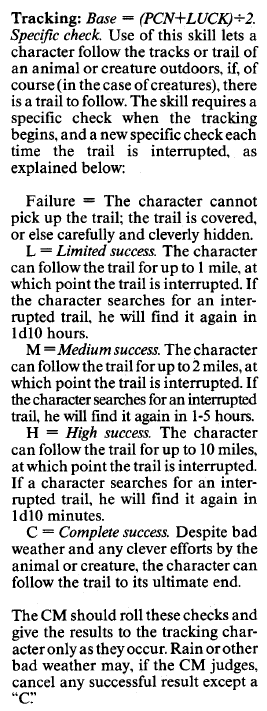
The horror roleplaying game Chill was perhaps the first game I played in which degrees of success were actually spelled out in the rules, rather than being left to the referee's judgement. How well the character rolls determines not only if the character succeeds or not, but how well, as seen in the example of the Tracking skill at right.

Flashing Blades combat rules include something like this. To hit, the player must roll 1D20 under a target number based on their character's attributes and expertise; if the player rolls less than half the target number, then the wound is serious and causes an additional 1D6 damage. A roll of 1 always hits, and bypasses any protection from armor the target of the attack may have. A roll of 20, on the other hand, is a fumble, and may result in anything from loss of actions to injury.

The rules for non-martial skills in FB state, "A roll equal to or less than the attribute indicates that the skill was used successfully," but I can't think of a single referee with whom I've played who didn't carry over the degrees of success from combat to skill rolls as well. In my own campaign, rolling between the target number and half the target number is simple success, rolling less than half the target number is a more significant success, and rolling a one means achieving Master-level success; conversely, rolling between the target number and half the range to twenty is a simple failure, rolling between half the range to twenty and twenty incurs some consequence for failing, and twenty is complete failure, likely with a dangerous consequence as well.

To use OG's example of attempting to jump onto a horse and knock off the rider, an Acrobatics roll is required to leap up behind the saddle. Let's say the character needs a fifteen or less to succeed: on a roll of 9-15, our swashbuckler manages to mount the horse behind the rider, and in the next round a successful grappling roll is required to knock the other rider off; on a roll of 2-8, I'd allow the grappling roll in the same round, and on a 1, the rider must make an immediate Dexterity check or tumble off on his own. On a roll of 16-18, however, our erstwhile swashbuckler is unable to gain a purchase on the rider or saddle and simply slides off the horse on the opposite side - make failure interesting, or at least a bit comical, remember? - on a roll of 19, he slides over the horse and catches his lace cuff on the saddle, trapping his arm until a succesful Dexterity roll works it loose, and on a twenty, the swashbuckler does indeed end up under the horse's hooves for an immediate trampling attack, if the rider should wish it - hey, it ain't all pratfalls. All of these results are likely to incur a Horsemanship check at some point as well.

There are circumstances in which outright failure is indeed an option, but playing about with the margins can be much more fun, both for the referee and the players. One of the most important aspects of refereeing, in my experience, is training my mind to improvise exactly these sorts of results quickly. I've found there's no substitute for being well-versed in genre tropes when it comes to making these calls in actual play, and that's the main reason I devote so many blog posts to books and movies and art; Cinematic and Wednesday Wyeth and The Pen and the Sword aren't filler - they're my conditioning program for the heavy-lifting of refereeing.
Read More
Posted in art, Chill, Cinematic, Flashing Blades, literature, Mike Mornard, playstyle, refereeing, The Pen and the Sword | No comments

Sunday, 27 January 2013

The Pen and the Sword: The Shadow of the Vulture

Posted on 00:09 by Unknown
"Damnation!" he muttered. "The accursed ones have ridden ahead of their fire. They've stolen on the village in the dark - come on, girl!"

But even as he caught her white wrist to drag her away, and she screamed and fought against him like a wild thing, mad with fear, the mud wall crashed at the point nearest them. It crumpled under the impact of a score of horses, and into the doomed village reined the riders, distinct in the growing light. Huts were flaring up on all hands, screams rising to the dripping clouds as the invaders dragged shrieking women and drunken men from their hovels and cut their throats. Gottfried saw the lean figures of the horsemen, the firelight gleaming on their burnished steel; he saw the vulture wings on the shoulders of the foremost. Even as he recognized Mikhal Oglu, he saw the chief stiffen and point.

"At him, dogs!" yelled the Akinji, his voice no longer soft, but strident as the rasp of a drawn saber. "It is Gombuk! Five hundred aspers to the man who brings me his head!"

With a curse von Kalmbach bounded for the shadows of the nearest hut, dragging the screaming girl with him. Even as he leaped he heard the twang of bowstrings, and the girl sobbed and went limp in his grasp. She sank down at his feet, and in the lurid glare he saw the feathered end of an arrow quivering under her heart. With a low rumble he turned toward his assailants as a fierce bear turns at bay. An instant he stood, head out-thrust truculently, sword gripped in both hands; then, as a bear gives back from the onset of the hunters, he turned and fled about the hut, arrows whistling about him and glancing from the rings of his mail. There were no shots; the ride through that dripping forest had dampened the powder-flasks of the raiders.

Von Kalmbach quartered about the back of the hut, mindful of the fierce yells behind him, and gained the shed behind the hut he had occupied, wherein he stabled his gray stallion. Even as he reached the door, someone snarled like a panther in the semi-dark and cut viciously at him. He parried the stroke with the lifted sword and struck back with all the power of his broad shoulders. The great blade glanced stunningly from the Akinji's polished helmet and rent through the mail links of his hauberk, tearing arm from shoulder. The Muhammadan sank down with a groan, and the German sprang over his prostrate form. The gray stallion, wild with fear and excitement, neighed shrilly and reared as his master sprang on his back. No time for saddle or bridle. Gottfried dug his heels into the quivering flanks and the great steed shot through the door like a thunderbolt, knocking men right and left like tenpins. Across the firelit open space between the burning huts he raced, clearing crumpled corpses in his stride, splashing his rider from heel to head as he thrashed through the puddles.

- "The Shadow of the Vulture," Robert E. Howard
Read More
Posted in literature, Robert E Howard, The Pen and the Sword, The Shadow of the Vulture | No comments

Sunday, 20 January 2013

The Pen and the Sword: The Three Musketeers

Posted on 00:01 by Unknown
"Come, gentlemen, have you decided?" cried Jussac for the third time.

"It is done, gentlemen," said Athos.

"And what is your choice?" asked Jussac.

"We are about to have the honor of charging you," replied Aramis, lifting his hat with one hand and drawing his sword with the other.

"Ah! You resist, do you?" cried Jussac.

"S'blood; does that astonish you?"

And the nine combatants rushed upon each other with a fury which however did not exclude a certain degree of method.

Athos fixed upon a certain Cahusac, a favorite of the cardinal's. Porthos had Bicarat, and Aramis found himself opposed to two adversaries. As to d'Artagnan, he sprang toward Jussac himself.

The heart of the young Gascon beat as if it would burst through his side--not from fear, God he thanked, he had not the shade of it, but with emulation; he fought like a furious tiger, turning ten times round his adversary, and changing his ground and his guard twenty times. Jussac was, as was then said, a fine blade, and had had much practice; nevertheless it required all his skill to defend himself against an adversary who, active and energetic, departed every instant from received rules, attacking him on all sides at once, and yet parrying like a man who had the greatest respect for his own epidermis.

This contest at length exhausted Jussac's patience. Furious at being held in check by one whom he had considered a boy, he became warm and began to make mistakes. D'Artagnan, who though wanting in practice had a sound theory, redoubled his agility. Jussac, anxious to put an end to this, springing forward, aimed a terrible thrust at his adversary, but the latter parried it; and while Jussac was recovering himself, glided like a serpent beneath his blade, and passed his sword through his body. Jussac fell like a dead mass.

- The Three Musketeers, Alexandre Dumas
Read More
Posted in Alexandre Dumas, literature, The Pen and the Sword, The Three Musketeers | No comments

Sunday, 13 January 2013

The Pen and the Sword: Swords of the Red Brotherhood

Posted on 08:04 by Unknown
"You murdering dog!" roared Harston. "Will you slay my men behind my back while they fight for your filthy hide as well as for mine?"

On all sides men ceased eating and drinking to gape in amazement.

"What do you mean?" sputtered Villiers.

"You've set your men to murdering mine at their posts!" bellowed Harston.

"You lie!" Smoldering hate burst into sudden flame.

With a howl Harston heaved up his cutlass and cut at the Frenchman's head. Villiers caught the blow on his armored left arm and sparks flew as he staggered back, ripping out his own sword.

In an instant the captains were fighting like madmen, their blades flaming and flashing in the firelight. Their crews reacted instantly and blindly. A deep roar went up as Englishmen and Frenchmen drew their swords and fell upon one another. The pirates left on the walls abandoned their posts and leaped down into the stockade, blades in hand. In an instant the compound was swarming with battling groups of men. The soldiers at the gate turned and stared down in amazement, forgetful of the enemy lurking outside. It had all happened so quickly - smoldering passions exploding into sudden battle - that men were fighting all over the compound before Vulmea could reach the maddened captains. Ignoring the swords that flashed about his ears, he tore them apart with such violence that they staggered backward and Villiers tripped and fell headlong.

"You cursed fools, will you throw away all our lives?"

Harston was frothing, and Villiers was bawling for assistance. A buccaneer ran at Vulmea and cut at him from behind. The Irishman half turned and caught his arm, checking the stroke in midair.

"Look, you fools!" he roared, pointing with his sword.

Something in his tone caught the attention of the battle-crazed mob. Men froze in their places, with lifted swords, and twisted their heads to stare. Vulmea was pointing at a soldier on the wall. The man was reeling, clawing the air, choking as he tried to shout. Suddenly he pitched to the ground and all saw the shaft standing up between his shoulders.

A yell of alarm rose from the compound. On the heels of the shout came a clamor of blood-freezing screams, the shattering impact of axes on the gate. Flaming arrows arched over the wall and stuck in logs, and thin wisps of blue smoke curled upward. Then from behind the huts along the south wall dark figures came gliding.

"The Indians are in!" roared Vulmea.

- "Swords of the Red Brotherhood," from the collection Black Vulmea's Vengeance, Robert E. Howard
Read More
Posted in Black Vulmea, literature, Robert E Howard, Swords of the Red Brotherhood, The Pen and the Sword | No comments
Older Posts Home
Subscribe to: Posts (Atom)

Popular Posts

  • The Pen and the Sword: Captain Alatriste
    It was clear that the Italian was doing very well. He could have killed the wounded man any number of times, but he was satisfied to harass ...
  • Letters to Isabel, Redux
    Marcello recounts a game played by the adventurers in his latest missive to his dear Isabel . I love this, integrating another game played ...
  • Madame la Présidente
    In Ancien Régime France, the title of présidente belonged to the presiding magistrates of the Parlements , the high court of Paris as well...
  • Off the Shelf: Chapbooks
    Chapbooks are popular books printed on cheap paper, often a single sheet folded into a booklet of eight to twenty-four pages, and illustrate...
  • Letters to Isabel, Redux
    The title of the post says it all: courtly intrigue . I'm often left at more than a little bit of a loss when referees complain that al...
  • Graphic Novels Challenge: Belladone
    An assassin takes a shot at Louis XIV, but the ball is deflected by the iron fan of a nearby nun, who with a winsome smile leaps over the s...
  • Special Maneuvers, Redux: A Reply to Jeff Rients
    "You are using Bonetti's defense against me, eh?" "I thought it fitting considering the rocky terrain." "Natura...
  • The Pernicious Influence of The Princess Bride
    Mandy Patinkin called it " The Wizard of Oz of our generation." Conceived as a fairy tale by William Goldman, TPB is a love stor...
  • The Pen and the Sword: The Cavalier in the Yellow Doublet
    He decided to finish the business, although not so hastily that it might work against him. Besides, there was no point in complicating his l...
  • The Cat Out of the Bag
    Jedediah at Book Scorpion's Lair has another actual play log from his 7th Sea campaign, in which the intrepid adventurers learn someth...

Categories

  • -C
  • 1602
  • 1612 (movie)
  • 1650 (game)
  • 7RPGS
  • 7th Sea
  • A Field in England
  • A to Z 2012
  • actual play
  • adventure path
  • Adventure Time
  • Against All Flags
  • Age of Ravens
  • Alain Delon
  • Alatriste
  • Alexander Macris
  • Alexandre Dumas
  • Alice B Woodward
  • All for One Régime Diabolique
  • alt history
  • Amanda Heitler
  • ancien régime
  • Andy Murray. meta
  • animal
  • animation
  • Anthony Hope
  • Arabian Nights
  • art
  • Arturo Pérez-Reverte
  • At Sword's Point (movie)
  • award
  • background
  • Backswords and Bucklers
  • bandwagon jumping
  • baragei
  • Barbaric Frontier
  • Barbie
  • Bardelys the Magnificent
  • Barry Lyndon
  • baseball
  • Batman
  • Bayuca
  • BBC America
  • Beedo
  • Belladone
  • BH 1 Mad Mesa
  • Big Purple
  • Black Vulmea
  • Black Vulmea's Vengeance
  • Blog of Holding
  • blogfest
  • Blogger
  • Blunders on the Danube
  • board game
  • Bob Anderson
  • Bold Pueblo Games
  • Bombshell Miniatures
  • Book Scorpion's Lair
  • books
  • Boot Hill
  • Bren at RPG Net
  • British Isles Traveller Support
  • BryanMD
  • Bushido
  • Caoimhe Ora Snow
  • cape-and-sword
  • Capitan
  • Capitán Alatriste (game)
  • Captain Alatriste
  • Captain Blood (movie)
  • Captain Blood (novel)
  • Captain from Castile
  • Captain Hook
  • Captain Horatio Hornblower
  • Captain Morgan
  • Cara King
  • card game
  • cartography
  • cartoon
  • Cassini map
  • catacombs
  • Catan Junior
  • Cesare Borgia
  • character
  • charity
  • Charles Perrault
  • chase
  • chateau
  • Chill
  • Christopher Columbus
  • Chronicles of Shadow Valley
  • Cinematic
  • comics
  • commercial
  • Condottieri Conflicts
  • conquistadors
  • ConTtessa
  • corsairs
  • cosplay
  • Crimson Cutlass
  • Crossbones
  • CS Forester
  • Cutthroat Island
  • cycling
  • Cyrano de Bergerac
  • d'Artagnan
  • d20
  • d20 Modern
  • d20 Past
  • d20 Pirates
  • Daffy Duck
  • Dangerous Beauty
  • Dangerous Liasons
  • Danny Kaye
  • Dark Dimension
  • David Balfour
  • DC Comics
  • De cape et d'épée
  • DeviantArt
  • Die Another Day
  • disability
  • Disneyland
  • diversity
  • Douglas Fairbanks Sr
  • Dr Rotwang
  • Drama Dice and Damsons
  • Dreams of the Lich House
  • DriveThruRPG
  • duel
  • Duelist (prestige class)
  • Dungeons and Dragons
  • Dynamite Entertainment
  • Dynasties and Demagogues
  • ECW
  • El Cazador
  • Ellen Kushner
  • Emmy Rossum
  • en français
  • En Garde (game)
  • EN World
  • endgame
  • Eric Treasure
  • errata
  • Errol Flynn
  • Ethan Skemp
  • Exchange of Realities
  • Fabled Lands
  • fantasy
  • festival
  • Fist Full of Seamen
  • Flashing Blades
  • Flashman
  • FLGS
  • Flying Swordsmen
  • Frank C Papé
  • Frank Frazetta
  • Frank Schoonover
  • Frankenstein
  • Fred Funcken
  • FXR
  • Game Empire
  • game fiction
  • game style quiz
  • games
  • Gary Gygax
  • George Waymouth
  • Gloire
  • Gonsalvo
  • gospel
  • Graham Bottley
  • Graphic Novels Challenge
  • grognard
  • gun control
  • GURPS
  • Hack and Slash
  • Hamlet (1996 movie)
  • Han shot first
  • Harold Lamb
  • heads up
  • Hearts
  • Heidi Brühl
  • Helen Hunt Jackson
  • Hendybadger
  • hero points
  • HeroPress
  • Hidden in Shadows
  • High Seas
  • historical roleplaying
  • history
  • hobby
  • holiday
  • Honor + Intrigue
  • Horatio Hornblower
  • Horrible Histories
  • horror
  • house rules
  • Howard Pyle
  • Howling Tower
  • humor
  • I Waste the Buddha With My Crossbow
  • ice hockey
  • Iceland
  • immersion
  • improv
  • Inca
  • Infernal Sorceress
  • International Catacomb Society
  • interview
  • IntWisCha
  • Ivanhoe
  • Jack Sparrow
  • James Bone 007 Roleplaying Game
  • James Fenimore Cooper
  • James Mason
  • Jean Laffite
  • Jedediah
  • Jeff Black
  • Jeff Rients
  • Jeffrey Catherine Jones
  • jeu de palme
  • JF
  • John Gilbert
  • John Paul Jones
  • John Sayles
  • Jules Verne
  • Khlit the Cossack
  • Kickstarter
  • Kingdom of Saguenay
  • komradebob
  • La Fille de d'Artagnan
  • lazy git
  • Le Ballet de l'Acier
  • Le Bossu
  • Legends of the High Seas
  • LEGO
  • linear adventure
  • literature
  • location
  • Lone Star
  • Long John Silver (novel)
  • Lord Dunsany
  • Lord Gwydion
  • Lord Nelson
  • Los Nikis
  • Lowell Francis
  • M.P.
  • magic
  • magic items
  • map
  • maritime
  • Mark Twain
  • martial arts
  • Marvel Comics
  • Masks
  • Maureen O'Hara
  • Mayan non-Apocalypse
  • Mead Schaeffer
  • Mediterranean
  • Melan
  • meta
  • Michael Crichton
  • Mike Mornard
  • milestone
  • miniatures
  • Mitch Williamson
  • Mithril Wisdom
  • Molière
  • Moonfleet
  • movie
  • music
  • musketeer
  • Mysterious Island
  • Mythic Game Master Emulator
  • Mythic Role Playing
  • names
  • Nasruddin
  • Natalie Dormer
  • Nate Christen
  • navel gazing
  • nc wyeth
  • NC Wyeth's Pilgrims
  • New France
  • Nick
  • npcs
  • NPS
  • Obsidian Portal
  • Odie
  • OEF
  • off the shelf
  • off-hand weapon
  • old man is old
  • Old Stuff Day
  • Order of the d30
  • Oriental
  • Osprey Publishing
  • OSR
  • Ottavia Piccolo
  • Paris
  • Pathfinder
  • Paul
  • PDQ#
  • perdustin
  • personal
  • Peter and Wendy
  • phoning it in
  • Pierre Alary
  • pike-and-shot
  • pilgrims
  • pirate
  • Pirate Latitudes
  • Pirates of the Caribbean Curse of the Black Peal
  • Pirates of the Caribbean On Stranger Tides
  • Pirates of Tripoli
  • playstyle
  • poetry
  • points of light
  • politics
  • pulps
  • Puss in Boots
  • QUAGS
  • Quickly Quietly Carefully
  • Rafael Sabatini
  • Raiders of the Seven Seas
  • Ramona
  • random
  • random. Mediterranean
  • rant
  • Raphael Sabatini
  • Ravyn
  • Ray Harryhausen
  • real life can be a pain in the ass
  • reenactors
  • refereeing
  • Regency
  • REH
  • reply
  • resolutions
  • Restoration
  • review
  • rewards
  • Richard the Lionheart
  • Rip Van Winkle
  • Rob Roy
  • Robert E Howard
  • Robert Louis Stevenson
  • Robert Newton
  • Robert Taylor
  • Robin Hood
  • Robin Laws
  • Robinson Crusoe
  • Robots and Rapiers
  • Rochefort
  • roleplaying
  • roleplaying games
  • Rome
  • Romeo and Juliet
  • Rory's Story Cubes
  • Royal Flash
  • RPG Blog Carnival
  • rpg history
  • RPG Stuff (blog)
  • RPGBA
  • rules
  • Ruritania
  • Saint Patrick's Day
  • sale
  • samurai
  • Samurai Heaven and Earth
  • sandbox
  • Sandy Hook shooting
  • Santa Claus
  • Sanxesta
  • SAR
  • Savage Worlds
  • save or die
  • Save Vs. Dragon
  • Scallywags
  • Scaramouche
  • Sean B
  • Semper Initiativus Unum
  • setting
  • sexism
  • shields
  • ship
  • siegecraft
  • Sinbad
  • SirJarva
  • social contract
  • social sandbox
  • social standing
  • solo
  • Solo Nexus
  • Solomon Kane
  • Sophie Marceau
  • Source of the Nile
  • Spacejacking
  • Spanish Fury
  • stage fighting
  • Stanley J Weyman
  • Star Wars
  • Steve Winter
  • Stewart Granger
  • story games
  • Super-Team Family
  • Swashbuckler (Jolly Roger game)
  • Swashbuckler (Yaquinto game)
  • swashbuckling
  • swashbuckling and sorcery
  • sword
  • Swords of the Red Brotherhood
  • Swordspoint
  • Swordswomen of the Silver Screen
  • Talk Like a Pirate Day
  • Taras Bulba
  • Tartuffe
  • Tavern Cards
  • TCM
  • Te Deum pour un massacre
  • Telecanter
  • Telecanter's Receding Rules
  • television
  • Tenkar's Tavern
  • tennis
  • Tercio Creativo
  • The 13th Warrior
  • The 9Qs
  • The Admiral's Ghost
  • The Adventures of Don Juan
  • The Adventures of Robin Hood
  • The Adventures of Sindbad
  • the Batman
  • The Black Arrow
  • The Black Buccaneer
  • The Black Swan
  • The Borgias
  • The Boy's King Arthur
  • The Buccaneer
  • The Business of War
  • The Cavalier in the Yellow Doublet
  • The Court Jester
  • The Courtship of Miles Standish
  • The Crimson Pirate
  • The Crown and the Ring
  • The Deerslayer
  • The Deluge
  • The Dragon's Flagon
  • The Duelists
  • The Dungeon Dozen
  • The Escapist
  • The Golden Voyage of Sinbad
  • The Isle of Pirate's Doom
  • The Justice of the Duke
  • The Lady and the Bandit
  • The Lion in Winter
  • The Mark of Zorro (1920)
  • The Mark of Zorro (1940)
  • The Mask of Zorro
  • The Master of Ballantrae (movie)
  • The Master of Ballantrae (novel)
  • The Mysterious Stranger
  • The Other Side
  • The Pen and the Sword
  • The Perfect Captain
  • The Phantom of the Opera
  • The Princess Bride
  • The Prisoner of Zenda
  • The Queen's Cavaliers
  • The Russian Storybook
  • The Savage AfterWorld
  • The Scarlet Cockerel
  • The Scarlet Pimpernel (1982 movie)
  • The Scarlet Pumpernickel
  • The Scottish Chiefs
  • The Sea Hawk
  • The Sea-Hawk
  • The Shadow of the Vulture
  • The Spanish Main
  • The Swordsman of Siena
  • The Thief of Bagdad
  • The Three Musketeers
  • The Three Musketeers (novel)
  • The Three Musketeers (Paul WS Andersen)
  • The Three Musketeers (RIchard Lester)
  • The Three Musketeers (Rowland Lee)
  • The Tudors
  • The Usual Suspects
  • The White Company
  • The World of Music
  • theatre
  • theRPGsite
  • Thoul's Paradise
  • Tim Brannan
  • Tim Snider
  • Tiny Solitary Soldiers
  • Top Secret
  • Toshiro Mifune
  • Tour de France
  • Traveller
  • Treasure Island
  • Treasure Island (1934)
  • Troll in the Corner
  • Trollsmyth
  • ttfn
  • TV Tropes
  • Twenty Years After
  • Twitter
  • Tyrone Power
  • Under the Red Robe
  • Universal Studios
  • Vaesen
  • Valley of the Giants
  • vanity
  • Vatel
  • veil of ignorance
  • Very Civile Actions
  • video
  • video game
  • Vikings
  • W Heath Robinson
  • Walter Paget
  • War and Game (blog)
  • wargames
  • Warren W Baumgartner
  • Warrior Pursuits
  • Wars of Louis Quatorze (blog)
  • Wayne R
  • Westward Ho
  • what shite
  • wiki
  • William Hobbs
  • Wimbledon
  • Wine and Savages
  • World of Music
  • world-building
  • Zak S
  • Zorro
  • Zorro (1974)

Blog Archive

  • ▼  2013 (157)
    • ▼  September (15)
      • Talk Like a Pirate Day!
      • Wednesday Wyeth
      • "The pass to Bourbon . . . Slapshot! . . . GOAL!"
      • Lazy Monday Link Dump
      • The Pen and the Sword: The Cavalier in the Yellow ...
      • Here Be Monsters
      • Dividends
      • Wednesday Wyeth
      • Meditation on a Visit to a Game Store
      • Random Encounters Coda: Order from Chaos
      • The Pen and the Sword: The Cavalier in the Yellow ...
      • Seriously
      • Retcon
      • Wednesday Wyeth
      • Another Solo Gaming Resource
    • ►  August (13)
    • ►  July (11)
    • ►  June (24)
    • ►  May (21)
    • ►  April (4)
    • ►  March (18)
    • ►  February (22)
    • ►  January (29)
  • ►  2012 (343)
    • ►  December (32)
    • ►  November (34)
    • ►  October (27)
    • ►  September (21)
    • ►  August (33)
    • ►  July (29)
    • ►  June (28)
    • ►  May (31)
    • ►  April (34)
    • ►  March (39)
    • ►  February (29)
    • ►  January (6)
Powered by Blogger.

About Me

Unknown
View my complete profile