ReallyBadTalk

  • Subscribe to our RSS feed.
  • Twitter
  • StumbleUpon
  • Reddit
  • Facebook
  • Digg
Showing posts with label Le Ballet de l'Acier. Show all posts

Wednesday, 4 September 2013

Retcon

Posted on 23:36 by Unknown
I received my copy of Osprey Publishing's French Musketeer 1622-1775 before I went on vacation. I don't want to get into a review of the book; I suck as a reviewer and I don't enjoy writing them. I've enjoyed many of René Chartrand other books for Osprey, but I don't feel this was his best effort. It's not an easy subject, with so much myth entwined with a paucity of historical records, particularly of the early years of the King's Musketeers. Still, I noticed a number of contradictions of information gleaned from other, seemingly reliable sources as well as a couple of confirmed errors. Overall, for me the book lacks the depth and breadth of other titles in the Warrior series, such as Matchlock Musketeer and Ironsides.

That said, it contains much that is worthwhile for anyone interested in the period and for gamers who want to present a more historically rich depiction of the King's Musketeers in their swashbuckling campaign. Frex, I worked in the duty of a King's Musketeer to be the first soldier to receive the king's orders in the morning and the last to receive them at night for our newly-promoted ensign when we played last weekend.

Unfortunately for me, my depiction of the Musketeers so far also took a couple of hits.

I started working in earnest on Le Ballet de l'Acier, my Flashing Blades campaign, about four-and-a-half years ago. I've consulted more books and websites than I can remember. My personal library of books on 17th century Europe is somewhere around a hundred volumes at this point, and that doesn't include another score read while hunkered down in library stacks at local universities. The number of websites I've visited in that time, in English and in French, easily doubles that number. Even with this vast collection of history at my fingertips, the reality is that none one of these sources truly contains all of the information for which I searched. My knowledge of the period was assembled piecemeal, from many different narratives, some popular history, some academic history, some fictional.

In some cases, I deliberately put aside history. Frex, Louis XIII didn't name himself captain of the King's Musketeers until 1627, as Mon Chartrand notes in his book, but I elected to make him captain, and the commanding officer captain-lieutenant, from the units founding in 1622 instead. In other instances, I allowed the fictional history of cape-and-sword authors, most notably Alexandre Dumas, to override the historical narrative; thus, fictional versions of d'Artagnan, Tréville, et al. replace their historical counterparts as they did in The Three Musketeers. This is one of the reasons I warn visitors to my campaign wiki at Obsidian Portal that the site is alt-history.

Of the places where my campaign and that tiny sliver of the historical record with which I'm personally familiar diverge, up to this point nothing that's taken place in the campaign itself required a specific retcon; either the action conformed to the known history or to my campaign specific alt-history. That is, until I read about the Garde du dedans du Louvre.

The maison militaire - the military units of the royal household - were divided into the Garde du dedans du Louvre, who stood guard over the king's person inside royal palaces and residences, and the Garde du dehors du Louvre, who stood watch outside of those same residences. The Garde du dedans du Louvre consisted of the Gardes du Corps, the Cent-Suisses, the Gardes de la Porte, and some constabulary foot soldiers armed with polearms. The King's Musketeers were assigned to the Garde du dehors du Louvre.

This directly contradicted information I presented to the players a couple of years back, when the campaign first got rolling; the King's Musketeers were assigned to the interior of the Louvre, while other units were posted to the exterior. It actually played a role in the actions, as the characters sought to smuggle the duchesse de Chevreuse and a wounded Lord Holland into the royal palace.

So, I can completely ignore a trivial historical fact, or I can attempt some sort of retcon to bring the events of the campaign in line with newly-learned period details. The fact that this distinction between guards serving on the inside versus the outside of a royal palace already came up in actual play should tell you that this is the kind of detail I appreciate as a referee, for situations and challenges it creates for the players and their characters. I'm loathe to toss out such a historical tidbit. This means I can choose to assign my earlier explanation to the campaign's alt-history - of course the King's Musketeers serve in the Garde du dedans du Louvre! - or I can decide it was a special situation, perhaps, or that the Musketeers were assigned to the Garde du dehors du Louvre after the events of the campaign took place, say in the year that the adventurers were abroad following their exile from Paris.

I haven't decided which way I want to go as yet; the adventurers just returned to court, and while I'm sure this is likely to come up again in actual play, it's one of those things I can kick down the road a bit, as I have options on how I can handle it should it crop up as I anticipate.

Over the years, I've heard gamers express the opinion that they wouldn't be willing to run historical roleplaying games for fear of getting something 'wrong.' The fact is, I get things 'wrong' all the time, sometimes in broad strokes, sometimes in niggling little bits like whether the King's Musketeers stood guard inside or outside the Louvre. While I firmly believe there's no substitute for putting in the research when preparing and running a historical roleplaying game campaign, being too afraid to risk making a mistake should never be an excuse to avoid running historical campaigns, nor is it likely to be a showstopper unless you let it become one.
Read More
Posted in alt history, history, Le Ballet de l'Acier, Osprey Publishing | No comments

Saturday, 8 June 2013

Tractability

Posted on 00:49 by Unknown
On Wednesday I wrote about one of the pitfalls associated with using a player character's ability or skill score as the target number for social interactions, specifically that, if not treated with some forethought, the score comes to define the world. Seduce a marquise? Roll under Charm. Bluff a provost-martial? Roll under Charm. Persuade the king to go to war with Spain? Yeah, you get the idea.

In fact, this is one of the reasons some gamers say they don't like social skills - 'They don't make sense!' - and prefer to simply override them at will when the results don't 'fit.' They have a point with respect to the problem, but their solution - to set aside the rules when they feel like it - is, to me, throwing the baby out with the bathwater. A better fix, for me, is to use smarter rules.

In Flashing Blades, the base value of a skill is the associated attribute score, which is then modified by possessing the skill, usually increasing the target number by + 1 to + 3, usually assigned at the gamemaster's discretion; frex, a character with a 12 Charm and the Etiquette skill might get a + 2 bonus, giving the player a target number of 14 to roll under on a d20 to impress a countess. Assigning ad hoc modifiers helps to alleviate some of the problems inherent in simply rolling under the attribute number, but I wanted something more holistic.

The first modifier I decided to use was the difference in Social Ranks between characters. This was something I started with Traveller, with the difference in Social Standings as a modifier to the reaction table roll, to better reflect social stratification in the Imperium. For FB, this was even more appropriate; characters with higher Social Ranks already expect to receive deference from their social inferiors, and this would be reflected in the modifiers assigned to social skill use as well.

I also wanted something more personal as well, to reflect a non-player character's individual nature, and for this I adapted a feature from another FB gamemaster's house rules for handling mistresses and courtship. In these house rules, which I discovered somewhere on the intrewebs and can no longer locate, each potential mistress was assigned a value of one to six; this number would be used in determining how loyal the potential mistress was to her lover or husband, should a player character attempt to seduce her away. I decided to expand this into a non-player character stat which reflected how amenable to suggestion that character might be. I called the new stat Tractability.

As with the loyalty rating on which it was based, Tractability is usually expressed by a number between one and six, making it a simple roll of a die to determine for randomly developed non-player characters; I did, however, leave myself the option for numbers greater than seven, for special cases. As with the BITS task system for Traveller, I wanted each score to have a verbal shorthand attached as well.

Rating Description
1 Mercurial
2 Impulsive
3 Flexible
4 Reserved
5 Unwavering
6 Intractable
7 + Inhuman


I made three - Flexible - the default value for most non-player characters. The Tractability score is used a couple of ways; as noted, it can be a modifier to the attribute-plus-skill target number for social skill rolls; it can also be used as a divisor, in keeping with a number of skill checks used in FB's published adventures, for a greater degree of difficulty; frex, Tractability 4 can be used as a - 4 penalty to a roll, or to divide the target number by four. The specific circumstances of using Tractability is the subject of the next post on social skills in Flashing Blades.
Read More
Posted in Flashing Blades, house rules, Le Ballet de l'Acier | No comments

Tuesday, 30 April 2013

Linear Adventures

Posted on 23:50 by Unknown
In the winter of 1625, Riordan O'Neill, a King's Musketeer, and Guillaume Sébastien, a physician, were, at the behest of the duke of Savoy, dispatched to Milan to seek the ransom of the Sabaudian vicomte de Praz-de-Lys, a captive of Don Alvaro de Salamanca, the Spanish governor of the Forte de Fuentes. Along the way, a French diplomat informed them of an important fact - should Don Alvaro, who to this point steadfastly refused to ransom his captive, die, the vicomte's parole would pass to the governor of Milan.

Mission-oriented advetures are a staple of roleplaying games; because they made for convenient tournament contests, many of the earliest roleplaying game adventure modules were of this sort, and as a result of their initial prevalence, the model became deeply ingrained in the expectations of many gamers. Rescue-the-hostage and retrieve-the-mcguffin were - and are - a staple of gaming action, so much so that when a poster at Big Purple referred to this as "trad," I had to agree, my own sandboxy proclivities notwithstanding.

Adventures of this sort have a somewhat ambiguous reputation among gamers; over time, the influence of would-be writers - [khan] NILES! [/khan] - on adventure design produced modules which increasingly prescribed the scope of player choices for risk of the adventure failing to deliver the anticipated conclusion. Plot-heavy adventures in which the player characters were ushered from scene-to-scene resulted in a backlash against modules, and the referees who ran them, as 'railroads.' Over time, the pendulum swung so hard the other way that a number of gamers took to describe any adventure with 'a plot' as a railroad.

I believe it was 3e D&D that referred to the 'trad' adventure model as 'linear adventures.' Linear adventures are the now-classic scene-scene-scene-climax, or event-event-event-destination, or encounter-encounter-encounter-boss fight, format found in most game books and modules. Despite the linear set-up, they may be experienced in a non-linear fashion, as when the adventurers succeed in bypassing one of the scenes through smart play or dumb luck, such as avoiding a bandit ambush.

Railroading, on the other hand, doesn't allow the adventurers to bypass the encounters the referee or adventure sets in front of them; attempting to do so results in the players being forced into facing the encounter, as when players' characters attempt to take the west road instead of the east road with the bandit ambush the referee has planned, and a massive lightning storm springs up that keeps the adventurers from going west.

Illusionism is railroading's kissin' cousin. In this instance, the players are free to go whatever direction they like, but no matter what they do, the referee springs his encounter on them anyway, as when the bandits attack the adventurers regardless of whether or not they take the east or west (or north or south) roads.

Unfortunately, some suggest that 'railroad' is somehow the opposite of 'sandbox,' ignoring or failing to understand that a referee can just as readily railroad the players and their characters in a sandbox as in more traditional adventures. Railroading and illusionism, are, to me, profoundly dysfunctional ways to play roleplaying games, and conflating all plot-driven adventures as railroads is a serious error.

Moreover, I don't think scene-scene-scene-climax is actually a good approach to defining linear adventure so much as it's the most common way it's presented in roleplaying games. A linear adventure is more about operational progress from a discrete starting point to achieve an explicit goal or end which is frequently external to the player characters, that is, the goal is imposed upon them by someone else. It is often structured as scene-scene-scene-climax in order to ape a story's rising and falling action, conflicts and crises, and conclusion; the problem is that much of the advice to referees for running linear adventures expects or encourages railroading or illusionism in order to maintain that structure. This is poor adventure design, of course, but it doesn't inherently need to be that way.

Rather than structuring a linear adventure as scene-scene-scene-climax, I may prepare a slew of options for how the npcs react depending on what the adventurers do, like in "The Lady of La Rochelle" for Flashing Blades, or set the actions of the npcs against a timeline in which the antagonists are acting and the adventurers are free to respond, like in Operation: Ace of Clubs for Top Secret, or as a series of events to which the adventurers may or may not respond, like in Burned Bush Wells for Boot Hill. Burned Bush Wells is an adventure which takes place in the eponymous town during a hard winter. There is a conflict between two factions, a powerful businessman and his crony marshal and the other business owners of the town. Sequential events in the adventure detail the steps taken by each faction to overcome the other, concluding with one faction or the other winning, depending on the involvement and actions - if any - of the adventurers.

BBW can be viewed as scene-scene-scene-conclusion, but it can also be viewed as a timeline which exists independently of the adventurers; the adventure makes only very general assumptions about how the adventurers will respond, if indeed they respond at all, to the sequence of events. It's entirely possible for the adventurers to bypass all of the events, side with either faction, or progress from starting event to ending event in order.

The events of the adventure unfold linearly - a thief, helping the doc, a shotgun wedding, and so on - moving toward a conclusion. The events are even dropped at the player characters' feet. But what BBW doesn't do is presume the adventurers's responses to the events, and it loads up the referee with enough information to wing it if the adventurers try something completely different, and it even gives advice to the referee on how the events change based on adventurer action and inaction during previous events.

When you get away from trying to structure the actions of the player characters as part of a story, then linear adventures can be constructed in such a way that they still lead from A to E but provide for meaningful player choices instead of ham-fisted transitions between scenes or encounters.

Linear adventures make sense in a sandbox when the player characters submit themselves to some authority - they join the army, they are inducted into an order, they buy an office, they are granted a title, &c. Requiring adventurers to fulfill their responsibilities gives meaning to accepting titles, offices, ranks, and so forth, and linear adventures arising out of those responsiblities may be one logical way for those duties to present themselves to, and impose themselves upon, the player characters. Unfortunately, linear adventures - specifically badly conceived and presented linear adventures - have poisoned the well to some degree, leading some gamers to dismiss them out of hand and even to claim that any attempt to control the actions of the adventurers - especially in a sandbox game-world - is railroading. This does not need to be so, but referees should also take care not make the fear become a reality when introducing linear adventures into their sandboxes.
Read More
Posted in adventure path, Le Ballet de l'Acier, linear adventure, refereeing, sandbox | No comments

Monday, 14 January 2013

Gaming is Good

Posted on 09:23 by Unknown
Pop quiz, hotshot. What do Santa Claus, Vito Corleone, and Emperor Palpatine have in common?

I channeled all of them while roleplaying Cardinal Richelieu on Saturday night.

This was the first chance I had to first-person roleplay His Eminence in our campaign, and wow, what a rush! First came Santa Claus. Riordan O'Neill, King's Musketeer, spotted a tail following him shortly after his return to Paris, and the next day he and his travelling companion, formerly Huguenot but recently converted doctor Guillaume Sébastien were rounded up by a contingent of the Cardinal's Guards and escorted to the Louvre for an interview with the Cardinal. The prelate sat, stroking a cat in his lap - which got a laugh for its Blofed-ness - as he first offered the doctor a commission as a médecin ordinaire du roi, one of the king's physicians, which the doctor accepted quickly. Next it was the soldier's turn, as His Eminence dangled an ensign's commission in his Guards. Riordan was sorely tempted but in the end he turned it down, even in the face of blackmail over a duel he fought a year ago in a Parisian alley.

After the Musketeer was dismissed, I got to pull out Vito Corleone - 'I may call upon you for a service' - and Emperor Palpatine as I broke down the doctor's resistance to spying at court for the Cardinal. Guillaume is genuinely conflicted over his character's religion and sincere in bridging the divide between his former and present co-religionists - and this produced some truly inspired roleplaying - and the Cardinal used this to insure the doctor's submission.

I also got to see how well one of my house rules worked in actual play as well as put 'rulings, not rules' into action. Player characters in my campaign may earn gloire (glory) dice, which are applied to openings and promotions in the various career paths open to the characters. Riordan earned two gloire dice, one for being decorated on campaign, the other for participating in the cavalry duel with Imperial soldiers at Casale. A roll of 10+ on 2D6 is normally required both an opening and a promotion from sergeant to ensign in the Musketeers in my campaign, so Riordan's player got to roll three dice instead. He cruised on the first roll with a fifteen, but only managed a nine on the second; after thinking about it for a moment, he asked if serving as cornet in Challons' company was worth a bonus, and I agreed that his brevet rank was worth a +1 to the roll, so he got his commission. This was something I'd contemplated as a house rule previously, and now I'm going to make it so, but with a slight twist - more about that another time.

I left my iPad at home, so I ran the game wiki-free for a change. I'm a little startled sometimes at how good my memory for the campaign background is - the only npc name I couldn't remember was Riordan's old landlady, and I improvised a pair of random encounters on the road home.

Finally, this was the first time in over a year the three of us were in the same room together to play. Playing over Skype is good enough, but face-to-face is better.

Now the two are off to Fontainebleau, to join the Musketeers' company and the king's court, respectively.

Gaming is good.
Read More
Posted in actual play, Flashing Blades, house rules, Le Ballet de l'Acier, refereeing | No comments

Thursday, 10 January 2013

Catching Up with Gonsalvo

Posted on 10:53 by Unknown
Gonsalvo at Blunders on the Danube recently concluded continued his series of posts on his Seventies-vintage English Civil War armies.

English Civil War: Royalist Infantry: pt 2
English Civil War Parliamentary Infantry pt 2
Royalist Cavalry pt 2
Royalist Infantry pt 3

As I was doing some prep the other day, I reflected on the fact that it's April 1626 in Le Ballet de l'Acier, our Flashing Blades campaign, and for all intents and purposes, it's the last year of peace for France for decades to come. I think this is the year I need to start building my own TYW miniatures army, for the conflicts ahead.
Read More
Posted in Blunders on the Danube, ECW, Gonsalvo, Le Ballet de l'Acier, miniatures, wargames | No comments

Thursday, 13 December 2012

Random Encounters in Real-time: the Verbal Kint Method

Posted on 12:08 by Unknown
Over the last couple of weeks, I've written at some length over the many ways in which I put together random encounters for my campaign. Most of my random encounters are prepped away from the table: my goal when I prep a location, from sites as small as a tavern to as large as a province, is to include at least a handful of chance encounters so that it's ready to run at any time. But best-laid schemes gang aft agley: actual play means facing a knee-buckling curve thrown by my the players, and that means improvising in real-time.

In a post at EN World, Ethan Skemp coined the phrase "Verbal Kint method of GMing" to describe a method of preparing random encounters.
I'm intrigued by randomness because I'm always keeping an eye out for potential structure that can help me move things along when I don't have an immediately fantastic idea, or an immediately obvious way in which a situation will play out. Sometimes that structure is rolling a die and then making myself hold to some interpretation of what the die roll means. Sometimes it's drawing in structure from an external source: running a St. Patrick's Day-themed game, for instance, wherein I may have to figure out a way to make something leprechaunish relevant while concealing the source from the players. Or basing villains off tracks on a semi-randomly chosen album and never letting the players know.

Call it the Verbal Kint method of GMing, I guess: find some structure in the world around you to act as a skeleton, let the logic of the game world add flesh and blood and skin, and there you go. The extra structure means you're often trying out new things, and adhering to it is good discipline.
(Fair warning: if you haven't seen The Usual Suspects and you want to be surprised by the ending, you're forewarned that the video and the rest of the post contain spoilers.)


Through this series of posts I've been using the structure provided by the rules for encounters and events from a variety of different games - Flashing Blades, Rory's Story Cubes, Backswords & Bucklers, Robots & Rapiers, Mythic Role Playing - as a tool for preparing the chance encounters which populate my game-world. The encounters I generated are not only random in their appearance in actual play, but by the process of their creation as well. The 'external structure' provided by a die roll, or a shuffled track on my iPod, or an adventure scenario generator, helps me to break out of the creative ruts into which my mind might otherwise settle. But, while well suited to advance preparation away from the table, some of these methods are admittedly a bit impractical to use in real-time, with the players waiting expectantly.

So, how would I go about Verbal Kint-ing an encounter at the table?

When called on to improvise in actual play, most of us pull from our knowledge of the game-world and the context of the adventurers' present circumstances. There are any number of external structures from which we could also draw inspiration, from music playing in the background to miniatures on the table to a passing comment from one of the players to the weather outside. But absent a bulletin board covered with wanted posters and dispatches and a porcelain coffee mug, I've found one source to be particularly useful and relevant to the task: the rule book.

If I'm working from my actual printed copy of Flashing Blades, this is particularly easy - the random encounters are located at the back of the book, so I simply flip through the pages, and the first three pages at which I stop are my inspiration. If I'm working from my pdf of the rules, on the other hand, I program three '1d24' into my random roller, take the first result as the first page, add the first two results for the second page, and add all three results for the third page.

Going back once more to the random encounter tables, my roll of 1d20=12 on the Encounter at Palace table is, "A Bishop, with 1d6=2 Curia Members (a possible Patron)" - his Patronage roll is 1d20=8, "The Patron wishes to have a message taken to someone in a dangerous position (a prisoner in the Bastille, perhaps, or a soldier on the front)."

Now I scroll through the rulebook. The page numbers are 1d24=20, 1d24=13, 1d24=4. Page twenty is from the combat rules section and along with several special attacks, it introduces the dueling code and features a striking woodcut of a duelist standing over a vanquished foe on a beach. Page 33 describes upper positions in the royal bureaucracy - magistrates, provincial governors, ambassadors, court ministers, and royal ministers. Page 37 describes the careers of bankers and investors.

Putting it together, the bishop of ____________ knows of the adventurers on the basis of their dueling exploits. He invites them to dinner. Through the meal, the prelate makes inquiries about the adventurers' exploits, as well as bits of court gossip, to test their honor and reserve, and if he's satisfied they are men of discretion, the bishop will explain that he seeks trustworthy messengers to carry a letter to a Flemish banker in Antwerp - Dutch ships and soldiers have recently attacked outworks around the city, and the journey is expected to be perilous. The bishop offers the adventurers a generous reward for their service.

The letter? A bank draft for the purchase of tulip bulbs, drawn on the diocese's accounts - the bishop is speculating in foreign commerce using Church funds.

And with that my series on random encounters, randomly created, concludes. It's not necessary, or even desirable, to do this for every chance encounter the adventurers face - there's nothing wrong with "Orcs (1-4)" or "1D6 Highwaymen" playing out exactly as advertised. But chance encounters need not be 'ran-DUMB,' either. In my campaigns, chance encounters represent the living game-world around the adventurers, and by generating the content randomly, in or out of actual play, I force my imagination to turn the corners on familiar paths in search of undiscovered country.
Read More
Posted in baseball, EN World, Ethan Skemp, Flashing Blades, Le Ballet de l'Acier, random, refereeing, The Usual Suspects, video | No comments

Monday, 10 December 2012

Random Encounters: Robots & Rapiers' Swashbuckling Adventure Scenario Generator

Posted on 12:01 by Unknown
Robots & Rapiers was a roleplaying game based on the premise of AI robots at a resort planet continuing to fulfill their roles long after a galactic war eliminated all their potential human visitors - I say "was," as it appears the game itself no longer in print and playtest files can no longer be downloaded, though the setting .pdf is still there.

One other piece of Robots & Rapiers remains available, as well, the swashbuckling adventure scenario generator. In principle, it is similar to the Tavern Trawling tables for Backswords & Bucklers; in practice, however, the Robots & Rapiers generator is both more detailed and more extensive, at the cost of yielding results which can be somewhat unwieldy to apply.

First I roll for a scenario goal, 1d10=1.
Table I. Scenario Goal
Rescue the [Victim] from the [Foe].
A good example of swashbuckling adventure fare. The results direct me to Section A of the generator, which details the following steps in creating the scenario.
1. Roll on Table II to determine how the characters find out about the adventure
2. Roll on Table III to determine who the Victim is that needs rescued
3. Roll on Table IV to determine who the Foe is who’s imprisoned the Victim
4. Roll on Table A(1) to determine the Foe’s motive.
Table II determines how the scenario is introduced to the adventurers; my rolls are 1d10=8, 1d10=1, so I take the first result on the second table.
Table II: How the Scenario Begins
Characters stumble into the event as its being perpetrated
So the scenario opens in media res. Next I determine who the Victim is, rolling 1d10=1, 1d10=6, 1d10=1.
Table III: Who’s the Victim?
1. Commoner – roll on table III(c)
6. The individual indicated
1 and 1d10=3 An old farmer
Next I roll for the Foe. Each foe belongs to a faction which is determined before the actual foe is diced up. My rolls are 1d10=4, 1d10=10.
Table IV: Who’s the Foe?
4. Foes of the King
10. GMs own invention, or – roll twice, it’s a conspiracy!
Since my goal here is to put the generator through its paces - and I like conspiracies! - I'll roll twice, 1d10=5, 1d10=8.
5. An ambitious noble looking to increase their power
8. A plot by the Queen and her agents against the king’s wishes
So, why do an ambitious noble and the Queen want to capture an old farmer? Next I roll to determine the conspirators' motives, 1d10=7.
Table A(1): Why were they taken prisoner?
7. [T]he Foe is mad with love for them or for a relative of theirs (Roll on Table III (b)) [to determine who the object of affection is]
1d10=9 The individual’s…
1d10=9 Other
Since the table provides for immediate family already, then "Other" can be someone like a niece or nephew, a grandchild, a ward, or neighbor. I'm thinking niece, to keep it in the family.

So the noble, with the help of the queen's agents, is abducting an old farmer because the noble is madly in love with the old farmer's niece, against the king's wishes. Lots of possibilities here.

Looking at the scenario, my first question is, play it serious, or play it light-hearted? Comedy is hard, but situations which are not what they seem are a staple of cape-and-sword adventures, and they make for entertaining choices for the players and their characters.

Maître Péquenaud is a veteran, a loyal sergeant once honored by Henri IV himself for his courage and ferocity. With his pension and his savings, he purchased land enough to make a comfortable living as a vintner, and in the years since his retirement he's become a pillar of the community, churchwarden for his local parish and an officer of a confraternity and participating as a delegate to the Estates General in 1614, where he was introduced to Louis XIII. Despite his many blessings, however, he has not been able to produce a child, leaving his brother's daughter as the heir-presumptive to his vines and cellars.

The young Marie Péquenaud, pre-deceased by her father, lives with her uncle and his wife. She is a lovely girl, and as heiress to her grandfather's vineyard, she is a catch which her grandfather plans to parlay to his advantage, to advance his interests and hers. However, Marie has fallen head-over-heels in love with the sieur de Gribouille, a poor but handsome nobleman, a trooper in the comte de Soissons gendarmerie company and a favorite of Soissons himself. Péquenaud believes he can do much better for his niece, as the king himself promised, than this penniless country knight, however, and forbids her to so much as speak of Gribouille.

Gribouille's pining for Marie has reached the ears of the duchesse de Chevreuse, confidante of the Queen and one of the foremost conspirators of the royal court. Seeking to curry favor with Soissons in her schemes against both the king and Cardinal Richelieu, Chevreuse offers to help Gribouille elope with Marie, by capturing and holding Péquenaud during a visit with the king's ministers at Fontainebleau. Chevreuse dispatches two of her own agents, the King's Musketeers Aramis and Louvigny, to seize Péquenaud and stash him somewhere while Gribouille races off to steal away the willing Marie and marry her before the old soldier can interfere.

The player characters stumble upon this abduction in progress. The first sign of something amiss is the sound of a shot followed by a riderless horse racing past them and someone shouting in the distance. Approaching the source, they spy three masked men surrounding a surprisingly vigorous old codger who grips and old arquebus by the barrel and swings it at the trio while yelling for the provost-marshal. One of the three clutches a bleeding arm, another is covered in dust where it appears he fell from his horse, and the third waves his sword menacingly at the old man. If the adventurers take a moment to observe the scene, they will notice that the mounted man with the sword does not attempt to stab the old man, despite having opportunities to do so.

What happens next is wholly dependent on what the adventurers choose to do. Both of the player characters in my campaign are friendly with Louvigny and Aramis, so a surprising reveal is possible. Do they then involve themselves in the scheme to marry the farmer's daughter niece? And if they do, how does it play out from here? What sort of complications arise?

The R&R swashbuckling adventure scenario generator is full of amazingly evocative possibilities and produces wonderfully convulated twists and turns. Many of them are geared toward the specific setting for R&R, including the factions and named non-player characters - hey, there's that named npcs in random encounters thing again! - but I've found they are easy enough to adapt.

My only issue with the generator - aside from the fact that no one's made a flash version of it yet - is that, if one is scrupulous about observing the rolls, it makes for great scenarios but awkward random encounters, at least if those encounters are tied to a location. Frex, a generated scenario may begin in a fishing village and end in the New World, which means that it's a poor fit as written for an encounter at the royal palace. Many gamers won't have this issue, as they simply ignore rolls that don't fit, but part of my fun comes from not changing the rolls - you may've noticed I'm 'rolling in the open' for the encounters I'm generating in my posts - so if the generated scenario doesn't fit the location for which it's rolled, then it becomes a rumor the adventurers may hear instead.

Tomorrow, sussing out the possible complications of the abduction of Maître Péquenaud using the Mythic Game Master Emulator.
Read More
Posted in Backswords and Bucklers, Le Ballet de l'Acier, random, refereeing, Robots and Rapiers | No comments

Friday, 7 December 2012

Random Encounters: Backswords & Bucklers

Posted on 01:59 by Unknown
Backswords & Bucklers is one of my favorite D&D variants to come out of the OSR. Beedo at Dreams in the Lich House posted a very good review from which I will quote liberally here.
The default classes are fighting man, scoundrel, and wise woman/cunning man. There are no spell-casting classes just yet (the wise class uses a bit of dowsing and herbalism to achieve some game effects). Equipment and money are Elizabethan. There are some tweaks to combat - missiles and firearms are very deadly, and there's a neat rule around zero hit points and dying that makes rapiers and puncture weapons deadlier that could be worth pulling into any D&D game as a house rule.

However, the strength of the two products is in providing a campaign framework and advice for running urban D&D style adventures in lieu of dungeon delves. Their term is "Tavern Trawling", and it's introduced in the first rules book but developed further in book 2. The idea is to build a tavern environment as the home base, replete with regulars, occasional visitors, and patrons, and use the urban landscape for missions that take the place of dungeon delves. It's very episodic and would feel quite a bit like a TV show in terms of ensemble cast and narrative structure. Characters hail from the lower echelon of society, and the missions, adventures, and fictional interludes are in the picaresque vein, more like the fiasco situations that spiral out of control in a Tarantino film than the grand moments of high fantasy.

Here's why I went bizonkers over these books and wanted to do an immediate review - the techniques presented for generating the taverns and patron situations are very toolboxy and could be used in a wide range of settings for brainstorming urban adventures. I could easily transplant the suggestions to any D&D game where there's the potential for city adventuring. I'll definitely return back to this product sometime after the Black City, when I work on that future low magic/horror themed sandbox. And for folks wanting to use the books to run their own Elizabethan urban crawl as is, there are like 12 scenarios in outline form and a full blown adventure ready to go. The ratio of value-to-cost is really high and I'd recommend checking it out.
I had the same reaction as Beedo - the tavern trawling tables, particularly the expanded tables in book 2, immediately caught my eye. While they are written for 16th century Elizabethan England, adapting them to 17th century Bourbon France is easy enough to do on the fly.

Five tables - Patron, Who They Represent, Type of Job Offered, Reward, and Complications - each consisting of twenty entries make up the Tavern Trawling system. Aside from a few suggestions appended to the entries, which I'll include where applicable below, the interpretation of the results is up to the referee. My five rolls are 1d20=1, 1d20=12, 1d20=20, 1d20=7, 1d20=19, producing the following results.
Table 1. Patron: Mysterious Stranger - "Cloaked, disguised"
Table 2. Who They Represent: Noble
Table 3. Type of Job Offered: Seduction - "Sexual, Political"
Table 4. Reward: Arms/Other Equipment - "I'll give you my father's pistol"
Table 5. Complications: No Complications
The absence of complications toward the player characters for a seduction for hire is a curious twist. From the set-up I'd expect some sort of blowback, so it suggests that the target is someone who won't - or can't - retaliate, t least not effectively.

Now my first thought - don't judge me here - is that the seduction is for sexual gratification: the noble is a cuckold fetishist. Indeed, the situation could open doors to a whole subculture within the French nobility, but while a cape-and-sword campaign which delves deeply in the alternative sexual lifestyles of Louis XIII's court could be fun for the right group of gamers, frankly we're not that group, and this is not that campaign, so I'm just gonna table that idea for the time being.

The notion that the seducee is the noble's spouse has some (admittedly tawdry) possibilities, however. Perhaps the noble believes his or her consort is being unfaithful and decides to 'test' the spouse's fidelity. One advantage of this scenario is it can be run for a variety of player character sexual identities - frex, a gay adventurer could be hired to seduce the male spouse of a noblewoman, exposing both his infidelity and his orientation. In fact, since one of the player characters in our campaign is gay and looking to kick up his heels a bit, this might be an interesting encounter for him.

As a general rule, I avoid creating encounters specifically aimed at a particular player character, preferring to focus on in-genre encounters applicable to whoever the adventurers happen to be. However, as the adventurers gain notoriety and build relationships in the game-world, it follows that they should be approached by others looking for their help. The way I handle this is to put player character-specific scenarios into my list of prepared random encounters, paired with a generic encounter - if the adventurer is present and the scenario fits the circumstances, then the player character-specific encounter takes place, otherwise I default to the generic encounter instead.

There is, however, a significant problem with steering this encounter toward our gay character - he's closeted to protect his reputation, and an attempt by the noblewoman to expose not only her husbands infidelity but his orientation risks exposing the player character, and per the conditions established by the tavern trawling tables, there should be no complications for the player characters arising directly from the encounter.

So rather than make this specific to one player character, I'll make it generic. In fact,the mysterious stranger will make the offer to the adventurer with a reputation as a womaniser - the Don Juan Secret - or the highest Charm score among the player characters.

The mysterious stranger who quietly offers to buy the adventurers' drinks gives his name as Enfou - an obvious alias - comes straight to the point: he seeks a man of discretion to seduce another man's wife, Madame de Malvoir. Enfou hints that revenge is the motivation, but the reality is more complex.

The husband, the sieur de Malvoir, is a magistrate in the Cour de Comptes in Paris, formerly a procureur in the Parlement de Bourgogne. He married the daughter - twenty years his junior - of a wealthy bourgeois burgher, from whom he received a generous dowry, but the marriage contract stipulated that Malvoir was excluded from inheriting the burgher's fortune, a codicil to protect the family's wealth for the burgher's heir. However, the sudden and unexpected death of both father and son meant the family fortune passed to Madame de Malvoir, exclusive of her marriage. His first path of recourse is the courts, to get the marriage contract revised, but the burgher was clever and thorough, and a family lawyer is making this difficult, therefore Malvoir wants to pursue another play. The magistrate has long suspected his wife of infidelity, and now he hopes to take advantage of her unfaithfulness. By proving adultery, Malvoir can get his wife sentenced to a convent and take control of her finances. He is a nasty piece of work, proud and cruel.

Lonely and humiliated by her cold, avaricious husband, the vivacious Madame de Malvoir is indeed an adulterer, but she is discrete and discriminating and through the loyalty of her servants she has avoided being compromised in her dalliances. She fears Malvoir, with good reason, and she resists allowing him to take control of her inheritance, conspiring with a lawyer and family friend from her youth to protect her assets. She's a sweet kid, and shrewd, like her father.

Enfou assures the seducer that his safety is in no way at risk and asks only that evidence of the seduction be left on the sheets, which will be collected by the maids in the morning - in fact, Malvoir plans to burst in on the couple in flagrante delicto. In exchange for this service, the seducer will receive a gift of a flintlock arquebus, chased in silver, made by the king's personal gunsmith, Marin de Bourgeoys.

Per the randomly-rolled guidelines, the situation should no have complications for the player chaacters - Malvoir will honor the bargain struck by Enfou, as he is interested in the fortune, not the adultery. But if I (role)play my cards right, the players and their characters may feel some sympathy for Madame de Malvoir's situation, and perhaps a little sense of responsibility for her fate.

And if they don't, they get a nice shiny hunting piece - provided they can pull off the seduction of Madame de Malvoir.

Tomorrow Monday, the swashbuckling adventure scenario generator for Robots & Rapiers.
Read More
Posted in Backswords and Bucklers, Le Ballet de l'Acier, random, refereeing, veil of ignorance | No comments

Thursday, 6 December 2012

Random Encounters: Rory's Story Cubes

Posted on 12:53 by Unknown
Rory’s Story Cubes are a remarkably simple and effective means for inspiring creative thinking and problem solving in all of us. Simply toss all the dice, examine each of the nine face-up images and let them guide your imagination through a story that begins with “Once upon a time…”.

The nine dice, each with an image on six sides, hold a total of 54 images. This means that with every roll, there are over 10 million combinations for you to use as the inspiration for your story. The uses for Rory’s Story Cubes are boundless. Whether it’s in a classroom or business, the process of creating and telling your own story can provide untold understanding of our language, of the world we live in and of ourselves.

The secret is not to think too deeply. Simply ‘gulp’ in the images and start talking. The story will reveal itself through the cubes and in so doing, will unleash creativity, freedom of expression and frequently, an insight to how to solve a seemingly intractable personal or business problem.
I don't recall where I first stumbled across Rory's Story Cubes, but after reading a bit about them, I was eager to check them out, for a couple of reasons. First, my daughter loves to write and tell stories, and I knew this was right in her wheelhouse, and second, the applications to my style of campaign preparation were obvious.

There are actually three different sets of Story Cubes: the original set, the Actions set, and the Voyages set. The nine blue-inked Actions dice icons feature little stick figures or drawings - "picto-verbs™" - of actions, while the nine green-inked Voyages dice icons represent places or travel. That's twenty-seven dice offering an astounding 1,023,490,369,077,469,249,536 possible combinations; the only real limitation is my own imagination in interpreting the various icons.

I'm been using the Story Cubes in a couple of ways: first, generating random encounters, either in conjunction with the tables contained in Flashing Blades or on their own, and second, to create events in the lives of various non-player characters whom the player characters know. They provide a means of creating a more complex backstory to an encounter than the random motivations table, and because they are geared to creating short stories, they give me a means of introducing some sort of random conflicts into the lives of their friends and allies, conflicts in which the player characters may choose to involve themselves out of loyalty, or be drawn into by virtue of a patron-client relationship. They are also very good for creating rumors.

My usual method for using the Story Cubes is to toss all twenty-seven dice into a container of some sort - in this instance, it's my son's travel-team baseball cap, left lying on the ottoman - and grab out a handful of dice. Here's my throw, and my initial free associations for each.
Helmet - armor, defense
Ball bouncing - playing tennis
Domed towers - Central Asia or Arabia
Drawing a picture - creating art
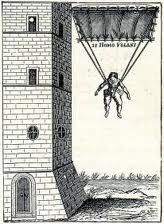
Parachutist - controlled descent, da Vinci invention?
Torii - Japan, Far East
Rocket crashing - fireworks?
Since I'm thinking about life at 17th century Fontainebleau at the moment, the parachutist and the rocket crashing appear to be anachronisms - typically in these instances I treat them as metaphors, as in the parachutist representing a 'controlled descent,' perhaps a courtier falling from the king's good graces and struggling to keep his offices, pensions, and so forth in the process. But I also recall that Leonardo da Vinci designed a parachute, and a Google search reveals that not only was he not the first person to illustrate the concept, there are claims that a working parachute was tested by Croatian inventor, Faust Vrančić or Fausto Veranzio, sometime between 1590 and 1617.

So perhaps the parachute isn't metaphorical after all. Now to turn this into an encounter.

At the tennis courts (bouncing ball) at Fontainebleau, there's a spirited discussion among several players of a rake leaping from his mistress' bedroom window into a moat in order to escape her husband's guards (helmet). Someone opines that such an exit is a dicier proposition without water to break the fall (rocket crashing). Another player of the group says that a missionary with the Spanish ambassador's entourage, recently returned from Tartary (domed towers), described how dancers in the Far East (torii) leaped from high platforms with large silk parasols to break their fall. Not to be outdone, the first player relates that a secretary of the Venetian ambassador's party spoke of a marvelous invention, a canopy from which a man was suspended and could float to the ground in perfect safety (parachutist) - it's said he even has an illustration of the machine (drawing a picture). The veracity of the claims is debated, and a wager to test the theory is offered.

Perhaps the adventurers decide to follow up with the Portuguese missionary or the Dalmatian secretary, to learn more about these marvels, with an eye to some future application or even to win the wager. Maybe they ignore it all together. This encounter or rumor is what I think of as grist for the mill - it establishes facts of the game-world for the player characters, to use or not at their discretion, which in my experience is an important part of running a sandbox-style campaign. And as a bit of historical background, it's kinda fun in its own right, a small way of bringing the historical period to life for the players.

Now, this probably sounds like a butt-load of work for very little return - in fact, the whole process took me less than ten minutes, including the Google searches - but here's the thing: I would never, ever have come up with anything even remotely like this on my own. The Story Cubes lead my imagination to wholly unexpected places, which is what makes them so much fun. I'll have more on this in a later post.

Tomorrow, creating a random encounter using the Backswords & Bucklers job tables.
Read More
Posted in Flashing Blades, Le Ballet de l'Acier, random, refereeing, Rory's Story Cubes | No comments

Monday, 22 October 2012

Breaking Balls

Posted on 11:43 by Unknown
Last Friday, pitcher Barry Zito became an unlikely hero to the baseball fans of San Francisco when he pitched 7 2/3 shutout innings and saved the Giants' season in beating the Cardinals, staving off elimination in the National League Championship Series, and bringing the final two games of the series home to AT&T Park. Zito, the 2002 AL Cy Young winner with the Oakland A's, came to the Giants in 2007 as the highest paid pitcher in baseball and promptly proved to be a bust, turning in end-of-the-rotation outings while drawing an ace pitcher's salary. This season saw him turn things around a bit, going 15-8, but even the regular season resurgence didn't really prepare anyone for his Game 5 gem.

In a league where most of the pitchers can hit the low to mid-nineties with their heaters, Zito beat a good-hitting Cardinals lineup with a fastball that never clocked over eighty-six miles per hour, and that only twice. What made it work was a remarkably sharp curveball that he consistently pitched for strikes. The beauty of Zito's curve, which travels in the low to mid-seventies, is that hitters have to adjust their timing to be ready for it, and when they do, an eighty-three mile-per-hour fastball suddenly looks rocket propelled by comparison.

I watched the game, and I honestly have to say it was one of the best pitching performances I've seen - including King Felix's perfecto earlier this season - in recent memory. He snapped off breaking ball after breaking ball that dropped through the zone, and when the Cards' hitters went after it, he shut them down with a high fastball. This is what it must've been like watching Sal Maglie pitch.

I was reminded of great curveballs by the cheese my players threw at me this weekend. After returning from Milan on their mission to located and perhaps ransom the vicomte de Praz-de-Lys, they received word that the king's grace was granted to them and they were free to return to Paris, their exile ended. However, with rumors of the long-delayed English fleet on its way to the Mediterranean at last swirling around Turin, and their new commander dangling the prize of sacking Genoa before them when the ships arrived, they decided to blow off returning to France, to remain in Turin in anticipation of the spring campaign against the Genoese and the Spanish.

What the adventurers did not and could not know is that the English warships, soundly defeated by the Spanish during a raid on Cadiz, and that the French were pursuing a separate peace with Spain which culminated in the Treaty of Monçon in March 1626. There never was going to be a resumption of the campaign against Genoa.

And that's perhaps why I didn't expect the players to opt to stay in Turin. From our previous game-day, it sounded like they were ready for their characters to head back to Paris. I planted the rumors of the English fleet and the spring offensive more for reasons of historical interest - this is what was being discussed in the courts of Europe in December 1625 - but I didn't really expect them to bite.

And rather than following through on their plans to go home, they opted to stay for the fireworks instead.

Meanwhile, Riordan O'Neill, the King's Musketeer, has been carrying on an affair with a lady-in-waiting to the princess of Piedmont during his time in Savoy, and I got another curveball there - he was actively pursuing a way to marry his mistress, despite their differences in social standing, even to the point of hoping he would get her pregnant before she was married off to a Savoyard soldier.

And then, when his hopes were dashed, he made sure the break was clean by trying to seduce her maid.

Running a sandbox means being prepared to handle the breaking balls the players send my way. Instead of rushing back to Paris with the vicomte's coded message to 'PROTECT WIFE' in their minds, they decided to pursue fortune and glory and settled for a chimera instead.

In practical terms for me as the referee, this advances my timeline considerably. Rather than arriving in Paris in January, they will arrive in April. I need to consider how the passage of four months affects the machinations of different non-player characters and their complex web of intrigues. What happened to the vicomte's family in Paris, for example? The players' original determination to aid the vicomte disappeared when presented with the chance to fill their saddlebags with Genoese loot. Now the fates of the vicomte and vicomtesse may take a very different turn.

These sweeping 11-5 curveballs that buckle the knees are what make running a sandbox so much fun for me. I'm spending the next couple of weeks figuring out what happens now, how the social landscape of the game changes as a result of the players' and characters' choices.

I'l probably work on it tonight, with my laptop on my knees, as I watch the Giants battle the Cards in a win-or-go-home Game 7 to determine who goes to the World Series on Wednesday.

I hope Matt Cain's curveball is as sharp as Barry Zito's.
Read More
Posted in actual play, baseball, Le Ballet de l'Acier, refereeing, sandbox | No comments

Thursday, 18 October 2012

Points of Light in a Sea of Lights

Posted on 11:55 by Unknown
I've written at length about the social aspects of the cape-and-sword sandbox, that the swashbucklers' game-world is less focused on setting locations than it is relationships between player and non-player charactes. However, a cape-and-sword campaign still takes place in a place - in fact, many swashbuckling campaigns are set in a world both alien and familiar. That world is our own, or more specicially, the world of our own past.

Now here's the thing: the real-world is big friggin' place. It's not a lonely penal colony in a backwater star system. It's not a keep on the borderlands, surrounded by a howling, monster-haunted wilderness. It's a world filled with people: their numbers are great, their settlements are many, their impact is profound, and their presence is all but inescapable.

So, the first thing a referee running a game in the real-world must consider is, how much of this do I really need to describe, anyway? The easy answer is, only those areas which are of particular relevance to the adventurers. One could, for example, play a campaign of roguish highwaymen and detail little beyond a forest and its roads and tracks, a few villages, a nearby town, and perhaps some ruins or a cavern as a hideout, with the assumption that the adventurers will remain within the edges of the sandbox by dint of social contract, campaign premise, or whatever.

But what happens when the edges of the sandbox are less distinct? How does the referee handle a setting which attempts to encompass a whole world, particularly our own?

In setting up Le Ballet de l'Acier, my Flashing Blades campaign, I wrestled a bit with this. The 'core setting' for the campaign is 1625 France, a country encompassing tens of millions of hectares of land, millions of people, thousands of kilometers of navigable rivers, and on and on. My approach to running any sandbox setting is to 'prep to improvise,' to assemble in advance the tools I need during actual play to make stuff up in response to what the adventurers do, so that if the adventurers, say, set off for Nancy from Paris, I can maintain the verisimilitude of the setting and offer credible answers to reasonable questions which may arise - how does, say, a farm in Champagne differ from a farm in Provence? what wares might a merchant in Limousin be transporting compared to a merchant in Lyonnais? are common names in Brittany different from those in Gascony?

As you might guess from those examples, part of my preparation revolved around a basic unit of political division in ancien régime France, the province. Provinces feature prominently in the career rules for Flashing Blades, so it was important for me to know something about them. I gathered information on physical geography, population demographics, and economics, along with a bit of history. Focusing on the provinces allowed me to break down the whole of France in manageable chunks.

Even so, my treatment of the provinces in necessarily broad-brush. Looking at a period map, it's easy to see the geographic complexity of the countryside, with hundreds of villages and anything from a half-dozen to a score of sizable towns and cities. Even detailing the provinces left me with a very broad-brush treatment of France.

More importantly, cape-and-sword campaigns are less about tromping across fields and forests than they are engaging in intrigues, so I needed to pay close attention to the geographical milieu in which these intrigues take place, and that meant cities. Early on a made a list of five cities, which I then set out to develop in some depth. Paris was the first and most obvious choice - really, it would be pretty easy to run an entire swashbuckling campaign set in Paris if I was so inclined. The largest, most politically important city in France - still the seat of royal power in the time of my campaign - I spent the more time acquiring a feel for Paris than I did any other place in the campaign, learning about its palaces and gardens, churches and priories, markets and alleys, bridges and quays, colleges and courts, prisons and cemeteries. The core rules for Flashing Blades and the short-adventure collection Parisian Adventure both describe numerous landmarks around the city, as does GRUPS Swashbucklers and At Rapier's Point, the Rolemaster cape-and-sword supplement - beyond those I dug through histories and guidebooks to the city, a number of them written as far back as the eighteenth century, to develop my feel for the Early Modern life of the future City of Light. I've found that approaching a city like a tourist tends to clue me in on what is likely to be important to the adventurers in the course of the game, and to prepare accordingly, a trick I learned while running Traveller, where adventurers may travel to three different worlds in single game-day.

After Paris, I next considered another important aspect for swashbuckling games - what if the adventurers chose to turn pirate? That mean ports, so the next three cities on my list were Rouen, La Rochelle, and Marseille. Rouen in this period is the gateway to New France and, along with Saint-Malo, one of the most important trading centers with the rest of Europe and points beyond. La Rochelle is also a critical port city in this time, with extensive trade with the Protestant countries of northern Europe - England, the Provinces, Denmark, Sweden, and the Empire; should some or all of the adventurers be Huguenots, moreover, knowing details on the most important Protestant stronghold in France was essential. Marseille is the gateway to the Mediterranean, and particularly important give the southward tilt of my sandbox.

The last of the five cities on my list was Toulouse, the 'Paris of the south,' an important administrative center in Occitan-speaking France, a city with deep history and rich culture - if forced to choose just one city in which to run a cape-and-sword campaign, I'd pick Toulouse over Paris in a heartbeat.

So, these - Paris, Toulouse, Rouen, La Rochelle, and Marseille - became the campaign's 'points of light,' the geographic 'shiny objects' with which a sandbox setting is studded. For each city there are various webs of intrigue against which the adventurers may brush, through rumors and random encounters; a number of them reach across France to one another as well, such as the Toulousain vicomte de Bouvard, a royal courtier whom the adventurers met on a visit to the Paris horse market. Over the course of play, two more cities, Grenoble and Torino, in the duchy of Savoy, have received more detailed treatment as a direct result of the adventurers' actions, and long-term I'm considering fleshing out Bordeaux and Amiens as well, in anticipation of future events in the campaign, specifically France's entry into the Thirty Years War.

It would be very convenient for me to limit my sandbox to a city, or even a province, but it would also be limiting in ways that I wouldn't really enjoy, and it would deny the players the freedom I want to them to have as they approach the campaign. "Small, isolated points of light scattered across a big, dark, dangerous world" may make for an excellent setting for some games, but for my cape-and-sword campaign, the game-world is a sea of light with a few that burn a bit brighter than the rest.
Read More
Posted in Le Ballet de l'Acier, points of light, refereeing, sandbox | No comments

Friday, 31 August 2012

Unleash the Spanish Fury!

Posted on 00:22 by Unknown
By way of Mitch Williamson at War and Game, I discovered Spanish Fury and Very Civile Actions!, a pair of sixteenth and seventeenth century wargames released by The Perfect Captain.

The Prefect Captain describes himself . . . er, itself, thus.
We are a small group of gamers with some big ideas! We like to play and design boardgames, miniatures rules, and campaign games for a host of periods. We have a yahoo group that supports our products. By the way, maybe we should mention that our goods are totally FREE!
Spanish Fury includes rules for land battles and skirmishes, sea battles, sieges, individual duels, and land and sea campaigns. In short, it promises "a complete games system, enabling players to enjoy the period in virtually every scale almost anywhere in Europe, from Portugal to Urals."

I downloaded the whole lot Thursday night, but I only had time to look at Actions!, the company-level skirmish module of Spanish Fury. The basic rules run about seventeen pages, and they are simple and clearly written - with some referencing, I felt I could play an intro scenario after a single read-through of the rules.

I'm really looking forward to digging into this. Actions!, in particular, looks like exactly what I want for use with my Flashing Blades campaign. I've been looking longingly at my Field of Glory: Renaissance books for awhile now, but Actions! is a great example of how sometimes less-is-more, ideal for running the sorts of quick'n'dirty scrapes in which the adventurers are most likely to find themselves in the course of the game. And as an added bonus, I think I could teach someone how to play in about ten minutes.

Now, there is a catch, as far as the whole "totally FREE!" thing goes. The Perfect Captain asks, in lieu of payment for their rules and counters, for a donation to charity.
Having established that, let me add the following. As gamers we like to spend our dough on stuff that helps us unwind and have a good time. Nothing wrong with that! But how about this. What if we took a portion of our hard-earned cash and gave it to someone who is going without? I think that would be pretty cool, don't you? We are NOT going to force anyone to donate to charity before they can download our games. We believe in the honour system.
They include a list of suggested charities, or donating money - and if you don't have that, a bit of time - to the charity of your choice. Mine is the restoration of a Hungarian castle, a project to protect a piece of history and provide sustainable jobs for the community.
Read More
Posted in charity, Le Ballet de l'Acier, Mitch Williamson, Spanish Fury, The Perfect Captain, Very Civile Actions, War and Game (blog), wargames | No comments

Monday, 6 August 2012

Tailor-Made

Posted on 20:02 by Unknown
Awhile back I drew the analogy between social relations in a cape-and-sword campaign and the dungeon and even megadungeon of the old school fantasy roleplaying game. Like the rooms of a dungeon, the non-player characters of the social milieu hold rewards, secrets, and dangers for the adventurers to discover.

Traditionally the referee is responsible for creating this social milieu. My own preference is to create a sandbox, status quo social setting. Another approach is to tailor the events of the campaign to the player characters, typically after character generation is completed.

There are some distinct advantages to the tailored approach. Adventurers may begin the game with built-in conflicts - frex, the Sworn Vengeance and Secret Loyalty Secrets in Flashing Blades - to pursue. It is efficient for the referee, reducing the scope of planning compared to many staus quo settings. It also provides the players with the opportunity to make meaningful choices for their characters; they drive the action, similar to the way characters in a more sandbox setting do. Finally, campaign events and situations tailored to the player characters avoid a potentially frustrating 'hunt for the (plot) hook.'

In a sandbox setting, on the other hand, challenges may not be as narrowly focused on the player characters as they are in more tailored campaigns. Conflicts tend to arise as a consequence of the adventurers' actions, rather than being introduced through the metagame. Player characters must proactively seek out challenges and adventures in the sandbox, such as listening for rumors or seeking out the sources of legends.

For this to succeed, one of the tricks the sandbox referee must perform is creating a setting which the players want to engage. Usually this is folded into the pitch for the game - you're heroes exploring lost ruins for treasure! you're space merchants trading among the stars! - and when the rubber meets the road, the referee's sandbox should live up to that promise, so that the adventurers can seek out those treasure-filled ruins or new markets for Terran widgets. Developing a cape-and-sword campaign sandbox means creating a social milieu which reflects players' expectations about the genre.

My approach to sandbox creation involves building the setting from behind a veil of ignorance - that is, with no foreknowledge of who the actual player characters will be - leaning heavily on those genre tropes to develop situations which invite the player characters to engage.

So what does this look like in practice? Meet the Montchèvres, a 'dungeon' in my Flashing Blades campaign.

In the spring of 1625, the family of Gaston de Montchèvre, vicomte de Praz-de-Lys, takes up residence in a rented Parisian townhouse. Like many of the Savoyard nobility, the vicomte is a soldier, commanding a company of chevaux-legers (light cavalry) in the ducal army. He served with distinction during the war against the Spanish in the 1610s, earning the notice of the constable of France, and with the constable's introduction, the vicomte travelled to Paris in 1618 where he was received at the court of King Louis XIII; the vicomte's marksmanship and falconry during a hunt at Fontainebleau brought Praz-de-Lys to the notice of the king himself.

As with many of the provincial nobility from the Alpine regions of Savoy, the vicomte de Praz-de-Lys is aligned with the French faction at the ducal court in Torino, opposed to the influence of Spain in northern Italy. Inspired by the marriage of the prince of Carignan, the duke of Savoy's youngest legitimate son, to the sister of the comte de Soissons, a French prince of the blood, the vicomte decided to pursue a French marriage for his own daughter and a military career in the royal army for his eldest son and heir.

The vicomte's plans are also designed to thwart the machinations of a close rival, his wife. Daughter of a Piedmontese cadet branch of a family of Genoese counts, Lucrezia di Ventimiglia was a pious and dutiful child who's one act of youthful rebellion - a whirlwind affair with a dashing cavalryman - resulted in a pregnancy and a marriage for which neither family was prepared. The viscontessa di Prato-di-Giglio - she refuses to use the French title - has ardent Spanish sympathies, and the vicomte used the move to forestall the viscontessa's schemes to marry their daughter to a pro-Spanish nobleman. She views the French, and in particular their tolerance of heretics at home and alliance with heretics against Catholic princes abroad, as an anathema.

The vicomte's plan is risky. His estate in Chiablese is modest, and his finances are critically overextended supporting another household in Paris along with his commitments at home in Savoy. The vicomte is eager for ducal and royal favor, to add lustre to his family name, and, in this, the campaign against Genoa is an important opportunity for the cavalry commander as well, to perhaps gain entry into the order of SS Maurizio i Lazarro or even the Annunziata and a pension, or to augment Catherine's dowry with booty won in battle. The vicomte already achieved an important part of his plan, obtaining a place for his daughter as a lady in the court of the princesse de Carignan.

The viscontessa is, of course, looking for ways to subvert her husband's alliances with the French. Mindful of her responsibilities, the viscontessa is nonetheless pursuing her own ambitions for her children; if she can't prevent a French marriage for her daughter and French service for her oldest son, she is determined that her youngest boy will find an appropriate place in the Church - preferably as part of a Spanish cardinal's curia in Rome - and to that end she's reaching out to the court of the Spanish ambassador in Paris for help.

Catherine de Montchèvre, the convent-educated daughter of Gaston and Lucrezia, is fully aware of the struggle between her father and mother over her future and that of her brothers. Behind a mask of ambivalence she schemes, manipulating her parents' mutual antipathy to her own ends. François de Montchèvre, the vicomte's heir, has few thoughts for anything other than swords and horses, while the youngest, Pierre, still clings to his mother's skirts, terrified of his father.

In addition to the family members themselves, the Montchèvre family includes a variety of servants - a lady-in-waiting to the viscontessa, a priest-confessor, maids, valets, and guards.

As noted above, rumors are an important part of sandbox settings, and in this case, one of the rumors - the one which drew in the adventurers - was that a Savoyard family recently arrived in Paris was seeking to fill positions in the household - tutors both ecclesiastical and secular, a fencing master, a horse master, a banker to manage finances, a lawyer, a steward, a physician, and an apothecary, as well as more menial jobs such as servants and coachmen. The rumor went on to note that the family was paying better-than-normal wages.

Anyone familiar with Flashing Blades will likely notice that most of those positions relate to careers and jobs which may be pursued by player characters. This presents a number of points of attachment for the adventurers, as does the Montchèvres' connections to other parts of the social setting, such as Catherine's connection at court, Lucrezia's connection to the Spanish ambassador, and Gaston's connection to the constable and the king. The Montchèvres also appear in a number of random encounters around Paris, providing another nexus to the family for the adventurers.

The intrigues of the Montchèvres as described here only scratch the surface, as the players and their characters discovered over our last two game days. In our campaign, the adventurers did indeed accept service with the family, and when one of the player characters attempted to seduce the viscontessa's lady-in-waiting, a duel involving the Cardinal's Guards followed, and the adventurers were exiled from Paris. They took service with a company of mercenaries heading for the wars in Savoy . . .

. . . which is where things take an interesting twist.

Since I hadn't planned for player characters to go to Turin, I generated some random encounters as ideas for events going on around the ducal court; a combination of the tables in the core rules for Flashing Blades, the Mythic Game Master Emulator, and Rory's Story Cubes turned the encounter, "The King/Queen/or Prince, with 2D6 Guards, 1D6 Ministers or Attendants, and 1D6 sycophants (a possible Patron)," plus the Patronage result, "The Patron wishes to have a message taken to someone in a dangerous position (a prisoner in the Bastille, perhaps, or a soldier on the front)," into an attempt to ransom the vicomte de Praz-de-Lys from his Spanish captors!

What made this particularly fun for me as the referee is that the capture of the vicomte by the Spanish was something I wrote about a year before the campaign even began, before I had any players, before a single character was created. Had the adventurers been in the service of the viscontessa and not been exiled from Paris, they would've heard of the vicomte's capture. Instead, through a wholly unplanned chain of events not contemplated at the start of the campaign, they found themselves trying to free the vicomte from the sinister Don Alvaro de Salamanca just this past weekend.

There is a lot to be said for tailor-made campaigns, but I don't think I could find it as satisfying as the serendipitous twists and turns of a campaign written from behind the veil of ignorance and refereed with the random dials turned to eleven.
Read More
Posted in Flashing Blades, Le Ballet de l'Acier, refereeing, sandbox | No comments

Saturday, 28 July 2012

Field Test

Posted on 22:38 by Unknown
During the course of our game today, the adventurers found themselves on the road, travelling from Turin to Milan, so I decided to give the event table I created a couple of months ago a try.

First, the adventurers were stranded for a few days at a Milanese inn when their horses took ill from some bad feed (26), then they were hit by a sharp snowstorm (66) which forced them to find shelter and cost them another travel day at least - and probably more as the roads turn to mud when the snow melts. The delay at the inn also resulted in one of the adventurers seducing the innkeeper's wife and a near-brawl with the woman's brothers.

The players realized that their characters are unlikely to be crossing the Alps on their way home to France after their mission to Milan is done.

So, event table actual play field test? Success!
Read More
Posted in actual play, Le Ballet de l'Acier, random | No comments

Saturday, 21 April 2012

R is for Recap

Posted on 11:22 by Unknown
I've mentioned my Flashing Blades campaign, Le Ballet de l'Acier - The Dance of Steel - a number of times in different posts, to highlight an example, but I haven't discussed it at any length.

The campaign began in in the chill winter February 1625, as a French soldier, Adrien Sannom, an ensign of pikemen in the Picardy Regiment, was sent to Paris to deliver dispatches for his colonel. Left to his own devices pending the return to his regiment, he wandred the fair and stopped a trio of gentlemen threatening an old man and his daughter then got into a scuffle at the theatre. Later he delivered a missive for another soldier to his mistress, and carried a message to the royal fortress at Vincennes and narrowly avoided freezing to death on the road back to Paris, then was nearly killed by an innkeeper who was beating his wife. Finally he returned to his regiment and was dispatched to forage for supplies for his company - and completely missed uncovering a Spanish plan for invading Picardy. (Life During Wartime, a one-shot at a Meetup)

The long winter showed little sign of easing in March 1625 when a sergeant of the King's Musketeers, Riordan O'Neill, visited the fair at Saint-Germain. He rescued an acrobat from three carousing fops then received an invitation to the theatre. Coming home from the theatre, he encountered the aftermath a duel, two gentlemen dying in an alley as one of the dead men's servants claimed that it was murder. The two duelists retire after marking Riordan well. (Gallant Madness)

At his earliest opportunity, Riordan O'Neill returned to the theatre at Saint-Germain, in the company of his friend Charles Duran, to ask out the actress-sister of the acrobat he rescued; the Musketeer was chagrined to discover that she is a prostitute. Chastened, he and Charles took up an invitation from another Musketeer to join him at a small tavern. They spotted a man and a woman in poor disguises about to be set upon by a gang of bravos - the trio defeated the bravos in a dark alley, capturing two, then learned that the two disguised nobles were the duchesse de Chevreuse and her English lover, Lord Holland. The duchesse charges them with sneaking her and Lord Holland back into the Louvre. (The Instruments of Darkness)

A plan is formulated, and Musketeer uniforms procured, to sneak the pair into the palace. Another friend, Charles Petit, an apothecary, is summoned to aid the injured Lord Holland, to rouse him enough to get him into the palace. While Riordan bribes one officer and bluffs another, one of the captured bravos convinces Petit to let him go, on the promise that he will give up the leader of the bravos who escaped earlier in the evening. After Riordan discovers the deception, the second prisoner is killed and dumped into the Seine, then the adventurers set off in search of the bravo leader. Staking out the tavern, they find the prostitute with whom the bravo was earlier seen, and attempt to bully her into giving up the bravo, but she refuses; later they tail her to a church, but they are put off by a priest before they can question her further. On returning to their lodgings at the Black Stork Inn, a mysterious man offers them thanks for aiding the duchesse, and delivers them a purse of gold francs and ring with a red stone. (No Hunting Like the Hunting of Man)

Charles Duran returns to his family in Dijon for a time, leaving Riordan O'Neill and Charles Petit to make good on the promised bribe to the officer at the Louvre, a German mercenary. Tracking him down, they discover that he's destroyed a tavern in a drunken rage, and they convince the cuckolded tavern owner to not summon the provost-marshal by paying for the damages themselves. March passed into April, and Charles Petit hears a rumor that a Savoyard noblewoman, the vicomtesse de Praz-de-Lys, is setting up household in Paris and looking for staff - a fencing master and tutors for her sons, a banker to handle the family finances, and so forth. Riordan and Charles present themselves for the positions of fencing master and tutor respectively, and are hired; Riordan takes the opportunity to flirt with the vicomtesse's layd in waiting. Returning to the Black Stork, Riordan is insulted by three men in the market of the Place Maubert; the three are waiting for a duelist, and mistake Riordan for the man's second. Once the duelist arrives, Riordan offers to be his second, and in the subsequent duel the three are killed. The duelist introduces himself Gil de Berault, and thanks him profusely, telling Riordan to look him up if ever he needs a second. They continue to work for the vicomtesse, and Riordan flirts with her lady-in-waiting. One day Riordan is summoned to the hôtel de Tréville; Tréville informs him that the duel upon which he happend back in March, on the way home from the theatre, involved a son of a Lorrainois count and two courtiers to the Queen-Mother. One of the courtiers is making inquiries, trying to learn Riordan's identity. and Tréville warns Riordan to be careful. Finally they meet Lorrainois count, who offers them his gratitude for delivering his son to a priest before he died. (A Thousand Friends)

Charles Petit and Riordan O'Neill continue to work for the vicomtesse as April turns to May. One day she asks if they can assist in purchasing a horse for her eldest son, and with the boy and another friend, Bruno Faucon, Riordan's assistant, they set off for the Paris horse market. At the market Riordan spots one of the two courtiers, who introduces himself to Riordan. The courtier and another nobleman are arguing over the merits of two horses, and a race is arranged, with Riordan agreeing to ride on behalf of the nobleman. Riordan wins the race through the Cours-la-reine and is invited to a party to be held by the nobleman in May. Later Riordan, with Charles and Bruno in tow, seeks out the vicomtesse's lady-in-waiting and finds her Les Halles, the main market, in the company of a young soldier. She goads Riordan and the soldier into a duel, as Charles and Bruno try in vain to warn him off. Bruno tails the soldier, and discovers him entering the residence of the Cardinal Richelieu at Place Royale. Convinced that they will be ambushed by the Cardinal's Guards, Riordan casts a wide net for help, pulling in three of his friends among the Musketeers. Arriving at the Hôpital Saint-Louis, where the duel is to be held, Charles sneaks in and finds the Cardinal's Guards clearing out the vagrants congregated there. The adventurers decide to turn the tables on them, ambushing two of the Guards and capturing the guardsmen's horses, killing one of the Guards in the process. (Best-laid Schemes)

The Cardinal's Guards discover Riordan O'Neill, Charles Petit, and Bruno Faucon, along with three other King's Musketeers, in the process of stealing the guardsmen's horses, and the adventurers are forced to flee as musket fire rattles around them. They realize that if word reaches the king, they could be in trouble, so they set off for Tréville's, to ask him to intercede with His Most Christian Majesty, but Tréville isn't at his townhome, and the delay allows the Cardinal to reach the king first. One of the Musketeer officers finds a place for the adventurers to stay until Tréville returns; meanwhile the guardsmen's captured horses are turned loose in the Tuileries gardens to browse on the royal shrubbery. That night word arives that the king is furious, and the Musketeers are exiled from Paris. The barber-surgeon of the Musketeers, Guillaume Sébastien, who treated the injured after the fight with the guardsmen, decides to flee as well, as he is likely to be branded a co-conspirator by the vengeful Cardinal. Two of the Musketeers decide to head south, to Toulouse; the third accept an offer from the comte de Challons, a friend of Tréville's, to join his mercenary company heading off to the war in Savoy, and Riordan, Bruno, and Guillaume join him. (A Hard Place to Leave)

The trip to Grenoble, where Challons' company is forming, is brutal as the adventurer attempt to avoid agents of the Cardinal by travelling through the mountainous heart of Burgundy, where they encounter and kill an angry boar. Afraid they will wreck their horses, they decide to take to the river, and head south on barges to Vienne. Leaving the river, they take the road to Grenoble, and are ambushed by bravos in the middle of an empty waste. Taking refuge on a hilltop, a battle with pistols and swords ensues, and the bravos are routed. Arriving in Grenoble at last, the adventurers discover that the officer they were to meet is missing, along with thousands in borrowed silver. (Into the Wild)

Guillaume, Riordan, and Bruno investigate the disappearance, eventually discovering a hidden compartment in the officer's lodgings at a Grenoblois inn. The hidden compartment leads the local provost-marshal to identify the culprits, a Dutch banker and a Venetian fencing master, who flee the city. Riordan takes over the company in the officer's absence, but makes a poor showing of it. A case of Anjou wine arrives from Paris for Riordan, but it is laced with poison and the Musketeer is saved only by the ministrations of Guillame.(The Hands Will Solve)

After a brief period of training, the company, with Riordan O'Neill as cornet and Guillaume Sébastien as surgeon, with Bruno Faucon as a camp-follower, sets out for Savoy in June 1625, to join the French army fighting alongside the Savoyards against the Genoese and Spanish. Challons and his officers are invited to a party hosted by the principessa di Piemonte, the sister of King Louis XIII. At the party a Savoyard count with Spanish sympathies insults Riordan and Guillaume, but Riordan maintains his compsure. Later the adventurers are approache by a expatriot French nobleman, who tries to recruit them to seize his brother's castle in Dauphiny, claiming that the brother is responsible for death of the officer in Grenoble. The men are invited to dance with the princess' ladies, and only Riordan manages to pull off the steps successfully, earning him the admiration of his partner, from whom he asks for a favor to carry into battle. Challons carabiniers are put into action against Imperial cavalry, Albanian and Polish mercenaries, raiding behind the lines. Their first action is a defeat, as the Albanians manage to slip away; their second, against the Poles, is inconclusive. Finally, Challons' company manages to ambush the Poles in their encampment and scores a decisive victory, with Riordan taking the Polish banner in the process. (Let Him Who Loves His Country)

October turns to November as Riordan O'Neill and Guillame Sébastien travel to Turin with the comte de Challons, where Riordan is honored by the duke of Savoy for his meritorious conduct in during the summer campaign; during the ceremony, the expat nobleman once again approaches them about taking his brother's castle, and Challons invites Riordan to participate in a duel at Casale with the Imperial cavalry commander. Riordan celebrates by seducing a pair of tavern wenches and Guillame finds himself seduced in turn by a French marquise in Turin. The lady-in-waiting with whom Riordan flirted at the princess' party renews her acquaintance, focing Riordan and Guillame to figure out a way to slip her out of a church under the eyes of two guards assigned as her escorts. To distract the priest and guards, Guillaume, a Huguenot, claims to want to convert to Catholicism, and the priest declares it a miracle. The lady-in-waiting manages to sip away in her maid's cloak, and she and Riordan spend an afternoon riding together in the countryside. The next day, as Riordan prepares to leave with Challons for the duel at Casale, he is issued another challenge, by the officer he was supposed to duel in Paris months ago. That challenge is put off as the adventurers ride for Casale. (Darker Than the Swoon of Sin)

. The cavalry duel at Casale is a five-on-five affair held outside the walls of the city, as a company of Spanish musketeers watch from across the river. The surgeon, Guillaume Sébastien, is placed under guard by the Monferrini as the ten combatants meet on the field. Riordan O'Neill defeats two of the Imperials and captures a third as the French are victorious, escaping under a hail of musket fire from across the river. Guillame is shot and left for dead by the Monferrini sergeant, who steals his medical instruments. They retire to a town to find a surgeon to heal their wounds. (The Spur That Pricks)

What's next for our intrepid swashbucklers? The expat noble and the castle in Dauphiny still awaits, as does the duel with the French officer. There's Riordan's mistress and the lusty marquise waiting for Riordan and Guillaume's return to Turin. A diplomat is on his way to Monferrat with a proposed mission to Milan for the swashbucklers, along with word of a pardon and their return to Paris - or perhaps they will stay in Savoy when the campaign is renewed in the spring? And who set the bravos and the poisoned wine on them?

The future beckons.
Read More
Posted in A to Z 2012, actual play, Flashing Blades, Le Ballet de l'Acier | No comments
Older Posts Home
Subscribe to: Posts (Atom)

Popular Posts

  • The Pen and the Sword: Captain Alatriste
    It was clear that the Italian was doing very well. He could have killed the wounded man any number of times, but he was satisfied to harass ...
  • Letters to Isabel, Redux
    Marcello recounts a game played by the adventurers in his latest missive to his dear Isabel . I love this, integrating another game played ...
  • Madame la Présidente
    In Ancien Régime France, the title of présidente belonged to the presiding magistrates of the Parlements , the high court of Paris as well...
  • Off the Shelf: Chapbooks
    Chapbooks are popular books printed on cheap paper, often a single sheet folded into a booklet of eight to twenty-four pages, and illustrate...
  • Letters to Isabel, Redux
    The title of the post says it all: courtly intrigue . I'm often left at more than a little bit of a loss when referees complain that al...
  • Graphic Novels Challenge: Belladone
    An assassin takes a shot at Louis XIV, but the ball is deflected by the iron fan of a nearby nun, who with a winsome smile leaps over the s...
  • Special Maneuvers, Redux: A Reply to Jeff Rients
    "You are using Bonetti's defense against me, eh?" "I thought it fitting considering the rocky terrain." "Natura...
  • The Pernicious Influence of The Princess Bride
    Mandy Patinkin called it " The Wizard of Oz of our generation." Conceived as a fairy tale by William Goldman, TPB is a love stor...
  • The Pen and the Sword: The Cavalier in the Yellow Doublet
    He decided to finish the business, although not so hastily that it might work against him. Besides, there was no point in complicating his l...
  • The Cat Out of the Bag
    Jedediah at Book Scorpion's Lair has another actual play log from his 7th Sea campaign, in which the intrepid adventurers learn someth...

Categories

  • -C
  • 1602
  • 1612 (movie)
  • 1650 (game)
  • 7RPGS
  • 7th Sea
  • A Field in England
  • A to Z 2012
  • actual play
  • adventure path
  • Adventure Time
  • Against All Flags
  • Age of Ravens
  • Alain Delon
  • Alatriste
  • Alexander Macris
  • Alexandre Dumas
  • Alice B Woodward
  • All for One Régime Diabolique
  • alt history
  • Amanda Heitler
  • ancien régime
  • Andy Murray. meta
  • animal
  • animation
  • Anthony Hope
  • Arabian Nights
  • art
  • Arturo Pérez-Reverte
  • At Sword's Point (movie)
  • award
  • background
  • Backswords and Bucklers
  • bandwagon jumping
  • baragei
  • Barbaric Frontier
  • Barbie
  • Bardelys the Magnificent
  • Barry Lyndon
  • baseball
  • Batman
  • Bayuca
  • BBC America
  • Beedo
  • Belladone
  • BH 1 Mad Mesa
  • Big Purple
  • Black Vulmea
  • Black Vulmea's Vengeance
  • Blog of Holding
  • blogfest
  • Blogger
  • Blunders on the Danube
  • board game
  • Bob Anderson
  • Bold Pueblo Games
  • Bombshell Miniatures
  • Book Scorpion's Lair
  • books
  • Boot Hill
  • Bren at RPG Net
  • British Isles Traveller Support
  • BryanMD
  • Bushido
  • Caoimhe Ora Snow
  • cape-and-sword
  • Capitan
  • Capitán Alatriste (game)
  • Captain Alatriste
  • Captain Blood (movie)
  • Captain Blood (novel)
  • Captain from Castile
  • Captain Hook
  • Captain Horatio Hornblower
  • Captain Morgan
  • Cara King
  • card game
  • cartography
  • cartoon
  • Cassini map
  • catacombs
  • Catan Junior
  • Cesare Borgia
  • character
  • charity
  • Charles Perrault
  • chase
  • chateau
  • Chill
  • Christopher Columbus
  • Chronicles of Shadow Valley
  • Cinematic
  • comics
  • commercial
  • Condottieri Conflicts
  • conquistadors
  • ConTtessa
  • corsairs
  • cosplay
  • Crimson Cutlass
  • Crossbones
  • CS Forester
  • Cutthroat Island
  • cycling
  • Cyrano de Bergerac
  • d'Artagnan
  • d20
  • d20 Modern
  • d20 Past
  • d20 Pirates
  • Daffy Duck
  • Dangerous Beauty
  • Dangerous Liasons
  • Danny Kaye
  • Dark Dimension
  • David Balfour
  • DC Comics
  • De cape et d'épée
  • DeviantArt
  • Die Another Day
  • disability
  • Disneyland
  • diversity
  • Douglas Fairbanks Sr
  • Dr Rotwang
  • Drama Dice and Damsons
  • Dreams of the Lich House
  • DriveThruRPG
  • duel
  • Duelist (prestige class)
  • Dungeons and Dragons
  • Dynamite Entertainment
  • Dynasties and Demagogues
  • ECW
  • El Cazador
  • Ellen Kushner
  • Emmy Rossum
  • en français
  • En Garde (game)
  • EN World
  • endgame
  • Eric Treasure
  • errata
  • Errol Flynn
  • Ethan Skemp
  • Exchange of Realities
  • Fabled Lands
  • fantasy
  • festival
  • Fist Full of Seamen
  • Flashing Blades
  • Flashman
  • FLGS
  • Flying Swordsmen
  • Frank C Papé
  • Frank Frazetta
  • Frank Schoonover
  • Frankenstein
  • Fred Funcken
  • FXR
  • Game Empire
  • game fiction
  • game style quiz
  • games
  • Gary Gygax
  • George Waymouth
  • Gloire
  • Gonsalvo
  • gospel
  • Graham Bottley
  • Graphic Novels Challenge
  • grognard
  • gun control
  • GURPS
  • Hack and Slash
  • Hamlet (1996 movie)
  • Han shot first
  • Harold Lamb
  • heads up
  • Hearts
  • Heidi Brühl
  • Helen Hunt Jackson
  • Hendybadger
  • hero points
  • HeroPress
  • Hidden in Shadows
  • High Seas
  • historical roleplaying
  • history
  • hobby
  • holiday
  • Honor + Intrigue
  • Horatio Hornblower
  • Horrible Histories
  • horror
  • house rules
  • Howard Pyle
  • Howling Tower
  • humor
  • I Waste the Buddha With My Crossbow
  • ice hockey
  • Iceland
  • immersion
  • improv
  • Inca
  • Infernal Sorceress
  • International Catacomb Society
  • interview
  • IntWisCha
  • Ivanhoe
  • Jack Sparrow
  • James Bone 007 Roleplaying Game
  • James Fenimore Cooper
  • James Mason
  • Jean Laffite
  • Jedediah
  • Jeff Black
  • Jeff Rients
  • Jeffrey Catherine Jones
  • jeu de palme
  • JF
  • John Gilbert
  • John Paul Jones
  • John Sayles
  • Jules Verne
  • Khlit the Cossack
  • Kickstarter
  • Kingdom of Saguenay
  • komradebob
  • La Fille de d'Artagnan
  • lazy git
  • Le Ballet de l'Acier
  • Le Bossu
  • Legends of the High Seas
  • LEGO
  • linear adventure
  • literature
  • location
  • Lone Star
  • Long John Silver (novel)
  • Lord Dunsany
  • Lord Gwydion
  • Lord Nelson
  • Los Nikis
  • Lowell Francis
  • M.P.
  • magic
  • magic items
  • map
  • maritime
  • Mark Twain
  • martial arts
  • Marvel Comics
  • Masks
  • Maureen O'Hara
  • Mayan non-Apocalypse
  • Mead Schaeffer
  • Mediterranean
  • Melan
  • meta
  • Michael Crichton
  • Mike Mornard
  • milestone
  • miniatures
  • Mitch Williamson
  • Mithril Wisdom
  • Molière
  • Moonfleet
  • movie
  • music
  • musketeer
  • Mysterious Island
  • Mythic Game Master Emulator
  • Mythic Role Playing
  • names
  • Nasruddin
  • Natalie Dormer
  • Nate Christen
  • navel gazing
  • nc wyeth
  • NC Wyeth's Pilgrims
  • New France
  • Nick
  • npcs
  • NPS
  • Obsidian Portal
  • Odie
  • OEF
  • off the shelf
  • off-hand weapon
  • old man is old
  • Old Stuff Day
  • Order of the d30
  • Oriental
  • Osprey Publishing
  • OSR
  • Ottavia Piccolo
  • Paris
  • Pathfinder
  • Paul
  • PDQ#
  • perdustin
  • personal
  • Peter and Wendy
  • phoning it in
  • Pierre Alary
  • pike-and-shot
  • pilgrims
  • pirate
  • Pirate Latitudes
  • Pirates of the Caribbean Curse of the Black Peal
  • Pirates of the Caribbean On Stranger Tides
  • Pirates of Tripoli
  • playstyle
  • poetry
  • points of light
  • politics
  • pulps
  • Puss in Boots
  • QUAGS
  • Quickly Quietly Carefully
  • Rafael Sabatini
  • Raiders of the Seven Seas
  • Ramona
  • random
  • random. Mediterranean
  • rant
  • Raphael Sabatini
  • Ravyn
  • Ray Harryhausen
  • real life can be a pain in the ass
  • reenactors
  • refereeing
  • Regency
  • REH
  • reply
  • resolutions
  • Restoration
  • review
  • rewards
  • Richard the Lionheart
  • Rip Van Winkle
  • Rob Roy
  • Robert E Howard
  • Robert Louis Stevenson
  • Robert Newton
  • Robert Taylor
  • Robin Hood
  • Robin Laws
  • Robinson Crusoe
  • Robots and Rapiers
  • Rochefort
  • roleplaying
  • roleplaying games
  • Rome
  • Romeo and Juliet
  • Rory's Story Cubes
  • Royal Flash
  • RPG Blog Carnival
  • rpg history
  • RPG Stuff (blog)
  • RPGBA
  • rules
  • Ruritania
  • Saint Patrick's Day
  • sale
  • samurai
  • Samurai Heaven and Earth
  • sandbox
  • Sandy Hook shooting
  • Santa Claus
  • Sanxesta
  • SAR
  • Savage Worlds
  • save or die
  • Save Vs. Dragon
  • Scallywags
  • Scaramouche
  • Sean B
  • Semper Initiativus Unum
  • setting
  • sexism
  • shields
  • ship
  • siegecraft
  • Sinbad
  • SirJarva
  • social contract
  • social sandbox
  • social standing
  • solo
  • Solo Nexus
  • Solomon Kane
  • Sophie Marceau
  • Source of the Nile
  • Spacejacking
  • Spanish Fury
  • stage fighting
  • Stanley J Weyman
  • Star Wars
  • Steve Winter
  • Stewart Granger
  • story games
  • Super-Team Family
  • Swashbuckler (Jolly Roger game)
  • Swashbuckler (Yaquinto game)
  • swashbuckling
  • swashbuckling and sorcery
  • sword
  • Swords of the Red Brotherhood
  • Swordspoint
  • Swordswomen of the Silver Screen
  • Talk Like a Pirate Day
  • Taras Bulba
  • Tartuffe
  • Tavern Cards
  • TCM
  • Te Deum pour un massacre
  • Telecanter
  • Telecanter's Receding Rules
  • television
  • Tenkar's Tavern
  • tennis
  • Tercio Creativo
  • The 13th Warrior
  • The 9Qs
  • The Admiral's Ghost
  • The Adventures of Don Juan
  • The Adventures of Robin Hood
  • The Adventures of Sindbad
  • the Batman
  • The Black Arrow
  • The Black Buccaneer
  • The Black Swan
  • The Borgias
  • The Boy's King Arthur
  • The Buccaneer
  • The Business of War
  • The Cavalier in the Yellow Doublet
  • The Court Jester
  • The Courtship of Miles Standish
  • The Crimson Pirate
  • The Crown and the Ring
  • The Deerslayer
  • The Deluge
  • The Dragon's Flagon
  • The Duelists
  • The Dungeon Dozen
  • The Escapist
  • The Golden Voyage of Sinbad
  • The Isle of Pirate's Doom
  • The Justice of the Duke
  • The Lady and the Bandit
  • The Lion in Winter
  • The Mark of Zorro (1920)
  • The Mark of Zorro (1940)
  • The Mask of Zorro
  • The Master of Ballantrae (movie)
  • The Master of Ballantrae (novel)
  • The Mysterious Stranger
  • The Other Side
  • The Pen and the Sword
  • The Perfect Captain
  • The Phantom of the Opera
  • The Princess Bride
  • The Prisoner of Zenda
  • The Queen's Cavaliers
  • The Russian Storybook
  • The Savage AfterWorld
  • The Scarlet Cockerel
  • The Scarlet Pimpernel (1982 movie)
  • The Scarlet Pumpernickel
  • The Scottish Chiefs
  • The Sea Hawk
  • The Sea-Hawk
  • The Shadow of the Vulture
  • The Spanish Main
  • The Swordsman of Siena
  • The Thief of Bagdad
  • The Three Musketeers
  • The Three Musketeers (novel)
  • The Three Musketeers (Paul WS Andersen)
  • The Three Musketeers (RIchard Lester)
  • The Three Musketeers (Rowland Lee)
  • The Tudors
  • The Usual Suspects
  • The White Company
  • The World of Music
  • theatre
  • theRPGsite
  • Thoul's Paradise
  • Tim Brannan
  • Tim Snider
  • Tiny Solitary Soldiers
  • Top Secret
  • Toshiro Mifune
  • Tour de France
  • Traveller
  • Treasure Island
  • Treasure Island (1934)
  • Troll in the Corner
  • Trollsmyth
  • ttfn
  • TV Tropes
  • Twenty Years After
  • Twitter
  • Tyrone Power
  • Under the Red Robe
  • Universal Studios
  • Vaesen
  • Valley of the Giants
  • vanity
  • Vatel
  • veil of ignorance
  • Very Civile Actions
  • video
  • video game
  • Vikings
  • W Heath Robinson
  • Walter Paget
  • War and Game (blog)
  • wargames
  • Warren W Baumgartner
  • Warrior Pursuits
  • Wars of Louis Quatorze (blog)
  • Wayne R
  • Westward Ho
  • what shite
  • wiki
  • William Hobbs
  • Wimbledon
  • Wine and Savages
  • World of Music
  • world-building
  • Zak S
  • Zorro
  • Zorro (1974)

Blog Archive

  • ▼  2013 (157)
    • ▼  September (15)
      • Talk Like a Pirate Day!
      • Wednesday Wyeth
      • "The pass to Bourbon . . . Slapshot! . . . GOAL!"
      • Lazy Monday Link Dump
      • The Pen and the Sword: The Cavalier in the Yellow ...
      • Here Be Monsters
      • Dividends
      • Wednesday Wyeth
      • Meditation on a Visit to a Game Store
      • Random Encounters Coda: Order from Chaos
      • The Pen and the Sword: The Cavalier in the Yellow ...
      • Seriously
      • Retcon
      • Wednesday Wyeth
      • Another Solo Gaming Resource
    • ►  August (13)
    • ►  July (11)
    • ►  June (24)
    • ►  May (21)
    • ►  April (4)
    • ►  March (18)
    • ►  February (22)
    • ►  January (29)
  • ►  2012 (343)
    • ►  December (32)
    • ►  November (34)
    • ►  October (27)
    • ►  September (21)
    • ►  August (33)
    • ►  July (29)
    • ►  June (28)
    • ►  May (31)
    • ►  April (34)
    • ►  March (39)
    • ►  February (29)
    • ►  January (6)
Powered by Blogger.

About Me

Unknown
View my complete profile