ReallyBadTalk

  • Subscribe to our RSS feed.
  • Twitter
  • StumbleUpon
  • Reddit
  • Facebook
  • Digg

Friday, 6 April 2012

F is for Field of Honor

Posted on 01:34 by Unknown
Once again, you are challenged to a duel. Roll 1D20 to determine the actual location where the duel takes place.

1. On a coral reef at low tide while sharks cicle in the nearby lagoon.

2. Amid the vine-choked ruins of a lost temple deep in the jungle, while drums throb in the distance.

3. Atop a galley's ram as it protrudes from the side of a galleon while cannons blast overhead.

4. In the candlelit crypt beneath an ancient abbey.

5. In the middle of a court ballet during a masquerade ball.

6. On a swaying rope bridge suspended above a rushing torent.

7. Inside a church campanile as the bells peal for a requiem mass.

8. Atop a clocktower as shafts of lightning from an approaching thunderstorm illuminate the sky.

9. Hanging from the creaking sails of a slowly spinning windmill.

10. Aboard a wildly-rocking gondola drifting on the Grand Canal.

11. In the twisting alleys of a tall garden hedge-maze.

12. While racing around the Piazza del Campo during the Palio di Siena, using horsewhips and daggers.

13. Amid the canvas shrouds of a sailmaker's loft.

14. In a lantern-lit mine tunnel where gaping shafts nearby lay concealed by shadows.

15. Amid the silk carpets and satin cushions of a Turkish seraglio as the sultan's concubines make bets or throw fruit at the duelists.

16. In a dusty caravanserai, between the resting camels and their yelling, jeering drivers.

17. On the slippery, crackling ice bridge over a yawning glacial crevasse.

18. Between sulphurous hot springs and bubbling mudpots as a steaming geyser rumbles menacingly.

19. Over a half-dissected corpse in an operating theatre in the middle of a crowded surgical lecture.

20. In a tavern crowded with drunken revelers - hey, they can't all be exotic.
Read More
Posted in A to Z 2012, duel, location, random | No comments

E is for Encounter

Posted on 00:18 by Unknown
At Howling Tower, Steve Winter is laying out an excellent series of posts on random encounters. In his most recent post, he describes ways to improve random encounters, such as preparing encounters in advance of their actual use and making an encounter an event. I've used these same techniques for years in the campaigns I run, and I'm going to talk about this more in the future, but in the meantime, read Steve's posts.
Read More
Posted in Howling Tower, random, refereeing, Steve Winter | No comments

Thursday, 5 April 2012

E is for Exegesis

Posted on 18:57 by Unknown
Roleplaying gamers have a sometimes contentious relationship with the rules of our games.

The rules for a roleplaying game may only number a handful of paragraphs, or run to literally thousands of pages across scores of books. Gamers refer to games as 'light' or 'heavy' depending on their perceived complexity. We draw distinctions between 'crunch' - the rules that determine how actions are resolved - and 'fluff - the descriptive text of the game and the game-world.

Even with all of this attention to the rules, roleplaying games, particularly complex games with many pages of rules, frequently require judgement calls in how the rules are applied. For example, the third edition of Dungeons and Dragons offered players the opportunity to play a magically awakened (intelligent) animal as a character. Years ago, I posed a question based on the idea of playing a knight's awakened warhorse. What happens if the warhouse character tries to climb a sheer cliff? Is the action resolved by rolling a Climb skill check for the hourse as with any other character? Does the horse suffer a penalty to climbing because of his equine body? Or is it simply impossible for the horse to climb a cliff at all?

The answer, according to the rules, was all of the above.

The precursor to roleplaying games was the wargame, and since the 19th century wargames often included a referee or umpire, a neutral third party whose role is to determine the success or failure of moves made by the players and resolve conflicts that arise from the application of the rules to the players' moves. This concept was adopted for roleplaying games very early in their history, of a referee or judge or game master - or more fancifully Dungeon Master, Administrator, Watcher, or Hollyhock God - as, among other things, the final arbiter of questions that arose from the rules.

This is not the only solution to the often-fractious question of WHO DECIDES? in roleplaying games. Early games like En Garde! and Boot Hill could be played without a referee, relying on consensus among the players over questions that arose during the game; later games expanded on this consensus approach by adding specific rules about how consensus would be acheived, or, if interpretation of the rules was vested in an individual, how that person's judgement could be reviewed and overridden.

But the traditional method, of a referee or game master as final arbiter, remains the most common.

So referees necessarily become familiar with the rules.

I found myself poring over the rules of Flashing Blades following our last game-day, for a hole I discovered in the rules some time ago came up in play. In FB, characters in combat may take two normal actions or one long action each turn; for example, a character might choose to thrust and parry (two normal actions) or lunge (one long action). If a character is stunned, then in the following round the character loses one normal action and may not take a long action.

With me so far?

So during our last game-day, one of the non-player characters in a duel was stunned by an attack - I determined in the following round that his one action would be to parry the likely attacks from the player character. The player, seeing the opportunity to take advantage of the stun, decided to attack and counter; a counter is akin to a riposte, turning a parry into an attack.

Except there was no attack for the player to counter, so per the rules this was a wasted action. According to the rules, the only way to get two fencing attacks per round is to attack and counter, regardless if an opponent is stunned or not. Despite the fact that the non-player character was stunned, the player's character could not gain an advantage.

As the referee for the game, my ruling at the time was to let the rules as-written stand, with the promise that I would revisit the subject. Sitting down with the rules, I searched to discern the intent behind the rule as-written. Was this really a hole, or was I just failing to understand the design intent? What aspect of fencing was this intended to simulate? How could I explain this in terms of what the characters would experience in the game-world?

The big question in my mind, is, does allowing a second attack against a stunned opponnent confer too much of an advantage? For example, a character can fire two pistols in a round, so two fencing attacks didn't seem unreasonable when limited to stunned opponents. A character can parry more than one attack in a round with the parry action, and it takes two stuns to make a character helpless in the following round.

Putting all of this together, it makes sense that a character can attack a stunned character twice, and thus another house rule - a rule specific to our campaign - gets added to the lexicon.

Years ago I listend to a rabbi explaining midrash, the interpretation of Torah, to understand the motivations and meaning behind the stories told in the sacred texts, and I was struck by the secular similarity to referees interpreting the sometimes Byzantine rules of tabletop roleplaying games. Specifically, midrash reminded me of that example of that horse trying to get up the cliff, where three different answers found in the rules were all correct, subject to the referee making the interpretation. In one campaign, the horse is able to surge up the cliff, sparks flying from its hooves, while in another, a horse would be forced to find another way around like a horse that we would expect in our own mudane world.

It may seem like having multiple interpretations of the same text is a failure on the part of the system, and their are many games who argue exactly that when asked. But each of those answers gives the campaign played by the referee and the players a distinctive feel, in the same way that rabbis have written different midrashim to understand the implications of a particular passage of Torah.

Exegesis is the search for the truth of a text, but referees may arrive at multiple truths from the text of the game's rules.

And that's a good thing.
Read More
Posted in A to Z 2012, Flashing Blades, refereeing | No comments

Wednesday, 4 April 2012

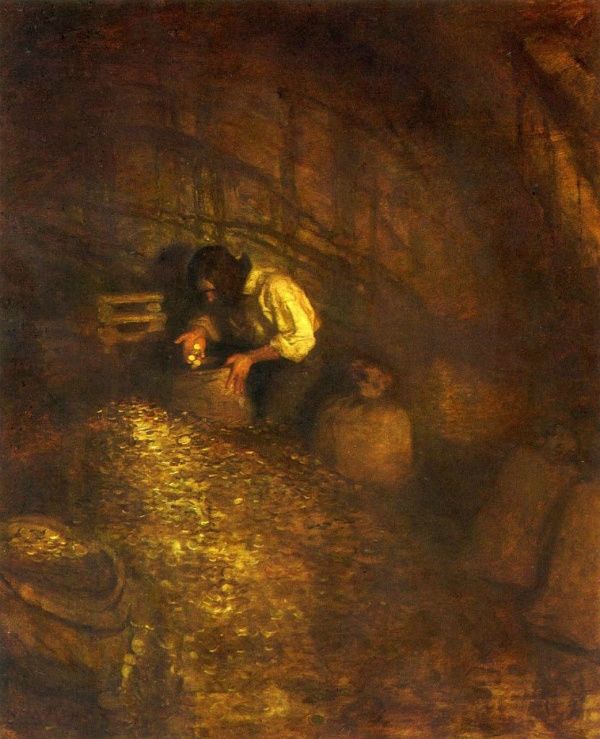
D is for Doubloons

Posted on 00:07 by Unknown

Out there is a fortune, waiting to be had.


For A to Z bloggers visiting Really Bad Eggs, Wednesday Wyeth in my weekly showcase of art by N.C. Wyeth and other illustrators. Click on the art tab to see other works in the series.
Read More
Posted in art, nc wyeth | No comments

Tuesday, 3 April 2012

C is for Challenge

Posted on 00:13 by Unknown
"A vile song, señor, and a vile tune with it," said a voice quite close.

However much the words hurt his pride in his mandolin Rodriguez recognised in the voice the hidalgo's accent and knew that it was an equal that now approached him in the moonlight round a corner of the house with the balcony; and he knew that the request he courteously made would be as courteously granted.

"Señor," he said, "I pray you to permit me to lean my mandolin against the wall securely before we speak of my song."

"Most surely, señor," the stranger replied, "for their is no fault with the mandolin."

"Señor," Rodriguez said, "I thank you profoundly." And he bowed to the gallant, whom he now perceived to be young, a youth tall and lithe like himself, one whom we might have chosen for these chronicles had we not found Rodriguez.

Then Rodriguez stepped back a short way and placed his kerchief upon the ground; and upon this he put his mandolin and leaned it against the wall. When the mandolin was safe from dust or accident he approached the stranger and drew his sword.

"Señor," he said, "we will now discuss music."

- Don Rodriguez: Chronicles of Shadow Valley, Lord Dunsany

For more on swashbuckling challenges, check out Tossing the Gauntlet.
Read More
Posted in literature, Lord Dunsany | No comments

Monday, 2 April 2012

B is for Buckler

Posted on 10:57 by Unknown
The buckler was a small, maneuverable, hand-held shield for deflecting and punching blows. It was usually round and made of metal but occasionally of hardened leather or layers of wood. Bucklers were typically round and frequently between 8 to 16 inches in diameter, but octagonal, square, and trapezoidal versions were also known.

The versatility of the sword and buckler as a method of fighting can be said to lay in its simplicity. As a two-weapon combination, it is simultaneously defensive and offensive. It offered some protection against missile weapons and was convenient for facing heavier weapons such as polearms and axes. Yet, its small size made it agile and quick. Combined with a good shearing sword or tapering cut-and-thrust blade, it could deflect attacks, strike blows of its own, and yet still allow the user’s own sword to cut around in any direction. Another advantage of metal bucklers was that unlike wooden shields, the point of an opponent’s weapon would not get stuck in the face of the buckler nor would the edge of a blade damage the rim (although, when this occurred it could be used to the shield man’s advantage). In many of the historical images of sword and buckler combat the familiar fighting postures found in longsword fencing manuals can be easily discerned, such as the wards of: high, middle, low, back, and hanging.
As described in an informative essay published by the Association of Renaissance Martial Arts, the buckler was introduced in the 13th century and remained popular with both soldiers and swordsmen for around three hundred years before finally falling into disuse in the 17th century.

The practice of striking one's buckler with a sword as a means of issuing a challenge or as a distraction, like stamping one's foot on the piste, while fighting gives us the word swashbuckler.

Thomas Fuller in his 1662, The History of the Worthies of England (Everyman Edition) described “swashblucker” as coming from the action of “swashing and making a noise on the buckler.” Apparently they would strike on their own bucklers with their swords during fighting. Similarly, Baret’s Alvearie of 1573 mentioned “to swash or to make a noise with swordes against tergats” while Ben Johnson in his early 17th century play, Staple of News, included the line, “I do confess a swashing blow”. Shakespeare in Romeo and Juliet also has the Capulet serving man Gregory make his “swashing blow” (i.e., a wide cut). John Florio also mentions, “A bravo, a swashbuckler, one that for money and good cheere will follow any man to defend him; but if any danger come, he runs away the first, and leaves him in the lurch.” And yet, in 1602 William Bass wrote a religious study that metaphorically referred faith to the confidence found in the “Sword & Buckler” as “The Serving Man’s Defence.”
As the rapier replaced earlier swords, so did the dagger and main-gauche replace the buckler, though rapier and buckler continues to appear in fencing manuals of the 17th century.

Characters in the Flashing Blades roleplaying game trained in the Italian and French fencing styles may carry bucklers as an off-hand parrying weapon. One of the advantages of the buckler in the FB fencing rules is that it's stronger than most blades, increasing the chance of breaking an opponent's sword. One of the characters in our campaign likes to carry a buckler as well as a swordbreaker.

The rules in Flashing Blades are intended to facilitate playing over a fairly lengthy period, covering the reigns of kings Henri IV, Louis XIII, and Louis XIV. This involves some necessary abstractions, of course, some of which I've addressed through house rules to capture more of the feel of the 1620s, when our campaign is set.

One of the abstractions in the game is that fighting styles and weapons remain consistent between 1589 and 1715. For my campaign, however, I want to capture the changes which occurred over the 17th century - rapiers and off-hand weapons should slowly be supplanted by the single smallsword as the weapon of choice among gentilhommes. Indeed, fighting with a buckler in the grand age of the swashbuckler should become increasingly rare.

I can handle this ebb and flow of time and fashion in the campaign a couple of ways. Frex, I can introduce house rules which change the styles and weapons available to the characters - after about 1650, a new fencing style, the 'smallsword' or 'court' style, with an emphasis on point-work - thrusts and lunges - will become available to the characters. As far as the existing fencing styles go, I could also simply say they're no longer available, but that's a bit too heavy-handed for me - rather they will simply fade into disuse among the non-player characters in the setting, making them an anachronism by the latter years of the Sun King's reign.

The buckler-wielding King's Musketeer in our campaign will start to experience this soon. His buckler brands him as a 'low' fighter, a barodeur, particularly among gentlemen, and they may comment upon it, dismissively perhaps - at their own peril, of course, for if Riordan O'Neill takes offense, they may well find themselves getting a first-hand demonstration of the buckler in action!

I prefer this to simply ruling weapons like bucklers or fencing styles out of the campaign. It gives the players the opportunity to make interesting choice about their characters, of finding their place in the game-world. Perhaps Riordan's player will embrace the image of a street-tough, or maybe he will conform to the social mores of the period and stop carrying the buckler. Either way, we both learn something about the character in actual play.

The referee controls the setting in a roleplaying game, but that control stops at the player's characters. Giving the players intriguing choices, and resolving the consequences of those choices in a way consistent with the game-world, is the referee's role.
Read More
Posted in history, house rules, refereeing, swashbuckling | No comments

Sunday, 1 April 2012

A is for Animation

Posted on 00:09 by Unknown
Welcome, A to Z Bloggers, to Really Bad Eggs, my thinking-aloud blog about cape-and-sword tabletop roleplaying games. Sunday's regular feature is Cinematic, a clip highlighting movie swordplay.

April Fool's Day seems ideal for Daffy Duck as the swashbuckling Scarlet Pumpernickel, something of a cross between Zorro and Percy Blakeney. Familiar characters and zany ending aside, it's not a bad little genre tale.

Read More
Posted in animation, cartoon, Daffy Duck, The Scarlet Pumpernickel, video | No comments
Newer Posts Older Posts Home
Subscribe to: Posts (Atom)

Popular Posts

  • The Pen and the Sword: Captain Alatriste
    It was clear that the Italian was doing very well. He could have killed the wounded man any number of times, but he was satisfied to harass ...
  • Letters to Isabel, Redux
    Marcello recounts a game played by the adventurers in his latest missive to his dear Isabel . I love this, integrating another game played ...
  • Madame la Présidente
    In Ancien Régime France, the title of présidente belonged to the presiding magistrates of the Parlements , the high court of Paris as well...
  • Off the Shelf: Chapbooks
    Chapbooks are popular books printed on cheap paper, often a single sheet folded into a booklet of eight to twenty-four pages, and illustrate...
  • Letters to Isabel, Redux
    The title of the post says it all: courtly intrigue . I'm often left at more than a little bit of a loss when referees complain that al...
  • Graphic Novels Challenge: Belladone
    An assassin takes a shot at Louis XIV, but the ball is deflected by the iron fan of a nearby nun, who with a winsome smile leaps over the s...
  • Special Maneuvers, Redux: A Reply to Jeff Rients
    "You are using Bonetti's defense against me, eh?" "I thought it fitting considering the rocky terrain." "Natura...
  • The Pernicious Influence of The Princess Bride
    Mandy Patinkin called it " The Wizard of Oz of our generation." Conceived as a fairy tale by William Goldman, TPB is a love stor...
  • The Pen and the Sword: The Cavalier in the Yellow Doublet
    He decided to finish the business, although not so hastily that it might work against him. Besides, there was no point in complicating his l...
  • The Cat Out of the Bag
    Jedediah at Book Scorpion's Lair has another actual play log from his 7th Sea campaign, in which the intrepid adventurers learn someth...

Categories

  • -C
  • 1602
  • 1612 (movie)
  • 1650 (game)
  • 7RPGS
  • 7th Sea
  • A Field in England
  • A to Z 2012
  • actual play
  • adventure path
  • Adventure Time
  • Against All Flags
  • Age of Ravens
  • Alain Delon
  • Alatriste
  • Alexander Macris
  • Alexandre Dumas
  • Alice B Woodward
  • All for One Régime Diabolique
  • alt history
  • Amanda Heitler
  • ancien régime
  • Andy Murray. meta
  • animal
  • animation
  • Anthony Hope
  • Arabian Nights
  • art
  • Arturo Pérez-Reverte
  • At Sword's Point (movie)
  • award
  • background
  • Backswords and Bucklers
  • bandwagon jumping
  • baragei
  • Barbaric Frontier
  • Barbie
  • Bardelys the Magnificent
  • Barry Lyndon
  • baseball
  • Batman
  • Bayuca
  • BBC America
  • Beedo
  • Belladone
  • BH 1 Mad Mesa
  • Big Purple
  • Black Vulmea
  • Black Vulmea's Vengeance
  • Blog of Holding
  • blogfest
  • Blogger
  • Blunders on the Danube
  • board game
  • Bob Anderson
  • Bold Pueblo Games
  • Bombshell Miniatures
  • Book Scorpion's Lair
  • books
  • Boot Hill
  • Bren at RPG Net
  • British Isles Traveller Support
  • BryanMD
  • Bushido
  • Caoimhe Ora Snow
  • cape-and-sword
  • Capitan
  • Capitán Alatriste (game)
  • Captain Alatriste
  • Captain Blood (movie)
  • Captain Blood (novel)
  • Captain from Castile
  • Captain Hook
  • Captain Horatio Hornblower
  • Captain Morgan
  • Cara King
  • card game
  • cartography
  • cartoon
  • Cassini map
  • catacombs
  • Catan Junior
  • Cesare Borgia
  • character
  • charity
  • Charles Perrault
  • chase
  • chateau
  • Chill
  • Christopher Columbus
  • Chronicles of Shadow Valley
  • Cinematic
  • comics
  • commercial
  • Condottieri Conflicts
  • conquistadors
  • ConTtessa
  • corsairs
  • cosplay
  • Crimson Cutlass
  • Crossbones
  • CS Forester
  • Cutthroat Island
  • cycling
  • Cyrano de Bergerac
  • d'Artagnan
  • d20
  • d20 Modern
  • d20 Past
  • d20 Pirates
  • Daffy Duck
  • Dangerous Beauty
  • Dangerous Liasons
  • Danny Kaye
  • Dark Dimension
  • David Balfour
  • DC Comics
  • De cape et d'épée
  • DeviantArt
  • Die Another Day
  • disability
  • Disneyland
  • diversity
  • Douglas Fairbanks Sr
  • Dr Rotwang
  • Drama Dice and Damsons
  • Dreams of the Lich House
  • DriveThruRPG
  • duel
  • Duelist (prestige class)
  • Dungeons and Dragons
  • Dynamite Entertainment
  • Dynasties and Demagogues
  • ECW
  • El Cazador
  • Ellen Kushner
  • Emmy Rossum
  • en français
  • En Garde (game)
  • EN World
  • endgame
  • Eric Treasure
  • errata
  • Errol Flynn
  • Ethan Skemp
  • Exchange of Realities
  • Fabled Lands
  • fantasy
  • festival
  • Fist Full of Seamen
  • Flashing Blades
  • Flashman
  • FLGS
  • Flying Swordsmen
  • Frank C Papé
  • Frank Frazetta
  • Frank Schoonover
  • Frankenstein
  • Fred Funcken
  • FXR
  • Game Empire
  • game fiction
  • game style quiz
  • games
  • Gary Gygax
  • George Waymouth
  • Gloire
  • Gonsalvo
  • gospel
  • Graham Bottley
  • Graphic Novels Challenge
  • grognard
  • gun control
  • GURPS
  • Hack and Slash
  • Hamlet (1996 movie)
  • Han shot first
  • Harold Lamb
  • heads up
  • Hearts
  • Heidi Brühl
  • Helen Hunt Jackson
  • Hendybadger
  • hero points
  • HeroPress
  • Hidden in Shadows
  • High Seas
  • historical roleplaying
  • history
  • hobby
  • holiday
  • Honor + Intrigue
  • Horatio Hornblower
  • Horrible Histories
  • horror
  • house rules
  • Howard Pyle
  • Howling Tower
  • humor
  • I Waste the Buddha With My Crossbow
  • ice hockey
  • Iceland
  • immersion
  • improv
  • Inca
  • Infernal Sorceress
  • International Catacomb Society
  • interview
  • IntWisCha
  • Ivanhoe
  • Jack Sparrow
  • James Bone 007 Roleplaying Game
  • James Fenimore Cooper
  • James Mason
  • Jean Laffite
  • Jedediah
  • Jeff Black
  • Jeff Rients
  • Jeffrey Catherine Jones
  • jeu de palme
  • JF
  • John Gilbert
  • John Paul Jones
  • John Sayles
  • Jules Verne
  • Khlit the Cossack
  • Kickstarter
  • Kingdom of Saguenay
  • komradebob
  • La Fille de d'Artagnan
  • lazy git
  • Le Ballet de l'Acier
  • Le Bossu
  • Legends of the High Seas
  • LEGO
  • linear adventure
  • literature
  • location
  • Lone Star
  • Long John Silver (novel)
  • Lord Dunsany
  • Lord Gwydion
  • Lord Nelson
  • Los Nikis
  • Lowell Francis
  • M.P.
  • magic
  • magic items
  • map
  • maritime
  • Mark Twain
  • martial arts
  • Marvel Comics
  • Masks
  • Maureen O'Hara
  • Mayan non-Apocalypse
  • Mead Schaeffer
  • Mediterranean
  • Melan
  • meta
  • Michael Crichton
  • Mike Mornard
  • milestone
  • miniatures
  • Mitch Williamson
  • Mithril Wisdom
  • Molière
  • Moonfleet
  • movie
  • music
  • musketeer
  • Mysterious Island
  • Mythic Game Master Emulator
  • Mythic Role Playing
  • names
  • Nasruddin
  • Natalie Dormer
  • Nate Christen
  • navel gazing
  • nc wyeth
  • NC Wyeth's Pilgrims
  • New France
  • Nick
  • npcs
  • NPS
  • Obsidian Portal
  • Odie
  • OEF
  • off the shelf
  • off-hand weapon
  • old man is old
  • Old Stuff Day
  • Order of the d30
  • Oriental
  • Osprey Publishing
  • OSR
  • Ottavia Piccolo
  • Paris
  • Pathfinder
  • Paul
  • PDQ#
  • perdustin
  • personal
  • Peter and Wendy
  • phoning it in
  • Pierre Alary
  • pike-and-shot
  • pilgrims
  • pirate
  • Pirate Latitudes
  • Pirates of the Caribbean Curse of the Black Peal
  • Pirates of the Caribbean On Stranger Tides
  • Pirates of Tripoli
  • playstyle
  • poetry
  • points of light
  • politics
  • pulps
  • Puss in Boots
  • QUAGS
  • Quickly Quietly Carefully
  • Rafael Sabatini
  • Raiders of the Seven Seas
  • Ramona
  • random
  • random. Mediterranean
  • rant
  • Raphael Sabatini
  • Ravyn
  • Ray Harryhausen
  • real life can be a pain in the ass
  • reenactors
  • refereeing
  • Regency
  • REH
  • reply
  • resolutions
  • Restoration
  • review
  • rewards
  • Richard the Lionheart
  • Rip Van Winkle
  • Rob Roy
  • Robert E Howard
  • Robert Louis Stevenson
  • Robert Newton
  • Robert Taylor
  • Robin Hood
  • Robin Laws
  • Robinson Crusoe
  • Robots and Rapiers
  • Rochefort
  • roleplaying
  • roleplaying games
  • Rome
  • Romeo and Juliet
  • Rory's Story Cubes
  • Royal Flash
  • RPG Blog Carnival
  • rpg history
  • RPG Stuff (blog)
  • RPGBA
  • rules
  • Ruritania
  • Saint Patrick's Day
  • sale
  • samurai
  • Samurai Heaven and Earth
  • sandbox
  • Sandy Hook shooting
  • Santa Claus
  • Sanxesta
  • SAR
  • Savage Worlds
  • save or die
  • Save Vs. Dragon
  • Scallywags
  • Scaramouche
  • Sean B
  • Semper Initiativus Unum
  • setting
  • sexism
  • shields
  • ship
  • siegecraft
  • Sinbad
  • SirJarva
  • social contract
  • social sandbox
  • social standing
  • solo
  • Solo Nexus
  • Solomon Kane
  • Sophie Marceau
  • Source of the Nile
  • Spacejacking
  • Spanish Fury
  • stage fighting
  • Stanley J Weyman
  • Star Wars
  • Steve Winter
  • Stewart Granger
  • story games
  • Super-Team Family
  • Swashbuckler (Jolly Roger game)
  • Swashbuckler (Yaquinto game)
  • swashbuckling
  • swashbuckling and sorcery
  • sword
  • Swords of the Red Brotherhood
  • Swordspoint
  • Swordswomen of the Silver Screen
  • Talk Like a Pirate Day
  • Taras Bulba
  • Tartuffe
  • Tavern Cards
  • TCM
  • Te Deum pour un massacre
  • Telecanter
  • Telecanter's Receding Rules
  • television
  • Tenkar's Tavern
  • tennis
  • Tercio Creativo
  • The 13th Warrior
  • The 9Qs
  • The Admiral's Ghost
  • The Adventures of Don Juan
  • The Adventures of Robin Hood
  • The Adventures of Sindbad
  • the Batman
  • The Black Arrow
  • The Black Buccaneer
  • The Black Swan
  • The Borgias
  • The Boy's King Arthur
  • The Buccaneer
  • The Business of War
  • The Cavalier in the Yellow Doublet
  • The Court Jester
  • The Courtship of Miles Standish
  • The Crimson Pirate
  • The Crown and the Ring
  • The Deerslayer
  • The Deluge
  • The Dragon's Flagon
  • The Duelists
  • The Dungeon Dozen
  • The Escapist
  • The Golden Voyage of Sinbad
  • The Isle of Pirate's Doom
  • The Justice of the Duke
  • The Lady and the Bandit
  • The Lion in Winter
  • The Mark of Zorro (1920)
  • The Mark of Zorro (1940)
  • The Mask of Zorro
  • The Master of Ballantrae (movie)
  • The Master of Ballantrae (novel)
  • The Mysterious Stranger
  • The Other Side
  • The Pen and the Sword
  • The Perfect Captain
  • The Phantom of the Opera
  • The Princess Bride
  • The Prisoner of Zenda
  • The Queen's Cavaliers
  • The Russian Storybook
  • The Savage AfterWorld
  • The Scarlet Cockerel
  • The Scarlet Pimpernel (1982 movie)
  • The Scarlet Pumpernickel
  • The Scottish Chiefs
  • The Sea Hawk
  • The Sea-Hawk
  • The Shadow of the Vulture
  • The Spanish Main
  • The Swordsman of Siena
  • The Thief of Bagdad
  • The Three Musketeers
  • The Three Musketeers (novel)
  • The Three Musketeers (Paul WS Andersen)
  • The Three Musketeers (RIchard Lester)
  • The Three Musketeers (Rowland Lee)
  • The Tudors
  • The Usual Suspects
  • The White Company
  • The World of Music
  • theatre
  • theRPGsite
  • Thoul's Paradise
  • Tim Brannan
  • Tim Snider
  • Tiny Solitary Soldiers
  • Top Secret
  • Toshiro Mifune
  • Tour de France
  • Traveller
  • Treasure Island
  • Treasure Island (1934)
  • Troll in the Corner
  • Trollsmyth
  • ttfn
  • TV Tropes
  • Twenty Years After
  • Twitter
  • Tyrone Power
  • Under the Red Robe
  • Universal Studios
  • Vaesen
  • Valley of the Giants
  • vanity
  • Vatel
  • veil of ignorance
  • Very Civile Actions
  • video
  • video game
  • Vikings
  • W Heath Robinson
  • Walter Paget
  • War and Game (blog)
  • wargames
  • Warren W Baumgartner
  • Warrior Pursuits
  • Wars of Louis Quatorze (blog)
  • Wayne R
  • Westward Ho
  • what shite
  • wiki
  • William Hobbs
  • Wimbledon
  • Wine and Savages
  • World of Music
  • world-building
  • Zak S
  • Zorro
  • Zorro (1974)

Blog Archive

  • ▼  2013 (157)
    • ▼  September (15)
      • Talk Like a Pirate Day!
      • Wednesday Wyeth
      • "The pass to Bourbon . . . Slapshot! . . . GOAL!"
      • Lazy Monday Link Dump
      • The Pen and the Sword: The Cavalier in the Yellow ...
      • Here Be Monsters
      • Dividends
      • Wednesday Wyeth
      • Meditation on a Visit to a Game Store
      • Random Encounters Coda: Order from Chaos
      • The Pen and the Sword: The Cavalier in the Yellow ...
      • Seriously
      • Retcon
      • Wednesday Wyeth
      • Another Solo Gaming Resource
    • ►  August (13)
    • ►  July (11)
    • ►  June (24)
    • ►  May (21)
    • ►  April (4)
    • ►  March (18)
    • ►  February (22)
    • ►  January (29)
  • ►  2012 (343)
    • ►  December (32)
    • ►  November (34)
    • ►  October (27)
    • ►  September (21)
    • ►  August (33)
    • ►  July (29)
    • ►  June (28)
    • ►  May (31)
    • ►  April (34)
    • ►  March (39)
    • ►  February (29)
    • ►  January (6)
Powered by Blogger.

About Me

Unknown
View my complete profile