ReallyBadTalk

  • Subscribe to our RSS feed.
  • Twitter
  • StumbleUpon
  • Reddit
  • Facebook
  • Digg

Saturday, 9 June 2012

Saturday Night Link Dump

Posted on 23:54 by Unknown
Sharing the love from around the blogosphere . . .

Vintage Wargaming has a novel idea for a randomizer: a roulette wheel.

Lurking Rythmically, by way of How to Succeed in RPGs or Die Trying has a post on Julie D'Aubigny, a real-life woman duelist among her many other talents.

d20 Pirates has a Mediterranean galley with stats and deck plans for your d20 gaming pleasure.

By way of Original Edition Fantasy, CLANG a 'revolutionary' fencing video game Kickstarter by author Neal Stephenson.

Enjoy.
Read More
Posted in d20 Pirates, Kickstarter, OEF, video game | No comments

Friday, 8 June 2012

"Money flows like water"

Posted on 16:01 by Unknown
Last week I introduced a discussion of the endgame in cape-and-sword roleplaying games, the point in a campaign at which the player characters become authority figures in the game-world, where conflicts transition from the physical to the political and power comes from one's position at least as often as from one's sword arm.

In the first part of the discussion, I went over how Social Rank is measured and achieved. One of the means of increasing a character's social standing is wealth, so I want to delve into this a bit further.

Awhile back I posed a question on the Tabletop Roleplaying Open forum at rpg.net in order to suss out a bit about player expectations from cape-and-sword roleplaying games. The first reply was so perfectly spot-on it's stayed with me for years now: "Money flows like water."
Money flows like water

The heroes can always rely on their wits and their swords. All other resources are transient. They may win fortunes with some ease, but lose them even more easily. The Musketeers gambling away the horses and saddles Buckingham gave them, Cyrano de Bergerac throwing away his life savings just because it was an impressive gesture, and so forth. This is partly a thing for the players to keep in mind, but as GM there's a responsibility as well: replenish what's freely spent, as appropriate.
With this excellent observation in mind, let's start by looking at sources of income.

In Flashing Blades, characters begin with a yearly allowance, randomly determined based on background, reflecting an inheritance or annuity, or perhaps a remittance of some sort; this may range from as low as fifty livres (silver coins) per year for a character with the Rogue background to up to 500 livres annually for a Nobleman. The Wealth Advantage may increase this by an additional 200 to 1500 livres each year; characters with the Title and Land Advantages also gain an bump to their annual allowances as well.

Most annual allowances don't cover a characters yearly expenses, however. Each month a character pays upkeep equal to three times his Social Rank in livres. A Nobleman with a starting Social Rank of 8 must therefore pay 288 £ per year in upkeep, but two-thirds of the time the starting allowance for Noblemen is just 300 £ or less. That leaves just a dozen silver pieces to pay for rapiers and daggers and pistols and horses and carriage rides and bottles of wine and bribes and mistresses. It also doesn't come close to covering taxes and tithes, which for that same nobleman come to another 135 £ per year, so unless one's running a debtor's prison sandbox, the yearly allowance won't cut it.

Careers provide additional income, but as careers elevate a character's Social Rank, the character's cost of living rises, and - as may be all-too-familiar to many gamers - the character's income struggles to keep pace. Take the career of a bureaucrat, for example. Annual pay doesn't approach cost of living, here defined as monthly upkeep for one year plus taxes and tithes.

Position AnnPay SocRank CoL
Minor Official 70 £ 5 258 £
Official of the Realm 100 £ 7 362 £
Magistrate 300 £ 10 525 £
Royal Official 300 £ 11 576 £
Court Minister 800 £ 13 858 £

This disparity between income and upkeep is no accident, of course. Like Traveller merchants and their starship mortgages, Flashing Blades uses personal finances as a means of motivating players and their characters to seek out adventure. In cape-and-sword stories, this is a familiar trope, which the game seeks to emulate. Alexandre Dumas devotes whole chapters to the exploits of the Musketeers to secure their kit for the campaign to La Rochelle, while Alatriste and Balboa turn to capturing slaves in Pirates of the Levant.

Beyond allowances, careers, and jobs, adventurers may seek to reduce their expenditures or increase their incomes by other means. For example, soldiers pay no taxes and priests pay no tithes, so military and ecclesiatical careers offer an appealing option to reduce a character's cost of living. Titled nobles pay only half-taxes, and bishops pay neither taxes nor tithes - again, a career in the Church can be lucrative.

Soldiers on campaign may come home with booty to add to their wealth (and may I add that any game with a booty table clearly deserves its props), and after mustering out may receive a retirement benefit and, at high ranks, a pension.

Corruption offers an opportunity to increase income as well, with some risk. Squeezing the peasants for additional taxes and pocketing the money, or embezzling from the crown, can pad a bureaucrat's fortune. Club treasurers, parish pastors, or the chancellors of bishops' curias can all borrow money to invest, keeping the interest and returning the principal at the end of the year.

That financial investment features so prominently in a cape-and-sword roleplaying game may seem out-of-place, but in fact it's consistent with the period and the historical romances of the genre, in particular Paul Féval's classic Le Bossu (The Hunchback), second in popularity only to The Three Musketeers in France. The riotous speculation surrounding the Mississippi bubble in the early eighteenth century figures in the plot of the story, and Flashing Blades' rules for bankers and investing are inspired by the novel.

The period of the fifteenth to eighteenth centuries is the era of tulip mania and the South Sea bubble. It's also the time of the great trading companies like the VOC and the East India Company, and Flashing Blades opens up this avenue to adventurers as well, with rules to build ships and establish trading companies in the pirate supplement High Seas.

Finally, adventurers may take out a loan from a banker, an important option to consider if, for example, a position is available but the character fails the roll for promotion and has the option to purchase the position instead. Borrowing is ubiquitous and a key to maintaining the lifestyle of the wealthy, and adventurers need not be unduly penalized for carrying debt. Per the rules, loans are for one year, but most bankers should be willing to allow the debt to roll over as long as the interest is paid; to make it variable, roll 3D6 against the character's Social Rank to determine if the lender demands that the loan plus interest must be repaid in full at the end of the year.

A character carrying too much debt, however, may find it difficult to obtain additional loans. A character must be able to pay his total cost of living expenditures plus the interest on the loan out of his established sources of income - allowances and careers - to be considered eligible for a loan. A character may attempt to get around this by seeking out different lenders, or by turning to usurous moneylenders, of course.

However creative the players are in managing their characters' finances, however, the campaign should provide alternative sources of wealth for the adventurers to pursue. The published adventures for Flashing Blades provide numerous examples of rewards. Consider once again the 'adventure path,' An Ambassador's Tales.
Upon returning to Paris, the surviving player-characters will receive their final rewards from the Cardinal. First, all characters will be paid normally, as agreed. As [sic] expenses paid by the characters (such as the fee for the Channel passage) will be reimbursed. A special bonus of 200 to 400 Livres will be paid to each character if the secret list of Geheimebond spies is given to the Cardinal (the Gamemaster should gauge the exact amount of this bonus for each character depending upon his participation in the theft). In addition, any character who performed a particularly heroic deed (in the Gamemaster's estimation) to further one of the five missions, will receive a bonus of up to 500 Livres (the exact amount is to be determined by the Gamemaster).
Again like Traveller, Flashing Blades includes encounters with potential patrons and as noted under the rules on influence, services performed on behalf of someone of higher Social Rank should be accompanied by a gratuity commensurate with the task. Patrons may also be persuaded to provide monies for expenses as well by cagey adventurers, as in the example above. As Brad Ellison wrote in the rpg.net post quoted above, it's on the referee to keep this tap open for the adventurers.

"The Rumormill," a collection of rumors in the adventure collection Parisian Adventures, provides examples of patronage and rewards.
One of the finest horses owned by the Viscount de Bouvard (an NPC first introduced in The Fencing Master) has been stolen. It is apparently valuable for breeding purposes, and the Viscount is offering 600 Livres to anyone who can find and return it. He is also offering 400 Livres for the head of the thief. (This rumor could lead the party off in search of the stolen horse; remember, the horse could've been taken anywhere - Germany, Italy, England, or even the New World - for breeding).
Chevalier du Vallier has fallen upon hard times, and is offering to sell his prized Small Country Estate in Bordeaux for only 9000 Livres. (Characters who are interested in buying land may wish to grab this offer while they can; other characters who have large property investments may also be interested in the estate; it is possible that the estate may be in bad disrepair).
Don't forget a good ol' fashioned treasure hunt. Indeed, if a referee doesn't want to deal with finances at all, simply give the adventurers a map to the treasure of Spada and let them set themselves up as counts if they like.

Well-heeled mistresses and suitors may also be sources of income for adventurers. Indeed, a character may choose lovers based on their pecuniary possibilities as readily as their other charms for this reason.

Last but not least, there are the wages of sin. Corruption has been addressed already, but don't forget blackmail, kidnapping, smuggling, highway robbery, piracy, gambling, cutting purses, extortion - all manner of criminal enterprises are open to less-principled swashbucklers. (This will get a blogpost all its own at some future date.)

As noted in the earlier post on social standing, characters in Flashing Blades may improve their Social Rank by accumulating fortunes, as measured by the value of the character's cash and property. Increasing Social Rank also means additional expenditures, not just in cost of living as described above, but in the trappings of status as well.

The ostentatious display of wealth is both historically appropriate and frequently featured in cape-and-sword romances. This was touched on earlier in posts on servants and staff for player characters. It also appears in property requirements for high-ranking nobles as well as in Flashing Blades adventures, such as "The Royal Hunt" in The Cardinal's Peril.
The characters must have at least one riding horse per player character,and a carriage (bought, borrowed, or rented) or they will be laughed at. Next, each character must have a tennis racquet and ball (at a cost of 10 Livres). Those who are not acquainted with the game might wish to take some lessons (for 5 Livres) so they won't look too silly on the courts of Fontainebleau. Each character should have a musket or arquebus for shooting and hunting. The party should have at least two falcons (at a cost of 60 Leach) for the falconry event, and a pack of six hunting dogs minumum (at a cost of 70 L each). All of the player-characters should wear fine dress.
Court life is alo expensive in other ways - characters on the hunting trip to Fontainebleau are also expected to pay a pourboire (baksheesh or bribe) "of 5 to 10 Livres daily" to the chief steward of the lodge or risk being left out of events.

As in the cautionary tale of Nicolas Fouquet, a certain amount of discretion in amassing of a fortune is in order. Wealth that vastly exceeds one's income - and in particular the amount of taxes and tithes paid - may attract the notice of royal magistrates and ministers.

The cape-and-sword endgame may feature rich characters accumulating vast wealth, but a more likely situation is a (sometimes uncertain) flow of money passing through the characters' fingers. This will become even more apparent later on with the discussion of building a clientele.

But first, among the rewards mentioned many times in Flashing Blades are Contacts and Favors, and their role in the endgame is up next.
Read More
Posted in endgame, Flashing Blades, refereeing | No comments

Wednesday, 6 June 2012

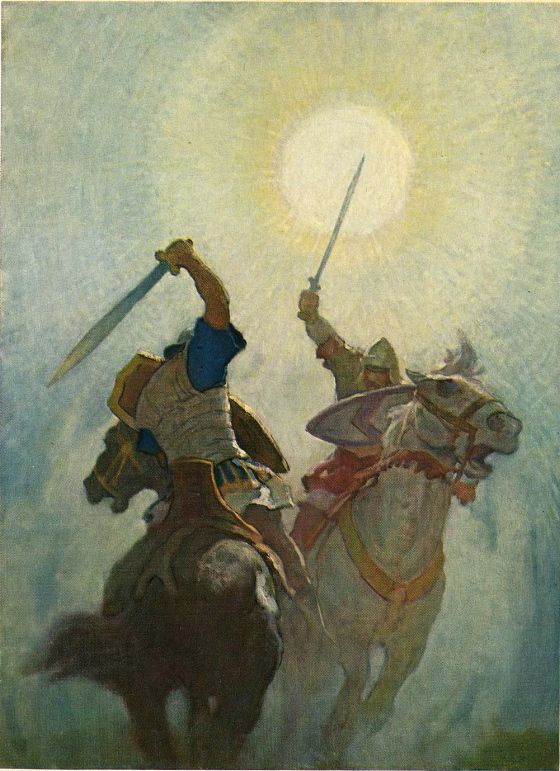
Wednesday Wyeth

Posted on 08:14 by Unknown
Read More
Posted in art, nc wyeth | No comments

Tuesday, 5 June 2012

Let Me Tell You About Someone Else's Character

Posted on 11:15 by Unknown
Meet Hercule De La Fouchardier, a Flashing Blades character posted on a blog that looks like it was originally intended to be a compendium of character generation examples for different roleplaying games but petered out after a half-dozen examples.

And check out Josh's FB character, Giancarlo di Venezia, featured in a two-part story at The Signe of the Frothing Mug.

I like seeing how other gamers approach the choices that the rules offer for creating a character.
Read More
Posted in character, Flashing Blades, RPG Stuff (blog) | No comments

Monday, 4 June 2012

Class Conscious

Posted on 12:04 by Unknown
Last week I introduced a discussion of the endgame in cape-and-sword roleplaying games, the point in a campaign at which the player characters become authority figures in the game-world, where conflicts transition from the physical to the political and power comes from one's position at least as often as from one's sword arm.

First, let's talk about how that position is measured.

En Garde! - the first cape-and-sword roleplaying game - includes rules for Social Level. An En Garde! character's Social Level is determined by a combination of status points gained or lost each month and positions and titles held by the character.

Drawing from En Garde! as well as Crimson Cutlass, Flashing Blades characters - player and non- - have a Social Rank. The Social Scale in Flashing Blades captures the social stratification of late Renaissance and Early Modern society, reflecting both the traditional position of the warrior nobility and the Church as well as the rise of the new nobility of the professional bureaucracy and military.

Social Rank is determined by a character's starting background and Advantages as well as positions and titles earned through both careers and adventuring. It's possible for a character with the Nobleman background and the Title advantage to begin the campaign as a duke with a Social Rank (SR) of 14, but most characters begin in the range of SR 2 to SR 9. As characters pursue various careers, these ranks increase with promotions. Different careers have different ranges of Social Ranks; frex, a character who starts the game as a sergeant in the Royal Army begins at SR 4 and may rise as high as SR 15, Field Marshal; while a bureaucrat begins at SR 7 and may rise to SR 16, Royal Minister. Interestingly, the career with the potential for the fastest rise - that is, the career with the fewest steps and the largest range between its lowest and highest Social Ranks - is the clergy; a Priest (SR 4) may become a member of a Bishop's Curia (SR 8), then a Bishop (SR 10), then a Prince-Bishop (SR 15), and finally a Cardinal (SR 16). An ambitious character could do far worse than to pursue a career in the Church.

The rules also suggest that characters may pursue more than one career; in fact, in at least one instance, it's expected, as a Soldier may be inducted into a Noble Order for being decorated twice on campaign, giving him the title of chevalier and Social Rank 8. Here's what the rules have to say on multiple careers, and on the impact of wealth on Social Rank.

Social Rank may be higher than indicated on the Social Scale in special circumstances. If the two highest Ranks possessed by a character are equal, count his Social Rank as one higher. A character who is both a Baron and a Magistrate, for example, is Social Rank 11 rather than 10. If four positions are held in one Social Rank, count it as two higher, and so on.

In addition, if a character is excessively wealthy, add one to Social Rank. Excessive wealth is defined as (10,000 L x the character’s normal Social Rank). Thus for a Count to be excessively wealthy, he must have 120,000 L in cash and property.

It is possible, although highly improbable, for a character to reach Social Rank 19 (i.e., by being a Grand Duke, Cardinal, Royal Minister, Royal Order Grandmaster, and Field Marechal, and having excessive wealth amounting to 180,000 L!). If a character reaches this point, however, he might as well be King! In realistic game terms, it should be considered phenomenal (and rare) to reach Social Rank 15 to 16.
The 'campaign turn' in Flashing Blades is one month; the required time commitment of an office, military rank, and so on is measured in months per year. As noted previously, when using the career rules in Flashing Blades, "adventures ought to be mixed in at regular intervals (one or two per game year)," similar to the great Arthurian roleplaying game, Pendragon - indeed, in both Flashing Blades and Pendragon, adventuring can be seen as something that occurs in a player character's downtime from their other responsibilities! Thus it's possible for player character to climb more than one career ladder at a time. Careers in banking or a club are especially suited to this, given the limited time demands placed on a character in these careers. Historically many clergy also held positions in the royal bureaucracy or the law, and a few, like the cardinal de La Valette, served as soldiers.

Balancing careers, both by a single player character and between several player characters in the campaign, requires that the players and the referee are flexible and creative. An adventure may arise out of a player character's career, frex, and other characters may assist, either in their free time or as part of their own careers; the aid rendered by Athos, Porthos, and Aramis to d'Artagnan in his service to the Queen on the matter of her missing jewels is a classic example in cape-and-sword tales. Players may choose to pursue some synchronicity in their careers, to be mutually supportive of one another.

In addition to mesuring the relative position in society of a character, Social Rank also provides a character with influence.
Rank hath privileges. The positions held to gain Social Rank have many powers of their own, but possessing e Social Rank itself grants a character influence. Informal influence cannot be measured in game terms. A person of high Social Rank will be treated with deference and politeness by all. He will be overly praised by his sycophants and overly despised by his enemies.

Sometimes, however, influence may have direct effects on the game, in one of two ways. First, any character may expect informal, polite requests to be granted by those three Social Ranks or more below his own, if he can roll his own Social Rank or below on a D20. Thus a Marquis could ask a small favor of a Baron or a Bishop, and have his request(s) granted on a roll of 13 or less on a D20. Polite requests are defined as those which are easy to grant, and which are of minor significance to the person asked (such as a Magistrate waiving a small fine, a Captain looking after someone in his company, a Baron allowing hunting on his estate, etc.). The possibilities are endless. Polite requests, no matter how polite they may be, will also often be influenced by bribery or reciprocal favors.

In addition, influence of Social Rank may be used, on rare occasions, to force those of lower Social Ranks to perform services which may be difficult or dangerous. Such services may only be requested of one six or more Social Ranks below the character, and may only be asked once per year (unless the character increases his or her Social Rank that year, in which case, he may ask 2 services). Such services may not be outrageous (e.g. asking an NPC to lay down his life for the character, or to give the character large sums of money) and the request must be within the power of the person requested. The person requested has a choice: to grant the request, or to automatically lose one Social Rank himself. A small reward or bribe is almost always offered for such services. Examples of difficult requests might be a Treasurer of a Royal Order bullying a rich merchant to go into an investment with him (perhaps with the lure of possible profits), a Lt. General forcing a townsman to quarter troops in his house, a Grand Duke squeezing a Secretary of a Noble Order to admit him to the Order, etc. Of course, some such requests may be granted through threats or violence, rather than influence.
I like these rules very much, though the degree of deference shown between social levels can be a bit jarring to players raised in our more egalitarian - in principle, if not always in practice - world.

Along similar lines, as an unwritten - so far - house rule for my own campaign, I allow the difference in Social Rank between two characters to modify certain Charm-based skill checks, such as Captaincy and Seduction. I did this using the Social Standing attribute score in Traveller years ago, and Thijs Krijger, moderator of the Flashing Blades Yahoo group, used this in his house rules for mistresses (which are sadly absent from his blog). In some cases, a non-player character in the service of another may use their master's Social Rank, frex, a guard on the gate of the château de Bauchery uses the baron's Social Rank of 12 rather than his own rank of 3 in determining if a Captaincy check will persuade him to stand aside.

The rules for influence are an important part of the endgame. Here we see a glimpse of how characters exert power, as they ask for - or compel - favors from subordinates. A character with a high Social Rank becomes akin to a chess master, identifying where and how to exercise influence to achieve goals. This will become particularly important in discussing how to build and maintain a clientele later on.

Beyond simply increasing in rank as one rises in a career or careers, Social Rank is an expected part of the game's reward system. Here's an example from the Flashing Blades 'adventure path,' An Ambassador's Tale.
Second, each character of Social Rank 4 or above who participated in all five adventures of the campaign, and has successfully completed his mission in each, has performed a great service for the King and realm. If untitled, he will be given the rank of Chevalier. If he is already titled, he will advance by one rank (i.e. from Count to Marquis). Those characters of Social Rank 3 or below will be given a commendation of honor (which will increase their Social Rank by 2 points) and an extra 100 Livres.

Third, each character in the Military or Bureaucracy, or in a Club or Order, may make an immediate roll for opening. If there is an opening, the character will be promoted. Characters in the Cardinal's Guard Company, or in the Clergy will be automatically promoted one rank. Characters who are not associated with any particular branch of government will be allowed to join the Military (in the Cardinal's Guard, as a Sergeant), the Clergy (as a Student of Theology) or the Bureaucracy (as a Bureaucrat) if they wish. A special month must be spent in learning the required skills if the characters are unqualified.

Finally, those characters who wish to, may remain in the service of the Cardinal. This is equivalent to both the Advantage 'Contact' and the Secret 'Secret Loyalty.'
Another unwritten house rule in my game is that a Social Rank bump given as a reward remains until the character reaches that rank as part of the normal progression in his career; frex, a member of a Bishop's Curia who receives a two-rank increase to his Social Standing stays at SR 10 on becoming a Bishop - his position in the Church rose to match his reputation.

Lastly, it's important to remember that a character's Social Rank also determines that character's monthly upkeep. With that in mind, I'm going to pivot to wealth in the next discussion of the cape-and-sword endgame.
Read More
Posted in endgame, Flashing Blades, refereeing, social standing | No comments

Sunday, 3 June 2012

Cinematic: Pirates of the Caribbean - The Curse of the Black Pearl

Posted on 00:30 by Unknown
Read More
Posted in Cinematic, pirate, Pirates of the Caribbean Curse of the Black Peal, video | No comments

Friday, 1 June 2012

DVR Alert

Posted on 08:24 by Unknown
On Sunday, 3 June, Turner Classic Movies will air George Sidney's Scaramouche, starring Stewart Granger, Janet Leigh, and Mel Ferrer.

If you don't mind spoilers, check out a classic clip.

Check local cable listings for times - I don't trust the TCM website.
Read More
Posted in Scaramouche, TCM, video | No comments
Newer Posts Older Posts Home
Subscribe to: Posts (Atom)

Popular Posts

  • Wednesday Wyeth
    In honor of the Batman appearing in my latest post for the Graphic Novels Challenge , this week NC Wyeth is subbed by the pencilers, inkers...
  • DVR Alert
    If Monday night's The Adventures of Don Juan whetted your appetite for more Errol Flynn, on Thursday Friday see him in his prime when ...
  • Cinematic: Against All Flags
  • Blast of the (d20) Past
    Preface: The following is a critique - okay, it's a rant - I posted on EN World in 2005 of d20 Past , the historical supplement for d20...
  • I Didn't Spend All Those Years Playing Boot Hill and Not Learn a Little Something About Bravery
    A 2e Boot Hill character's attributes are Speed, Gun Accuracy, Throwing Accuracy, Bravery, Strength, and Experience. Five of the six af...
  • Cinematic: Star Wars
    The fight choreographer - who's also the man under the Vader mask - for this scene is a chap named Bob Anderson, who also choreographed ...
  • Wednesday Wyeth
  • Stupid Dice Tricks
    I have mixed feelings about novelty randomisers. Novelty randomisers aren't new to roleplaying games - Crimson Cutlass , for example, u...
  • The Pen and the Sword: Captain Alatriste
    It was clear that the Italian was doing very well. He could have killed the wounded man any number of times, but he was satisfied to harass ...
  • How to Referee, Part One
    I was shooting pool and drinking beer with some friends, a bunch of guys I hung out with pretty regularly about twenty years ago. The bar ha...

Categories

  • -C
  • 1602
  • 1612 (movie)
  • 1650 (game)
  • 7RPGS
  • 7th Sea
  • A Field in England
  • A to Z 2012
  • actual play
  • adventure path
  • Adventure Time
  • Against All Flags
  • Age of Ravens
  • Alain Delon
  • Alatriste
  • Alexander Macris
  • Alexandre Dumas
  • Alice B Woodward
  • All for One Régime Diabolique
  • alt history
  • Amanda Heitler
  • ancien régime
  • Andy Murray. meta
  • animal
  • animation
  • Anthony Hope
  • Arabian Nights
  • art
  • Arturo Pérez-Reverte
  • At Sword's Point (movie)
  • award
  • background
  • Backswords and Bucklers
  • bandwagon jumping
  • baragei
  • Barbaric Frontier
  • Barbie
  • Bardelys the Magnificent
  • Barry Lyndon
  • baseball
  • Batman
  • Bayuca
  • BBC America
  • Beedo
  • Belladone
  • BH 1 Mad Mesa
  • Big Purple
  • Black Vulmea
  • Black Vulmea's Vengeance
  • Blog of Holding
  • blogfest
  • Blogger
  • Blunders on the Danube
  • board game
  • Bob Anderson
  • Bold Pueblo Games
  • Bombshell Miniatures
  • Book Scorpion's Lair
  • books
  • Boot Hill
  • Bren at RPG Net
  • British Isles Traveller Support
  • BryanMD
  • Bushido
  • Caoimhe Ora Snow
  • cape-and-sword
  • Capitan
  • Capitán Alatriste (game)
  • Captain Alatriste
  • Captain Blood (movie)
  • Captain Blood (novel)
  • Captain from Castile
  • Captain Hook
  • Captain Horatio Hornblower
  • Captain Morgan
  • Cara King
  • card game
  • cartography
  • cartoon
  • Cassini map
  • catacombs
  • Catan Junior
  • Cesare Borgia
  • character
  • charity
  • Charles Perrault
  • chase
  • chateau
  • Chill
  • Christopher Columbus
  • Chronicles of Shadow Valley
  • Cinematic
  • comics
  • commercial
  • Condottieri Conflicts
  • conquistadors
  • ConTtessa
  • corsairs
  • cosplay
  • Crimson Cutlass
  • Crossbones
  • CS Forester
  • Cutthroat Island
  • cycling
  • Cyrano de Bergerac
  • d'Artagnan
  • d20
  • d20 Modern
  • d20 Past
  • d20 Pirates
  • Daffy Duck
  • Dangerous Beauty
  • Dangerous Liasons
  • Danny Kaye
  • Dark Dimension
  • David Balfour
  • DC Comics
  • De cape et d'épée
  • DeviantArt
  • Die Another Day
  • disability
  • Disneyland
  • diversity
  • Douglas Fairbanks Sr
  • Dr Rotwang
  • Drama Dice and Damsons
  • Dreams of the Lich House
  • DriveThruRPG
  • duel
  • Duelist (prestige class)
  • Dungeons and Dragons
  • Dynamite Entertainment
  • Dynasties and Demagogues
  • ECW
  • El Cazador
  • Ellen Kushner
  • Emmy Rossum
  • en français
  • En Garde (game)
  • EN World
  • endgame
  • Eric Treasure
  • errata
  • Errol Flynn
  • Ethan Skemp
  • Exchange of Realities
  • Fabled Lands
  • fantasy
  • festival
  • Fist Full of Seamen
  • Flashing Blades
  • Flashman
  • FLGS
  • Flying Swordsmen
  • Frank C Papé
  • Frank Frazetta
  • Frank Schoonover
  • Frankenstein
  • Fred Funcken
  • FXR
  • Game Empire
  • game fiction
  • game style quiz
  • games
  • Gary Gygax
  • George Waymouth
  • Gloire
  • Gonsalvo
  • gospel
  • Graham Bottley
  • Graphic Novels Challenge
  • grognard
  • gun control
  • GURPS
  • Hack and Slash
  • Hamlet (1996 movie)
  • Han shot first
  • Harold Lamb
  • heads up
  • Hearts
  • Heidi Brühl
  • Helen Hunt Jackson
  • Hendybadger
  • hero points
  • HeroPress
  • Hidden in Shadows
  • High Seas
  • historical roleplaying
  • history
  • hobby
  • holiday
  • Honor + Intrigue
  • Horatio Hornblower
  • Horrible Histories
  • horror
  • house rules
  • Howard Pyle
  • Howling Tower
  • humor
  • I Waste the Buddha With My Crossbow
  • ice hockey
  • Iceland
  • immersion
  • improv
  • Inca
  • Infernal Sorceress
  • International Catacomb Society
  • interview
  • IntWisCha
  • Ivanhoe
  • Jack Sparrow
  • James Bone 007 Roleplaying Game
  • James Fenimore Cooper
  • James Mason
  • Jean Laffite
  • Jedediah
  • Jeff Black
  • Jeff Rients
  • Jeffrey Catherine Jones
  • jeu de palme
  • JF
  • John Gilbert
  • John Paul Jones
  • John Sayles
  • Jules Verne
  • Khlit the Cossack
  • Kickstarter
  • Kingdom of Saguenay
  • komradebob
  • La Fille de d'Artagnan
  • lazy git
  • Le Ballet de l'Acier
  • Le Bossu
  • Legends of the High Seas
  • LEGO
  • linear adventure
  • literature
  • location
  • Lone Star
  • Long John Silver (novel)
  • Lord Dunsany
  • Lord Gwydion
  • Lord Nelson
  • Los Nikis
  • Lowell Francis
  • M.P.
  • magic
  • magic items
  • map
  • maritime
  • Mark Twain
  • martial arts
  • Marvel Comics
  • Masks
  • Maureen O'Hara
  • Mayan non-Apocalypse
  • Mead Schaeffer
  • Mediterranean
  • Melan
  • meta
  • Michael Crichton
  • Mike Mornard
  • milestone
  • miniatures
  • Mitch Williamson
  • Mithril Wisdom
  • Molière
  • Moonfleet
  • movie
  • music
  • musketeer
  • Mysterious Island
  • Mythic Game Master Emulator
  • Mythic Role Playing
  • names
  • Nasruddin
  • Natalie Dormer
  • Nate Christen
  • navel gazing
  • nc wyeth
  • NC Wyeth's Pilgrims
  • New France
  • Nick
  • npcs
  • NPS
  • Obsidian Portal
  • Odie
  • OEF
  • off the shelf
  • off-hand weapon
  • old man is old
  • Old Stuff Day
  • Order of the d30
  • Oriental
  • Osprey Publishing
  • OSR
  • Ottavia Piccolo
  • Paris
  • Pathfinder
  • Paul
  • PDQ#
  • perdustin
  • personal
  • Peter and Wendy
  • phoning it in
  • Pierre Alary
  • pike-and-shot
  • pilgrims
  • pirate
  • Pirate Latitudes
  • Pirates of the Caribbean Curse of the Black Peal
  • Pirates of the Caribbean On Stranger Tides
  • Pirates of Tripoli
  • playstyle
  • poetry
  • points of light
  • politics
  • pulps
  • Puss in Boots
  • QUAGS
  • Quickly Quietly Carefully
  • Rafael Sabatini
  • Raiders of the Seven Seas
  • Ramona
  • random
  • random. Mediterranean
  • rant
  • Raphael Sabatini
  • Ravyn
  • Ray Harryhausen
  • real life can be a pain in the ass
  • reenactors
  • refereeing
  • Regency
  • REH
  • reply
  • resolutions
  • Restoration
  • review
  • rewards
  • Richard the Lionheart
  • Rip Van Winkle
  • Rob Roy
  • Robert E Howard
  • Robert Louis Stevenson
  • Robert Newton
  • Robert Taylor
  • Robin Hood
  • Robin Laws
  • Robinson Crusoe
  • Robots and Rapiers
  • Rochefort
  • roleplaying
  • roleplaying games
  • Rome
  • Romeo and Juliet
  • Rory's Story Cubes
  • Royal Flash
  • RPG Blog Carnival
  • rpg history
  • RPG Stuff (blog)
  • RPGBA
  • rules
  • Ruritania
  • Saint Patrick's Day
  • sale
  • samurai
  • Samurai Heaven and Earth
  • sandbox
  • Sandy Hook shooting
  • Santa Claus
  • Sanxesta
  • SAR
  • Savage Worlds
  • save or die
  • Save Vs. Dragon
  • Scallywags
  • Scaramouche
  • Sean B
  • Semper Initiativus Unum
  • setting
  • sexism
  • shields
  • ship
  • siegecraft
  • Sinbad
  • SirJarva
  • social contract
  • social sandbox
  • social standing
  • solo
  • Solo Nexus
  • Solomon Kane
  • Sophie Marceau
  • Source of the Nile
  • Spacejacking
  • Spanish Fury
  • stage fighting
  • Stanley J Weyman
  • Star Wars
  • Steve Winter
  • Stewart Granger
  • story games
  • Super-Team Family
  • Swashbuckler (Jolly Roger game)
  • Swashbuckler (Yaquinto game)
  • swashbuckling
  • swashbuckling and sorcery
  • sword
  • Swords of the Red Brotherhood
  • Swordspoint
  • Swordswomen of the Silver Screen
  • Talk Like a Pirate Day
  • Taras Bulba
  • Tartuffe
  • Tavern Cards
  • TCM
  • Te Deum pour un massacre
  • Telecanter
  • Telecanter's Receding Rules
  • television
  • Tenkar's Tavern
  • tennis
  • Tercio Creativo
  • The 13th Warrior
  • The 9Qs
  • The Admiral's Ghost
  • The Adventures of Don Juan
  • The Adventures of Robin Hood
  • The Adventures of Sindbad
  • the Batman
  • The Black Arrow
  • The Black Buccaneer
  • The Black Swan
  • The Borgias
  • The Boy's King Arthur
  • The Buccaneer
  • The Business of War
  • The Cavalier in the Yellow Doublet
  • The Court Jester
  • The Courtship of Miles Standish
  • The Crimson Pirate
  • The Crown and the Ring
  • The Deerslayer
  • The Deluge
  • The Dragon's Flagon
  • The Duelists
  • The Dungeon Dozen
  • The Escapist
  • The Golden Voyage of Sinbad
  • The Isle of Pirate's Doom
  • The Justice of the Duke
  • The Lady and the Bandit
  • The Lion in Winter
  • The Mark of Zorro (1920)
  • The Mark of Zorro (1940)
  • The Mask of Zorro
  • The Master of Ballantrae (movie)
  • The Master of Ballantrae (novel)
  • The Mysterious Stranger
  • The Other Side
  • The Pen and the Sword
  • The Perfect Captain
  • The Phantom of the Opera
  • The Princess Bride
  • The Prisoner of Zenda
  • The Queen's Cavaliers
  • The Russian Storybook
  • The Savage AfterWorld
  • The Scarlet Cockerel
  • The Scarlet Pimpernel (1982 movie)
  • The Scarlet Pumpernickel
  • The Scottish Chiefs
  • The Sea Hawk
  • The Sea-Hawk
  • The Shadow of the Vulture
  • The Spanish Main
  • The Swordsman of Siena
  • The Thief of Bagdad
  • The Three Musketeers
  • The Three Musketeers (novel)
  • The Three Musketeers (Paul WS Andersen)
  • The Three Musketeers (RIchard Lester)
  • The Three Musketeers (Rowland Lee)
  • The Tudors
  • The Usual Suspects
  • The White Company
  • The World of Music
  • theatre
  • theRPGsite
  • Thoul's Paradise
  • Tim Brannan
  • Tim Snider
  • Tiny Solitary Soldiers
  • Top Secret
  • Toshiro Mifune
  • Tour de France
  • Traveller
  • Treasure Island
  • Treasure Island (1934)
  • Troll in the Corner
  • Trollsmyth
  • ttfn
  • TV Tropes
  • Twenty Years After
  • Twitter
  • Tyrone Power
  • Under the Red Robe
  • Universal Studios
  • Vaesen
  • Valley of the Giants
  • vanity
  • Vatel
  • veil of ignorance
  • Very Civile Actions
  • video
  • video game
  • Vikings
  • W Heath Robinson
  • Walter Paget
  • War and Game (blog)
  • wargames
  • Warren W Baumgartner
  • Warrior Pursuits
  • Wars of Louis Quatorze (blog)
  • Wayne R
  • Westward Ho
  • what shite
  • wiki
  • William Hobbs
  • Wimbledon
  • Wine and Savages
  • World of Music
  • world-building
  • Zak S
  • Zorro
  • Zorro (1974)

Blog Archive

  • ▼  2013 (157)
    • ▼  September (15)
      • Talk Like a Pirate Day!
      • Wednesday Wyeth
      • "The pass to Bourbon . . . Slapshot! . . . GOAL!"
      • Lazy Monday Link Dump
      • The Pen and the Sword: The Cavalier in the Yellow ...
      • Here Be Monsters
      • Dividends
      • Wednesday Wyeth
      • Meditation on a Visit to a Game Store
      • Random Encounters Coda: Order from Chaos
      • The Pen and the Sword: The Cavalier in the Yellow ...
      • Seriously
      • Retcon
      • Wednesday Wyeth
      • Another Solo Gaming Resource
    • ►  August (13)
    • ►  July (11)
    • ►  June (24)
    • ►  May (21)
    • ►  April (4)
    • ►  March (18)
    • ►  February (22)
    • ►  January (29)
  • ►  2012 (343)
    • ►  December (32)
    • ►  November (34)
    • ►  October (27)
    • ►  September (21)
    • ►  August (33)
    • ►  July (29)
    • ►  June (28)
    • ►  May (31)
    • ►  April (34)
    • ►  March (39)
    • ►  February (29)
    • ►  January (6)
Powered by Blogger.

About Me

Unknown
View my complete profile